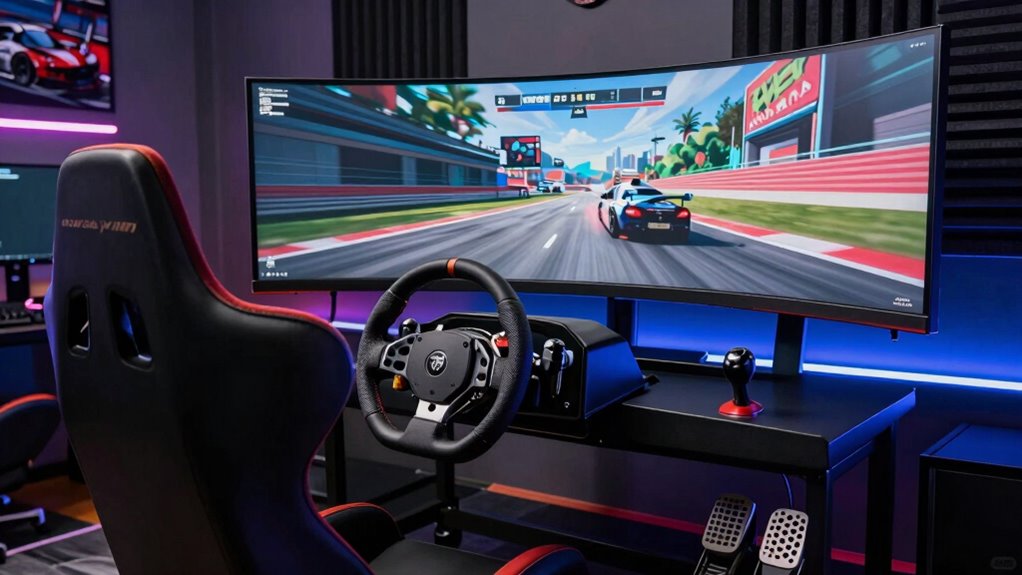

You’ve likely noticed that sim racing gear now looks more like professional equipment because of advancements in technology. Today’s gear offers high precision, immersive experiences, and realistic feedback, making home setups excellent for training and competition. Virtual reality, motion simulators, and advanced systems create an authentic racing environment right in your own space. As a result, sim racing has transformed into a serious pursuit for enthusiasts and aspiring pros alike—if you keep exploring, you’ll discover how these innovations shape the future of home racing.

Get the little things that make your day delivered free with Prime
- Fast, free delivery on millions of items
- Prime Video, Amazon Music and more included
- Member-only deals all year
Key Takeaways
- Advances in technology have transformed casual setups into professional-grade racing stations.
- VR and motion systems create immersive experiences similar to real racing environments.
- Sim racing gear now supports training, competition, and skill development at home.
- High-quality equipment enhances realism, making home setups comparable to professional racetracks.
- The pursuit of authenticity and serious competition has driven the evolution of home sim racing gear.
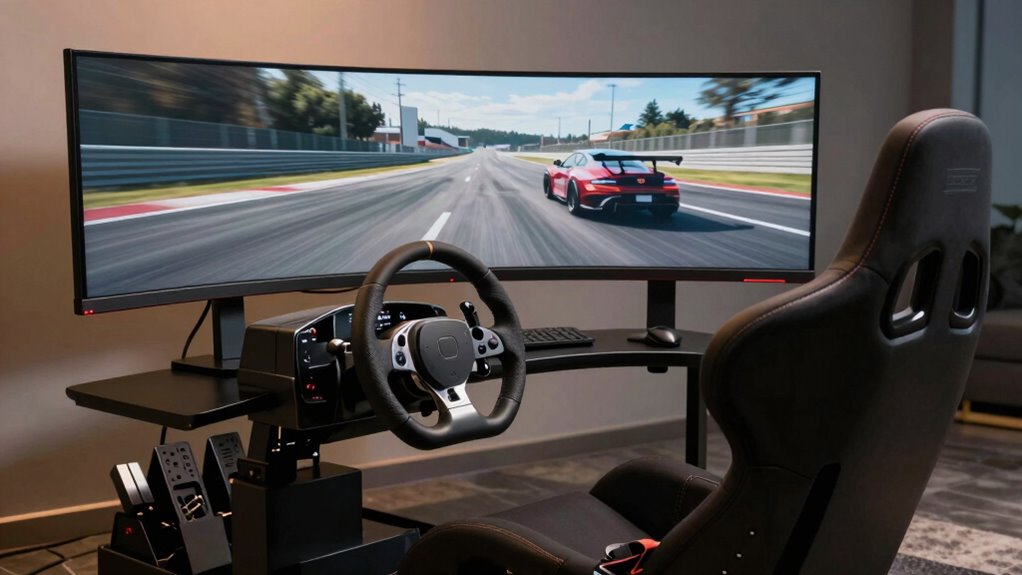
Sim racing has shifted from a casual hobby to a serious pursuit, with dedicated gear transforming home setups into professional-grade racing stations. Today, enthusiasts like you invest in high-quality equipment to replicate real-world racing as closely as possible. This progression isn’t just about having fun; it’s about achieving a level of immersion that makes every lap feel authentic. Virtual reality headsets play a vital role in this evolution, immersing you directly into the race. When you slip on a VR headset, the outside world fades away, and you’re transported to the cockpit of your favorite race car. This technology provides a sense of depth and spatial awareness that flat screens simply can’t match, allowing you to look around corners or check your mirrors just like in real racing. It’s this level of immersion that makes your home setup feel like a professional racing station.
Alongside virtual reality, motion simulation gear takes your experience to the next level. Motion simulators incorporate actuators that move your seat or entire rig in sync with the game’s dynamics. When you accelerate, brake, or take sharp turns, the motion platform responds accordingly, giving you tactile feedback that enhances your sense of speed and control. This kind of realistic feedback makes every race more intense and engaging, helping you develop better driving instincts. It’s no longer enough to just see the track; you feel it beneath you, balancing the visual and physical sensations for unmatched realism. These advancements in motion simulation technology, such as advanced motion systems, are why many serious sim racers consider their setups as close to real racing as possible. Additionally, the integration of advanced technology enhances the overall realism, creating a seamless and immersive experience for dedicated racers.
The convergence of virtual reality and motion simulation has fundamentally changed what it means to have a serious home sim racing setup. You no longer rely solely on a steering wheel and pedals; instead, you’re immersed in a complete environment that mimics the sensations of real racing. This combination allows you to train, compete, and refine your skills in a controlled, home-based environment that rivals professional training facilities. As a result, your equipment becomes more than just a game controller; it’s a tool for precision, training, and immersive entertainment. The evolution to such advanced gear proves that sim racing isn’t just a pastime anymore—it’s a serious sport requiring serious gear. Your commitment to quality gear and cutting-edge technology underscores your dedication to the craft, making your home setup as close to the real thing as possible. Understanding the importance of realistic feedback ensures that your setup truly replicates the conditions of actual racing.
professional sim racing wheel and pedal set
As an affiliate, we earn on qualifying purchases.
As an affiliate, we earn on qualifying purchases.
Frequently Asked Questions
How Much Does High-End Sim Racing Gear Typically Cost?
High-end sim racing gear typically costs between $1,000 and $5,000, depending on features like virtual reality integration and custom modifications. You’ll find premium setups with realistic steering wheels, force feedback, and immersive VR headsets, elevating your experience. If you want the best, expect to invest more for advanced customization and high-quality components that make your virtual races feel incredibly authentic.
What Are the Essential Components of a Professional Sim Racing Setup?
You need a sturdy racing wheel with force feedback to feel every turn and bump, enhancing realism. Add a high-resolution monitor or virtual reality headset for immersive visuals. A comfortable racing seat and sturdy frame provide stability during intense sessions. Pedals with adjustable tension help simulate real braking. Finally, good audio gear completes the experience, making virtual tracks feel as real as possible.
Can Sim Racing Gear Improve Actual Driving Skills?
Imagine your hands as skilled painters, and your sim racing gear as the canvas that sharpens your craft. Yes, it can improve real-world skills by enhancing your driving technique and reflexes. The realistic feedback and controls help you develop better car control, precision, and situational awareness. Over time, this immersive practice transfers to actual driving, making you more confident and skilled on the road or track.
How Long Does Sim Racing Equipment Usually Last?
Sim racing equipment typically lasts between 3 to 7 years, depending on usage and build quality. If you frequently use your setup with virtual reality and force feedback features, expect more wear and tear. High-quality gear with solid force feedback usually endures longer, but components like pedals and VR headsets may need replacements sooner. Proper maintenance can extend the lifespan of your equipment, ensuring you get the most out of your investment.
Is Professional Calibration Necessary for Optimal Performance?
Professional calibration isn’t always necessary, but it greatly enhances calibration accuracy and performance consistency. If you want your sim racing gear to deliver precise, realistic feedback and consistent results, professional calibration can make a noticeable difference. It guarantees all components work together effectively, especially if you’re competitive or aiming for a more immersive experience. For casual racers, regular self-calibration might suffice, but for peak performance, expert calibration is highly recommended.
As an affiliate, we earn on qualifying purchases.
Conclusion
As you invest in high-quality sim racing gear, you’re not just upgrading your setup—you’re transforming your passion into a serious pursuit. Imagine a casual gamer who, after upgrading to a professional-grade wheel and pedals, places top in online competitions. That’s the power of turning your home into a dedicated racing hub. With the right equipment, you’ll find yourself pushing limits, achieving more, and truly living the thrill of the race from your own garage.
As an affiliate, we earn on qualifying purchases.
As an affiliate, we earn on qualifying purchases.
NFL season / tailgating Picks
team gear
As an affiliate, we earn on qualifying purchases.