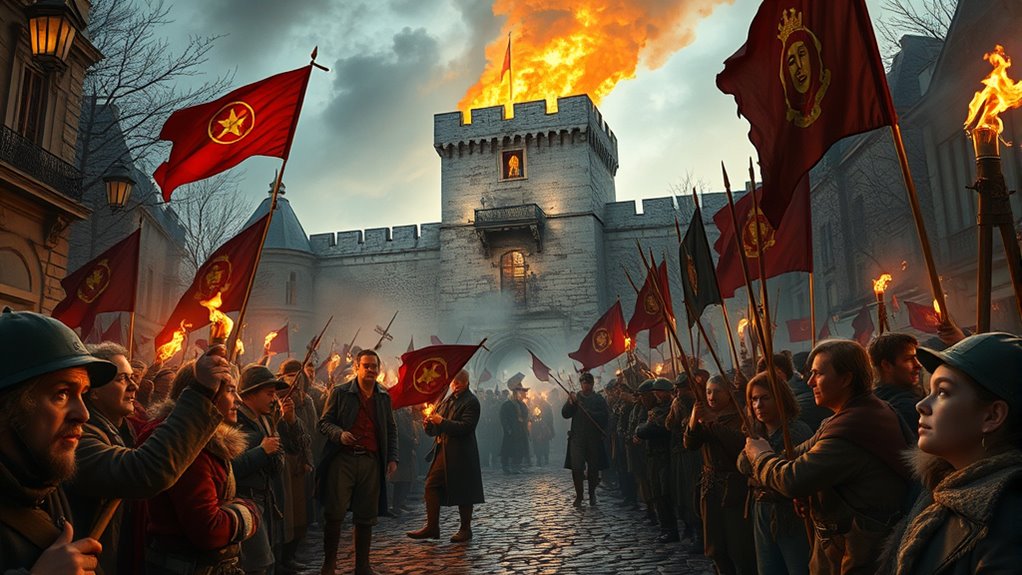

The French Revolution started because of deep economic inequality and political corruption that left many feeling oppressed and frustrated. You see, the wealthy aristocrats hoarded wealth, while most people, including peasants and workers, faced high taxes and poverty. When unrest grew, people demanded change, and revolutionary ideas spreading across France fueled demands for liberty and equality. The revolution’s consequences transformed France’s society and government, paving the way for modern democracy. Keep exploring to discover how these causes led to such profound change.
Key Takeaways
- Economic inequality and heavy taxes on the Third Estate fueled resentment and demands for reform.
- Political unrest grew as King Louis XVI’s inability to address crises eroded public trust.
- The storming of the Bastille became a symbol of challenge to tyranny and revolutionary spirit.
- Revolutionary ideals like liberty, equality, and fraternity inspired widespread social and political change.
- The revolution dismantled traditional structures, leading to radical reforms and lasting impacts on France and the world.
The French Revolution was a pivotal event that reshaped France and influenced the course of world history. As you explore its origins, you’ll see that much of the unrest stemmed from deep-rooted economic disparity and widespread political unrest. The economy in France was in turmoil, with a small aristocratic class hoarding wealth and privileges, while the majority of the population struggled with poverty and high taxes. This stark economic disparity bred resentment among the common people, who felt exploited and ignored by the ruling classes. The burden of taxes fell heavily on the Third Estate—peasants, artisans, and the bourgeoisie—yet they had little political power to change their situation. This economic inequality created a fertile ground for discontent, fueling demands for reform and justice.
Alongside economic issues, political unrest was brewing across the nation. The monarchy, led by King Louis XVI, appeared out of touch with the needs of its people. The king’s inability to address the financial crisis, coupled with his extravagant spending and ineffective governance, eroded public trust. Frustration grew as the Estates-General convened in 1789, revealing deep divisions between the clergy, nobility, and commoners. The commoners, feeling underrepresented and oppressed, took bold steps to assert their rights—most notably by forming the National Assembly. This act of defiance marked the start of a broader challenge to royal authority and the old political order. The storming of the Bastille later that year became a symbol of this revolutionary spirit, as citizens stood against tyranny and demanded change.
Political unrest grew as King Louis XVI’s inability to address crises eroded trust, fueling demands for change and revolutionary action.
As you explore more thoroughly, you’ll realize that the combination of economic disparity and political unrest created a perfect storm. The economic hardships made the people enthusiastic for change, while political unrest gave them a platform to voice their grievances. The monarchy’s failure to reform or compromise only intensified the unrest, leading to radical actions and revolutionary ideals. The revolution’s early years saw the dismantling of traditional structures—feudal privileges, aristocratic dominance, and absolute monarchy. Instead, revolutionary ideas spread, emphasizing liberty, equality, and fraternity. These concepts resonated widely, inspiring people to challenge centuries-old traditions and seek a new, more just society. Furthermore, the development of new political ideas such as liberalism and republicanism helped shape the revolutionary agenda and inspire future reforms.
In short, the revolution was driven by the people’s desire to address their economic hardships and political frustrations. You see that it was these intertwined issues that pushed France toward upheaval, ultimately transforming it—and the world—in profound ways. The revolution’s initial causes made clear that without addressing inequality and political oppression, change becomes inevitable.
Top picks for "french revolution caus"
Open Amazon search results for this keyword.
As an affiliate, we earn on qualifying purchases.
Frequently Asked Questions
How Did the French Revolution Influence Other European Nations?
You see that the French Revolution inspired other European nations by spreading revolutionary ideas and encouraging political upheaval. As you observe, these ideas challenged monarchies and aristocratic control, leading to protests and reforms across the continent. Countries like Haiti, Spain, and the German states adopted similar ideals of liberty and equality, sparking their own struggles for change. The revolution’s influence created a ripple effect, transforming Europe’s political landscape profoundly.
What Role Did Women Play During the French Revolution?
Women became the fiery sparks igniting revolutionary change through their activism and participation. They organized protests, marched to Versailles, and voiced demands for bread and rights, transforming the revolution into a collective roar. Their passionate involvement challenged traditional roles, showing that revolutionary participation isn’t just for men. By standing shoulder to shoulder with revolutionaries, women proved that change comes when voices unite, shaping history with courage and conviction.
Were There Any Long-Term Effects on the French Monarchy?
You see, the French Revolution brought significant long-term effects on the monarchy, leading to monarchical reforms that abolished absolute power and established more democratic governance. These changes marked a lasting legacy, as the monarchy no longer held unchecked authority, paving the way for a constitutional monarchy and, eventually, the French Republic. The revolution fundamentally reshaped France’s political landscape, ensuring the monarchy’s influence diminished and modern ideas of citizenship and rights took hold.
How Did the Revolution Impact the French Economy?
Did the revolution shake your economy to its core? It certainly caused significant economic upheaval, disrupting trade, agriculture, and industry. Market reforms attempted to stabilize finances but often failed, leading to inflation and shortages. You felt the strain as the revolution challenged traditional economic structures, forcing you to adapt to new policies and confront uncertainty. This turbulent period reshaped France’s economic landscape, leaving a legacy of transformation and upheaval that you still feel today.
What Were the Global Repercussions of the French Revolution?
You see, the French Revolution sparked global change by inspiring peasants’ uprisings and spreading revolutionary ideals across Europe and the world. It challenged monarchies and promoted ideas of liberty, equality, and fraternity, encouraging other nations to rethink their governance. These ripple effects led to reforms, revolutions, and the decline of absolute monarchies, shaping the modern political landscape and inspiring future movements advocating for human rights and democracy worldwide.
Conclusion
As you reflect on the French Revolution, remember how it was a spark that ignited a worldwide desire for freedom and justice. Like Prometheus stealing fire, the revolution challenged the old order, forever changing history. Though chaos ensued, it paved the way for equality and rights we now cherish. Let its story remind you that even in darkness, the flame of change can lead to a brighter dawn.