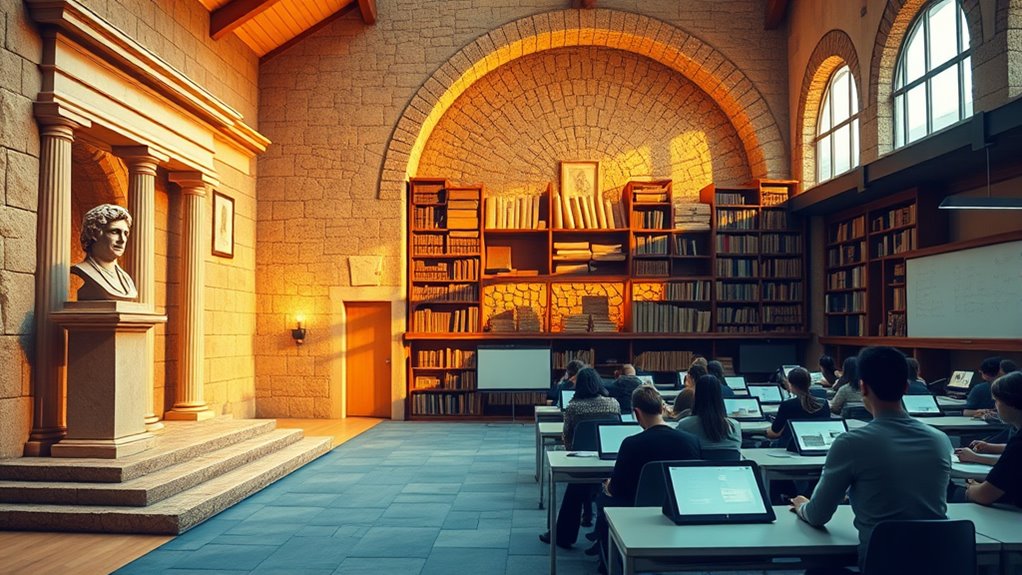

The history of education traces a path from Ancient Greece, where dialogue and virtue shaped learning, to today’s diverse schools that emphasize critical thinking, inclusivity, and technology. Over time, reforms emerged during the Renaissance, the Enlightenment, and the 19th century, making education more accessible and relevant. In the 20th century, innovations and inclusive practices transformed teaching into a personalized, lifelong experience. Continue exploring this journey to see how education continually adapts to society’s needs.

Get the little things that make your day delivered free — and shop member deals
- Fast, free delivery on millions of items
- Access to Prime Big Deal Days deals on October 6–7
- Prime Video, Amazon Music and more included
Key Takeaways
- Education in Ancient Greece emphasized dialogue, critical thinking, and moral development, laying foundational philosophical principles.
- Medieval and Renaissance periods expanded education beyond religious focus, promoting humanism and individual discovery.
- The Enlightenment and 19th-century reforms introduced child-centered, experiential learning and institutionalized public education.
- The 20th century saw innovations like inclusive, technology-enhanced learning focused on critical thinking and social skills.
- Modern education continues to evolve with technological integration, lifelong learning, and reforms reflecting societal values.

Have you ever wondered how education has evolved over centuries? It’s a fascinating journey that begins with ancient civilizations and leads to the modern schools we see today. One of the earliest influences shaping education was the philosophy of learning, which guided thinkers and educators in understanding how people acquire knowledge. In ancient Greece, philosophers like Socrates, Plato, and Aristotle emphasized dialogue, critical thinking, and the pursuit of wisdom. They believed education wasn’t just about memorizing facts but about cultivating virtue and understanding. This philosophical foundation laid the groundwork for future educational systems.
Ancient Greek philosophers emphasized dialogue, critical thinking, and virtue as foundations of education.
As time progressed, societies began to see the need for more structured approaches to teaching, sparking various educational reforms. During the Middle Ages, monasteries and cathedral schools became centers of learning, but they mostly served the clergy and the elite. The Renaissance brought a renewed focus on human potential and curiosity, inspiring new methods of teaching that emphasized individual discovery. Moving into the Enlightenment, thinkers like John Locke and Jean-Jacques Rousseau challenged traditional notions of education, advocating for child-centered learning and experiential education. These ideas fueled educational reform movements that aimed to make learning more accessible and relevant to everyday life.
The 19th century marked a significant turning point as education started becoming more institutionalized and standardized. Governments and society recognized education as essential for progress, leading to the establishment of public schools and compulsory education laws. This period was driven by the belief that education could serve as a tool for social mobility and national development. Throughout this era, debates about the purpose of education persisted, with some advocating for a more practical, vocational approach, while others emphasized liberal arts and moral development. These discussions were rooted in ongoing philosophical debates about the role of education in shaping individuals and society.
In the 20th century, innovation and reform continued at a rapid pace. The focus expanded from simply transmitting knowledge to fostering critical thinking, creativity, and social skills. Educational reformers pushed for inclusive education and equal opportunities for all students, regardless of background. The development of technology further transformed learning environments, making education more accessible and diverse. Additionally, the integration of educational technology into classrooms has revolutionized how students learn and engage with content. Today, the philosophy of learning continues to evolve, emphasizing personalized education, lifelong learning, and adaptability to a changing world. Your understanding of this history shows how education reflects broader societal values and ongoing efforts to improve how we learn and grow.
Frequently Asked Questions
How Did Education Differ Between Ancient Civilizations?
You’ll notice that in ancient civilizations, education varied widely based on societal influences and their ancient curriculum. For example, in Egypt, education focused on religion and administration, while Greece emphasized philosophy and arts. Societal needs shaped what was taught, with some cultures prioritizing practical skills for daily life, and others fostering intellectual development. These differences reflect how each society’s values and structures influenced their educational priorities and methods.
What Role Did Religion Play in Early Education Systems?
Religion played a central role in early education systems, shaping curriculum and methods. You learn that religious influence guided spiritual teachings, moral values, and social norms. Schools often served as places to pass down sacred texts and traditions, reinforcing spiritual beliefs. This integration of religion helped establish a moral foundation and community identity, making education a means to transmit spiritual teachings alongside practical skills, ensuring cultural continuity within early civilizations.
How Have Technological Advances Transformed Modern Education?
Technological advances have revolutionized your education by creating digital classrooms and enabling online learning. You can now access resources anytime, anywhere, making learning more flexible and personalized. Interactive tools and multimedia content keep you engaged, while virtual collaboration fosters teamwork. These innovations break down geographical barriers, giving you opportunities to connect with educators and peers worldwide, transforming your educational experience into a dynamic, accessible, and interactive journey.
What Are the Biggest Challenges Facing Education Today?
You face a storm of challenges in education today, like accessibility gaps that block some students from equal learning opportunities and funding disparities that leave schools struggling in the shadows. These issues threaten to widen the divide, making it harder for everyone to thrive. To navigate this turbulent sea, you need innovative solutions and equal support, ensuring education becomes a bridge rather than a barrier for all learners.
How Will Education Evolve in the Next Century?
In the next century, you’ll see education evolve into more futuristic learning environments that emphasize personalized curricula tailored to individual needs and interests. Technology will play a bigger role, enabling immersive virtual experiences and real-time feedback. You’ll have more control over your learning path, fostering creativity and critical thinking. Education will become more flexible, accessible, and engaging, preparing you better for an ever-changing world.
Conclusion
As you reflect on this journey, remember that education has evolved from ancient Greece’s philosophical debates to today’s digital classrooms. Did you know that over 1.6 billion students worldwide are now learning online? This shift highlights how education continues to adapt and expand, shaping our future. So, as you step forward, consider how these historical changes have paved the way for the endless learning possibilities ahead. Your education is part of this ongoing story.
NFL season / tailgating Picks
team gear
As an affiliate, we earn on qualifying purchases.