The future of design tools with AI-powered co-creation involves collaborating with intelligent systems that enhance your creativity and streamline workflows. You’ll experience intuitive interfaces, real-time suggestions, and automation that make complex tasks easier. AI adapts to your style and provides valuable insights, helping you explore multiple ideas quickly. This seamless partnership boosts your confidence and productivity, transforming the design process into a more inspiring journey—discover how these innovations will reshape your creative world.
Key Takeaways
- AI will serve as a collaborative partner, generating design variations and adapting to individual styles for personalized creativity.
- Intuitive interfaces with voice, gesture, and contextual prompts will make complex design tools accessible to all skill levels.
- Data-driven analytics will provide real-time feedback on emotional impact and clarity, refining designs efficiently.
- Design processes will accelerate through rapid iteration, automation of repetitive tasks, and seamless human-machine collaboration.
- Future tools will foster a co-creative environment, amplifying human ingenuity and inspiring innovative, effortless design workflows.
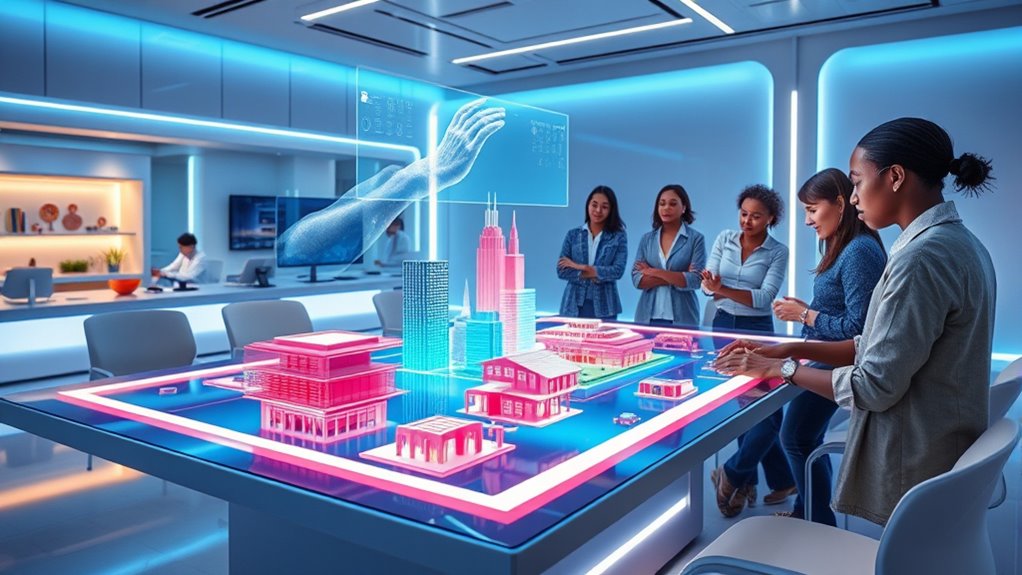
The future of design tools is poised to revolutionize how creators bring ideas to life, blending advanced technology with intuitive interfaces. AI integration stands at the forefront of this transformation, offering powerful capabilities that complement your creative process. Instead of replacing your skills, AI acts as a collaborative partner, helping you brainstorm, refine, and execute ideas more efficiently. Imagine tools that understand your style preferences, suggest improvements in real time, and automate repetitive tasks, freeing you to focus on the creative aspects that truly matter. This seamless integration enhances your user experience by making complex processes feel natural and accessible, regardless of your skill level.
With AI-powered co-creation, the design process becomes more dynamic. You can input initial concepts or sketches, and the system will generate variations, helping you explore multiple directions rapidly. This accelerates the iterative cycle, allowing you to experiment without the usual time constraints. As you work, AI continuously learns from your choices, adapting its suggestions to better align with your vision. This personalized touch ensures that your creative voice remains central, even as the tool offers intelligent guidance. Additionally, user experience is improved through thoughtful interface design and intelligent feedback mechanisms.
User experience is key in the evolution of future design tools. Developers focus on creating interfaces that feel intuitive, removing barriers to entry and reducing the learning curve. Voice commands, gesture controls, and contextual prompts become commonplace, enabling you to interact with your tools naturally. You’re empowered to stay immersed in your work without constantly switching between menus or deciphering complex features. The goal is to make sophisticated functionality feel effortless, so your attention stays on the creative process rather than the mechanics of the software.
Furthermore, AI-driven analytics and feedback loops improve your ability to make data-informed decisions. For example, if you’re designing a logo or user interface, the tool can analyze how users might perceive your design and suggest tweaks to optimize clarity or emotional impact. This integration of AI enhances your user experience by providing insights that were previously difficult or time-consuming to gather manually.
Ultimately, this evolution of design tools fosters a collaborative environment where your ideas are amplified by intelligent technology. You become more productive, inspired, and confident in your work, knowing that AI is there to support and elevate your creative capabilities. As these tools continue to develop, they promise a future where design is not just a technical task but a truly co-creative journey, seamlessly merging human ingenuity with machine intelligence.
Top picks for "future design tool"
Open Amazon search results for this keyword.
As an affiliate, we earn on qualifying purchases.
Frequently Asked Questions
How Will AI Co-Creation Impact Designer Job Roles?
AI co-creation transforms your role by enhancing collaborative workflows, allowing you to work seamlessly with intelligent tools. You’ll focus more on strategic thinking and creativity, while AI handles repetitive tasks. This shift encourages skill evolution, pushing you to develop new expertise in managing AI-driven processes. As a result, your job becomes more dynamic, innovative, and efficient, making you a crucial part of the evolving design landscape.
What Are the Ethical Considerations in Ai-Driven Design Tools?
Are you aware of the ethical concerns in AI-driven design tools? You should consider bias concerns, which can reinforce stereotypes or exclude groups, and privacy implications, risking sensitive data exposure. You must guarantee transparency and fairness in your designs. How do you balance innovation with responsibility? Addressing these issues is vital to creating ethical AI tools that respect user rights and promote inclusive, trustworthy design practices.
Can AI Fully Replace Human Creativity in Design?
AI can’t fully replace your human creativity because it lacks your unique perspective, emotional authenticity, and creative autonomy. While AI tools can assist and inspire, they don’t possess the nuanced understanding of human experiences that fuel genuine innovation. You bring personal insight and emotional depth to your designs, making them truly authentic. Rely on AI as a partner, but remember, your creative autonomy is irreplaceable in crafting meaningful, emotionally resonant work.
How Accessible Will Ai-Powered Design Tools Become for Small Businesses?
AI-powered design tools will become increasingly accessible for small businesses, offering affordable access and user-friendly interfaces. You’ll find these tools easy to learn and integrate into your workflow, enabling you to create professional designs without needing extensive technical skills or large budgets. As technology advances, expect more intuitive options that empower small businesses to compete effectively and innovate, making high-quality design resources more democratized than ever before.
What Skills Will Designers Need to Adapt to AI Collaboration?
Think of yourself as a gardener tending to a evolving landscape. To thrive alongside AI, you’ll need creative adaptability to embrace new ideas and technical literacy to navigate tools effectively. Mastering AI collaboration means cultivating flexibility, understanding algorithms, and blending human intuition with machine insights. By doing so, you transform your design process into a harmonious symphony where innovation blossoms, and your skills remain essential in this dynamic creative ecosystem.
Conclusion
As you navigate the evolving landscape of design, imagine stepping into a studio where AI and your creativity blend seamlessly like brushstrokes on a canvas. With these powerful tools at your fingertips, you can craft visions once thought impossible, turning abstract ideas into vivid reality. Embrace this future where collaboration with AI feels natural, inspiring you to push boundaries and shape designs that captivate and transform the world around you.