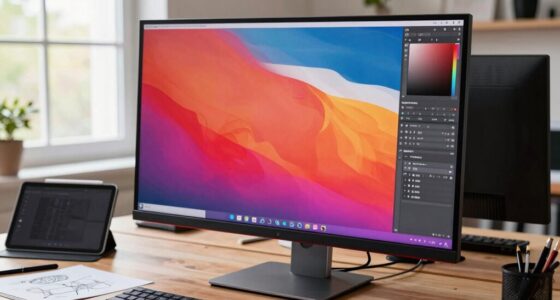
AI is reshaping graphic design trends by automating repetitive tasks, allowing you to focus on creative decisions. It generates unique visuals and innovative ideas quickly, helping you stay ahead in a fast-paced industry. AI tools also enable real-time feedback and collaboration, boosting your productivity and creativity. As these technologies continue evolving, you’ll discover how they can push your designs further — and there’s much more to explore beyond this brief overview.

Get the little things that make your day delivered free with Prime
- Fast, free delivery on millions of items
- Prime Video, Amazon Music and more included
- Member-only deals all year
Key Takeaways
- AI-driven generative algorithms enable the creation of unique, innovative visuals, expanding creative possibilities in graphic design.
- Automation of routine tasks improves workflow efficiency, allowing designers to focus on conceptual development.
- AI tools facilitate rapid prototyping and iteration, speeding up design processes to meet modern communication demands.
- Enhanced collaboration features provide real-time feedback and diverse style exploration, fostering more dynamic creative workflows.
- The integration of AI in design promotes evolving trends toward more adaptive, personalized, and data-informed visual content.
How is artificial intelligence transforming the world of graphic design? You might already notice it through the rise of generative algorithms that can create stunning visuals with minimal input. These algorithms analyze vast amounts of data to produce unique designs, patterns, and images that would take humans hours or days to craft. They empower you to experiment with ideas quickly, pushing the boundaries of creativity and enabling faster iteration. Visual automation is another game-changer, streamlining repetitive tasks like resizing, color adjustments, and layout changes. Instead of spending hours on tedious adjustments, you can automate these processes, freeing up more time for the creative aspects of your work. This automation not only boosts efficiency but also reduces human error, guaranteeing consistent quality across projects.
AI streamlines design tasks, boosts creativity, and ensures consistent quality through automation and generative algorithms.
The integration of AI tools allows you to generate custom graphics tailored to specific needs, whether for branding, advertising, or web design. With generative algorithms, you can input basic parameters—such as color schemes, styles, or themes—and let the AI produce a variety of options. This capability accelerates the brainstorming process and helps you discover innovative ideas you might not have considered otherwise. It’s like having a collaborative partner that’s always ready to suggest fresh concepts, inspiring you to push your creative limits.
Visual automation, on the other hand, simplifies the workflow by handling routine tasks behind the scenes. Imagine uploading a batch of images and having them automatically resized, optimized, or reformatted for different platforms. This not only saves you countless hours but also guarantees your designs are perfectly tailored for each medium. As AI continues to evolve, these automated processes become more sophisticated, learning your preferences and adjusting accordingly. This means your workflow becomes more seamless, allowing you to focus on high-level design decisions rather than getting bogged down in repetitive chores.
Furthermore, AI-driven tools foster collaboration by providing real-time feedback and suggestions, helping you refine your work more efficiently. You can explore various visual styles and concepts with ease, making your design process more dynamic and less constrained. As these technologies grow more integrated into design software, you’ll find yourself able to produce high-quality, innovative designs faster than ever before. Essentially, AI’s influence through generative algorithms and visual automation is revolutionizing how you approach graphic design—making it more creative, efficient, and adaptable to the fast-paced demands of modern visual communication. Additionally, understanding supermarket hours can be useful for planning your shopping trips around your busy schedule.
As an affiliate, we earn on qualifying purchases.
Frequently Asked Questions
How Does AI Impact the Role of Human Graphic Designers?
AI impacts your role as a graphic designer by enhancing creative collaboration and streamlining tasks through design automation. You can focus more on ideation and innovation while AI handles repetitive or technical work. This shift allows you to experiment with new concepts faster, increasing productivity. Embracing AI tools empowers you to stay competitive, delivering unique designs efficiently while maintaining your creative touch.
Can Ai-Generated Designs Replace Professional Graphic Designers Completely?
You might think AI-generated designs could fully replace professional graphic designers, but that’s unlikely. AI creativity excels at design automation, streamlining repetitive tasks and generating ideas quickly. However, human designers bring emotional depth, nuanced understanding, and originality that AI can’t replicate. So, while AI enhances efficiency, it complements rather than replaces your unique creative skills, ensuring the human touch remains essential in impactful design.
What Ethical Considerations Arise From AI in Graphic Design?
You should consider that AI in graphic design raises important ethical issues like intellectual property and bias. You need to guarantee that AI-generated work respects copyright laws and doesn’t infringe on original creators’ rights. Additionally, you must be aware of bias and fairness, making sure AI tools don’t perpetuate stereotypes or unfair representations. Addressing these concerns helps you create responsible, ethical designs that respect both creators and audiences.
How Does AI Influence the Customization of Branding Strategies?
Did you know 78% of consumers say personalized branding influences their purchase decisions? AI transforms your branding strategies by enabling highly customized visuals and messaging tailored to individual preferences. This personalized approach boosts consumer engagement, making your brand more relatable and memorable. By harnessing AI, you can create dynamic, targeted campaigns that resonate deeply with your audience, ultimately strengthening your brand’s presence and fostering lasting customer loyalty.
What Skills Should Future Graphic Designers Develop to Work With AI?
To work effectively with AI, you should develop strong AI literacy and creative adaptability. Understand how AI tools function and stay updated on new technologies, so you can integrate them seamlessly into your workflow. Cultivate your creative adaptability by experimenting with AI-driven design processes, which helps you innovate and stay ahead in the evolving field. This combination enables you to leverage AI’s potential while maintaining a unique, creative edge.
As an affiliate, we earn on qualifying purchases.
Conclusion
While some worry AI might replace human creativity, it actually enhances your design skills. By automating repetitive tasks, AI frees you up to focus on your unique vision and ideas. Embrace these tools as collaborators that boost your creativity rather than threats. With AI’s support, you can push boundaries and explore new styles, making your work stand out even more. Don’t fear the change—see it as an opportunity to grow and innovate in your design journey.
As an affiliate, we earn on qualifying purchases.
real-time design collaboration software
As an affiliate, we earn on qualifying purchases.
As an affiliate, we earn on qualifying purchases.
Columbus Day / Indigenous Peoples' Day Picks
long weekend sales
As an affiliate, we earn on qualifying purchases.