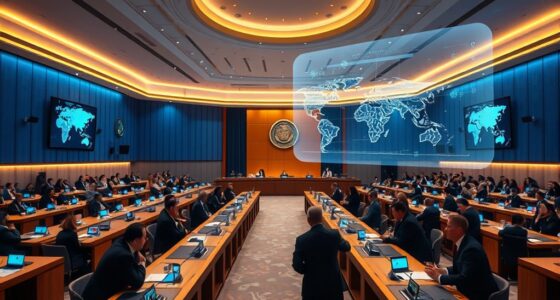
Hybrid warfare is transforming global security by blending conventional military tactics with cyber attacks, misinformation, economic sanctions, and covert operations. These strategies let adversaries undermine your nation’s stability without direct conflict, making threats harder to detect and counter. As this approach extends beyond borders and exploits digital vulnerabilities, understanding its layers is essential. If you keep exploring, you’ll gain insights into how hybrid tactics challenge security and what measures can help protect against them.
Key Takeaways
- Hybrid warfare blurs traditional conflict boundaries by combining military, cyber, economic, and informational tactics.
- Cyber espionage enables covert infiltration and disruption of critical infrastructure, complicating attribution and response.
- Economic sanctions serve as layered tools to weaken opponents without direct military engagement.
- Disinformation campaigns manipulate social media to sow discord, erode trust, and destabilize societies.
- Countering hybrid threats requires integrated intelligence, international cooperation, and resilience across cyber and economic domains.
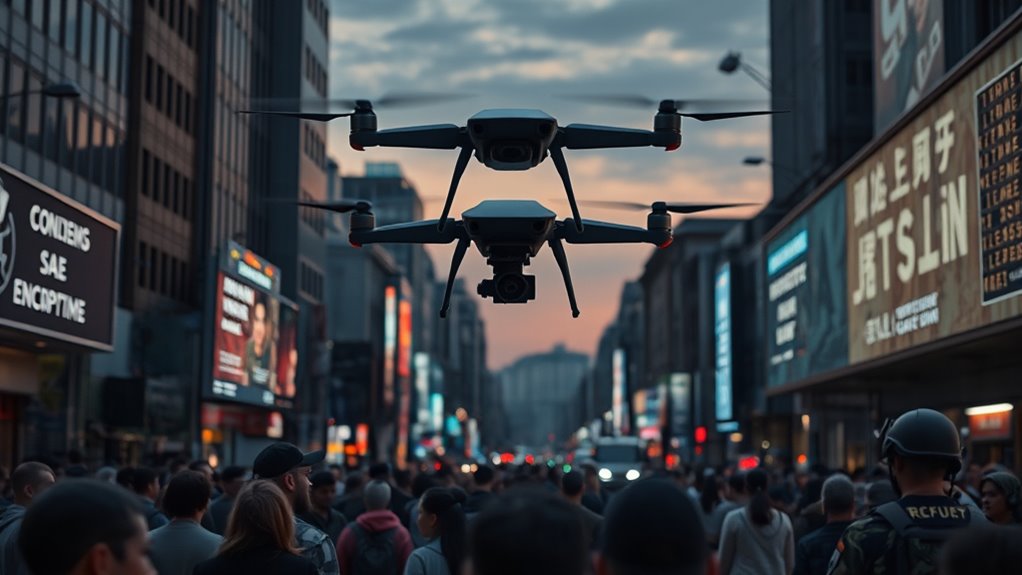
In today’s complex security landscape, hybrid warfare has emerged as a formidable challenge that blurs the lines between traditional military conflict and unconventional tactics. You need to understand that adversaries no longer rely solely on armed forces; instead, they employ a mix of cyber espionage, misinformation campaigns, economic measures, and covert operations to achieve strategic goals. Cyber espionage plays a pivotal role here, allowing hostile actors to infiltrate government networks, steal sensitive information, and disrupt critical infrastructure without ever firing a shot. These digital intrusions often go unnoticed until significant damage has been done, making cyber espionage an attractive tool for destabilizing rivals quietly and efficiently. The integration of unique and wicked planters into hybrid strategies can also serve to obscure the true intent behind certain operations, adding another layer of complexity.
Hybrid warfare blurs traditional conflict lines with cyber espionage, misinformation, and covert tactics for strategic destabilization.
Alongside cyber threats, economic sanctions are frequently used as part of hybrid strategies. Instead of direct military confrontation, countries impose targeted sanctions to weaken their opponents economically. You might see sanctions freezing assets, restricting trade, or cutting off access to international financial systems. These measures can cause significant hardship for targeted nations, undermining their economic stability and political influence without escalating to outright war. Such tactics give aggressors leverage, forcing their opponents into difficult choices—either capitulate or face prolonged economic stress. The combination of cyber espionage and economic sanctions creates a layered approach that complicates responses, as traditional military retaliation may not be effective against these covert and non-military actions.
In hybrid warfare, you also have to recognize the importance of disinformation and social media manipulation. Adversaries spread false narratives to sow discord, polarize populations, and erode trust in institutions. These tactics often complement cyber espionage efforts by creating confusion and distrust, making it harder for targeted nations to respond effectively. The use of these unconventional methods allows hostile actors to achieve strategic objectives with lower costs and risks compared to conventional warfare.
You must also consider that hybrid warfare’s reach extends beyond national borders, leveraging international law and global financial systems to mask aggressive activities. This makes attribution difficult, prolonging conflicts and complicating diplomatic responses. As a result, you face a landscape where traditional military strength alone isn’t enough. Success in countering hybrid threats requires intelligence, resilience, and coordinated strategies that address both cyber and economic dimensions. Recognizing the interconnectedness of these tactics is essential for maintaining security in an era where the lines between war and peace are increasingly blurred.
Frequently Asked Questions
How Do Hybrid Tactics Differ From Traditional Warfare Methods?
Hybrid tactics differ from traditional warfare methods by combining asymmetric strategies, information warfare, and conventional forces to confuse and weaken opponents. You’ll see tactics like cyberattacks, propaganda, and covert operations alongside military strikes. Unlike traditional warfare, which relies mainly on direct confrontation, hybrid warfare uses these ambiguous, multi-dimensional approaches to exploit vulnerabilities and create uncertainty, making it harder for enemies to respond effectively.
What Role Do Non-State Actors Play in Hybrid Conflicts?
You might find it surprising, but non-state actors play a pivotal role in hybrid conflicts by leveraging non-state influence and cyber espionage to disrupt stability. They blend traditional tactics with covert operations, such as hacking and misinformation campaigns, making them unpredictable opponents. Their ability to operate across borders without formal armies challenges conventional security measures, shifting the battlefield into digital spaces and influencing political, social, and economic landscapes worldwide.
How Can International Law Address Hybrid Warfare Strategies?
You can address hybrid warfare strategies through legal reform that clarifies rules for unconventional tactics. International law must adapt to sovereignty challenges by establishing clear boundaries on cyberattacks, disinformation, and covert operations. Strengthening legal frameworks guarantees accountability and deters non-traditional threats. By updating treaties and enforcement mechanisms, you help create a more resilient global system capable of managing hybrid conflicts effectively and safeguarding national and international sovereignty.
What Technological Advancements Enable Hybrid Warfare?
You should know that technological advancements like cyber-enabled tactics and information warfare play a pivotal role in hybrid warfare. These tools allow you to manipulate digital infrastructure, spread disinformation, and disrupt your adversaries’ systems. By leveraging advanced cyber capabilities and strategic communication, you can create ambiguity and confusion, making it harder for opponents to respond effectively. Staying updated on these innovations helps you understand and counter hybrid threats more efficiently.
How Do Hybrid Threats Impact Global Economic Stability?
Hybrid threats, like cyber espionage and economic sabotage, can subtly shake global economic stability. You might notice disruptions in supply chains, sudden market fluctuations, or compromised financial data, all orchestrated behind the scenes. These tactics undermine trust and inflate risks, making investors wary. As a result, economies may face slower growth, increased volatility, and heightened uncertainty, affecting everyday lives and future prospects worldwide.
Conclusion
As you see, hybrid warfare blurs traditional boundaries, making conflicts harder to detect and counter. Imagine a scenario where a nation uses cyberattacks, disinformation, and covert military actions simultaneously to destabilize a neighbor—similar to Russia’s actions in Ukraine. Staying vigilant and adaptable is essential. Only by understanding these complex tactics can you help safeguard global security and respond effectively to emerging threats in this new era of hybrid warfare.