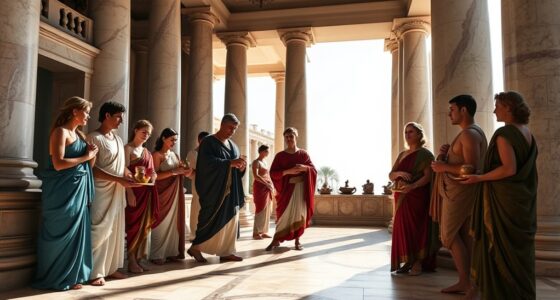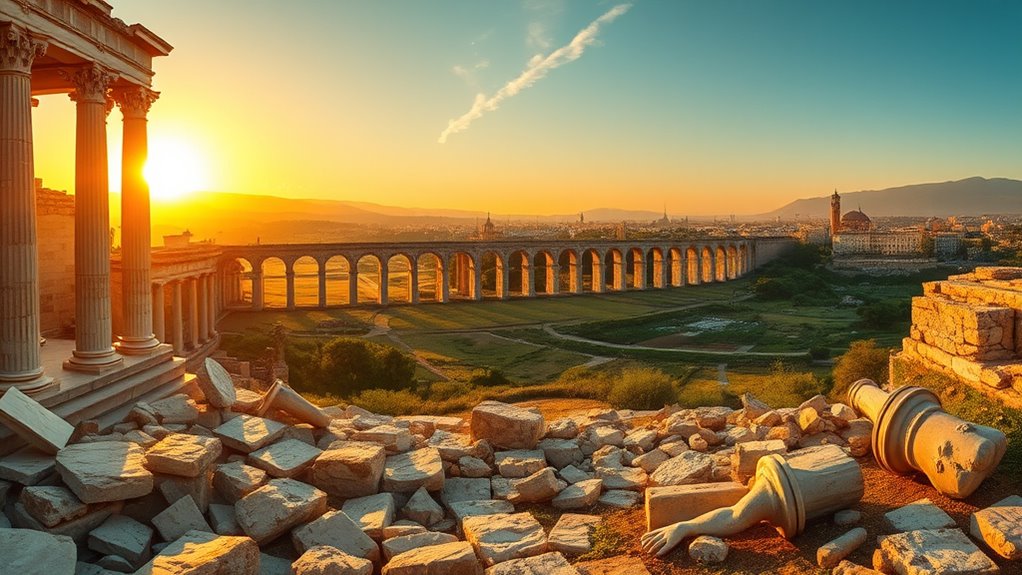

The rise and fall of the Roman Empire teach us that internal corruption, economic weakness, and external threats can weaken even the strongest societies. When leaders prioritize personal gain, trust erodes, and stability suffers. Economic decline drains resources and fuels unrest. External invasions exploit these vulnerabilities, hastening collapse. To avoid repeating history, it’s essential to understand how internal health and integrity keep civilizations resilient—keep exploring more to uncover the full lessons from Rome’s rise and fall.
Key Takeaways
- Internal political corruption and decay can weaken a nation as much as external threats.
- Economic overextension and inequality undermine long-term stability and societal cohesion.
- Strong leadership and trust in institutions are vital for sustainable growth and resilience.
- Vigilance against internal vulnerabilities is essential to prevent decline and preserve power.
- Lessons from history emphasize that internal health determines a nation’s endurance more than external invasions.

Have you ever wondered how one of history’s most powerful empires rose to greatness and then abruptly declined? The Roman Empire’s story is a compelling lesson in how internal flaws can undermine even the mightiest civilizations. At its peak, Rome expanded across vast territories, boasting impressive military strength, innovative engineering, and a complex political system. Yet, beneath this grandeur, there was a growing undercurrent of political corruption. As you look closer, you’ll see how greed and self-interest infiltrated the Senate and leadership, diverting attention from the common good. Corruption became normalized, eroding trust in institutions and weakening the empire’s cohesion. Leaders prioritized personal gain over the stability of Rome, which set a dangerous precedent. This political decay didn’t happen overnight; it was a gradual process fueled by ambitious politicians and unscrupulous officials. As political corruption spread, it created a cycle of instability that hampered decision-making and allowed petty rivalries to dominate governance. Additionally, the spread of vetted content highlights how the empire’s internal decline was compounded by external pressures.
Simultaneously, the empire faced a mounting economic decline that compounded its problems. As you examine the economic struggles, you’ll notice that overextension of resources, heavy taxation, and reliance on slave labor drained Rome’s economy. The costs of maintaining vast borders and funding military campaigns drained public coffers, leaving fewer resources for infrastructure, public services, and military defense. Inflation soared, and currency devalued, making everyday life harder for citizens and merchants alike. Wealth became concentrated in the hands of a few, widening the gap between rich and poor and fueling social unrest. These economic hardships weakened Rome’s internal stability, making it more vulnerable to external threats and invasions. The decline of trade, coupled with political turmoil, created a vicious cycle that further destabilized the empire.
The downfall of Rome teaches us that no matter how powerful a nation appears, internal weaknesses can be its undoing. Political corruption erodes trust and hampers effective governance, while economic decline strips away the resources needed to sustain a thriving society. As you reflect on this history, it’s clear that vigilance against corruption and sound economic management are vital for long-term stability. Rome’s fall was not caused solely by external invasions; it was also driven by internal decay. Recognizing these lessons helps us understand the importance of integrity and sustainability in leadership today. If you want to prevent similar fates in your own society, you must prioritize transparency, accountability, and economic resilience. The story of Rome remains a timeless reminder that a civilization’s strength depends on its internal health as much as its external power.
Roman Empire history book
As an affiliate, we earn on qualifying purchases.
As an affiliate, we earn on qualifying purchases.
Frequently Asked Questions
What Modern Nations Directly Descended From the Roman Empire?
You should know that Italy, along with countries like Spain, France, Portugal, and Romania, directly descend from the Roman Empire. These nations carry on the Roman heritage and Roman influence through their languages, legal systems, and cultures. By studying their history, you’ll see how the legacy of Roman civilization still shapes modern societies, emphasizing the importance of understanding their shared roots and enduring Roman influence in today’s world.
How Did Roman Culture Influence Contemporary Legal Systems?
Did you know that over 60% of modern legal systems in Western countries are rooted in Roman law? You can see this influence in the way laws are written, interpreted, and applied today. Roman culture’s legal principles, like fairness and justice, form a significant part of your legal legacy. This cultural legacy shapes contemporary laws, court systems, and legal education, ensuring Roman ideas still impact your daily life.
Could the Roman Empire Have Survived Longer With Different Leadership?
Yes, the Roman Empire might’ve lasted longer with better leadership. If leaders had prioritized imperial stability and implemented effective leadership reforms, chaos and internal strife could’ve been reduced. Strong, consistent leadership would have reinforced the empire’s resilience, helping it adapt to external pressures. You can see how stability and reforms are vital for long-lasting empires, emphasizing that wise leadership could’ve extended Rome’s dominance considerably.
What Role Did Technology Play in Rome’s Expansion and Decline?
Technology played a pivotal role in Rome’s expansion and decline. You see, ancient innovations like aqueducts, roads, and military tools helped Rome conquer and control vast territories. However, as the empire declined, technological decline set in, weakening infrastructure and military strength. This decline in innovations made it harder to sustain their vast empire, ultimately contributing to Rome’s fall. Innovations fueled growth, but technological stagnation hastened their downfall.
Are There Any Parallels Between the Roman Empire’s Fall and Current Global Powers?
You can see parallels between the Roman Empire’s fall and current global powers in economic decline and military overstretch. Just like Rome, modern nations face economic challenges that weaken their influence, while overextending military commitments drain resources and erode stability. These issues highlight how unchecked growth and overreach can lead to decline, reminding you to balance economic health and military strength to maintain long-term power.
ancient Roman engineering models
As an affiliate, we earn on qualifying purchases.
As an affiliate, we earn on qualifying purchases.
Conclusion
So, as you watch modern empires crumble and rise, remember Rome’s spectacular slide from glory. Maybe next time, you’ll learn that power, hubris, and a touch of chaos tend to be timeless trends—just like the Romans discovered too late. After all, history’s greatest lesson is that even the mightiest can topple if they forget to keep their sandals tied. Stay humble, or face a future as dramatic as Rome’s own dramatic decline.
Roman political history documentary
As an affiliate, we earn on qualifying purchases.
As an affiliate, we earn on qualifying purchases.
Roman empire replica artifacts
As an affiliate, we earn on qualifying purchases.
As an affiliate, we earn on qualifying purchases.