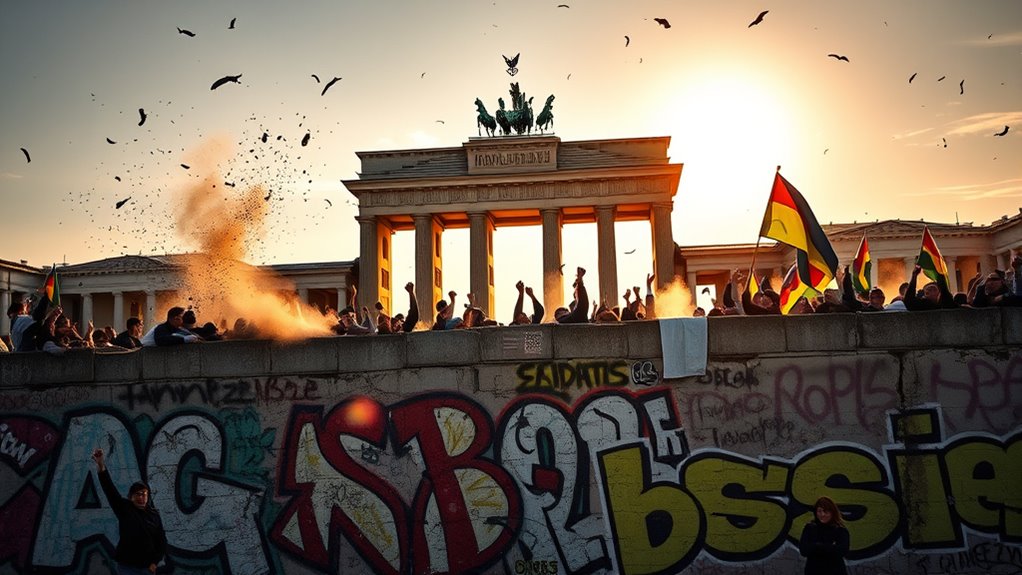

The fall of the Berlin Wall in 1989 is a pivotal moment that ended Cold War divisions and symbolized freedom triumphing over oppression across Europe. It marked the collapse of decades-long ideological and physical barriers, uniting East and West in a moment of spontaneous hope and change. The event showed how collective will can overcome entrenched divisions, transforming history and international relations. To understand how this historic event happened and its lasting impact, there’s more to explore.

Get the little things that make your day delivered free with Prime
- Fast, free delivery on millions of items
- Prime Video, Amazon Music and more included
- Member-only deals all year
Key Takeaways
- The fall of the Berlin Wall on November 9, 1989, symbolized the end of Cold War divisions and the collapse of East-West barriers.
- It was driven by political reforms, Gorbachev’s policies, and mass protests in Eastern Europe.
- Spontaneous crossings and public pressure led to the wall’s rapid and peaceful dismantling.
- The event marked a turning point, fostering European unity and transforming Cold War dynamics.
- It demonstrated that entrenched physical and ideological barriers can be overcome through collective will.

Have you ever wondered how a single day can change the course of history? The fall of the Berlin Wall on November 9, 1989, is one such moment. It marked the end of decades of Cold War dynamics that had divided Europe and defined East West relations for nearly half a century. During this period, the Iron Curtain symbolized the physical and ideological divide between communist Eastern Europe and democratic Western Europe. You might imagine how tense the atmosphere was, with each side watching the other closely, wary of potential conflict or sudden shifts in power. This division wasn’t just about geography; it represented contrasting political systems, economic models, and visions for the future, creating a fracture that seemed unbreakable.
A single day in 1989 reshaped Europe, ending Cold War divisions symbolized by the Iron Curtain and the Berlin Wall.
In the context of Cold War dynamics, the Berlin Wall was both a literal and symbolic barrier. It embodied the struggle for influence and control between the Soviet Union and the West, especially the United States and its NATO allies. You could say it was a physical manifestation of the ideological battle that defined the era. For years, East Germans faced restrictions that limited their freedoms, while West Berliners enjoyed relative openness and prosperity. The wall not only kept people contained but also reinforced the stark contrast in lifestyles and political ideologies. As tensions simmered, the world watched anxiously, fearing that any misstep could escalate into conflict.
Yet, by 1989, the tension began to shift. The Cold War was slowly thawing as reform movements gained momentum in Eastern Europe and political changes swept through the Soviet Union under Mikhail Gorbachev’s leadership. You saw the influence of glasnost and perestroika encouraging more openness and reforms, which challenged the rigid status quo. East West relations started to improve, leading to a wave of negotiations and easing of restrictions. People in East Berlin and beyond sensed that the division might not last forever. When the East German government announced relaxed travel rules, it set off a wave of excitement and confusion. Thousands rushed to the wall, enthusiastic to see what lay beyond and to test the new policies.
The actual fall of the wall was rapid and spontaneous, a symbol of the shifting tides in international relations. It was a moment when longstanding divisions crumbled, and the world watched as people from both sides celebrated their newfound freedom. The fall didn’t just reunite a city; it signaled a broader transformation in Cold War dynamics and the trajectory of East West relations. You can also consider how the costs of building the wall—both financial and human—highlight how physical barriers can have deep and lasting impacts on communities. It became a powerful reminder that even the most entrenched barriers can be overcome through collective will and change. That day, history was rewritten, and the world stepped closer to unity after decades of division.
As an affiliate, we earn on qualifying purchases.
Frequently Asked Questions
What Were the Immediate Economic Impacts After the Wall’s Fall?
After the wall fell, you saw immediate economic impacts through rapid economic restructuring and market liberalization. Industries in East Germany opened up, attracting investments and boosting trade. However, you also faced challenges like unemployment and inflation due to the sudden shift. The integration of markets created opportunities, but it required significant adjustments as the economy shift over a planned to a more free-market system.
How Did the Fall Influence Global Cold War Diplomacy?
This event changed everything, transforming Cold War diplomacy overnight. You see, the fall of the wall sparked a wave of diplomatic shifts, easing tensions and opening dialogue between East and West. It paved the way for new treaties and cooperation, effectively ending decades of hostility. You could say it rewrote the global diplomatic playbook, making peaceful coexistence the new norm and reshaping world politics forever.
Were There Any Underground Protests Leading up to the Fall?
You’d find that underground activism and clandestine demonstrations played a pivotal role in the lead-up to the fall. People secretly organized protests, sharing information and challenging the regime’s restrictions. These hidden efforts helped build momentum among citizens, fueling public discontent. Though often hidden from authorities, these underground protests created a foundation for the larger, open demonstrations that eventually contributed to the wall’s fall.
How Did East German Citizens Prepare for Reunification?
You prepared for reunification by joining civil rights movements and utilizing underground networks to stay informed and organized. You attended secret meetings, shared information discreetly, and advocated for change despite risks. These efforts helped you build a sense of unity and resilience, enabling you to push for reunification. Your underground activities kept hope alive and laid the groundwork for the historic events that ultimately led to the fall of the Berlin Wall.
What Role Did International Leaders Play in the Event?
You see international leaders orchestrate the fall, guiding history with diplomatic negotiations and leadership initiatives. They pressured East and West Germany, easing tensions and fostering unity. Their speeches acted as bridges, inspiring hope and action. Leaders from the U.S., USSR, and Europe played pivotal roles, turning political will into tangible change. Their efforts painted a path toward reunification, transforming a divided city into a symbol of freedom.
As an affiliate, we earn on qualifying purchases.
Conclusion
As you reflect on the fall of the Berlin Wall, you see it not just as a barrier’s end, but as the breaking of chains that once confined hope. It’s like a dawn piercing through the darkest night, revealing a new world of unity and freedom. This event reminds you that even the tallest walls can crumble when courage and determination stand together. History’s whisper urges you to believe in the power of change.
As an affiliate, we earn on qualifying purchases.
European history documentary DVD
As an affiliate, we earn on qualifying purchases.
As an affiliate, we earn on qualifying purchases.
Columbus Day / Indigenous Peoples' Day Picks
long weekend sales
As an affiliate, we earn on qualifying purchases.