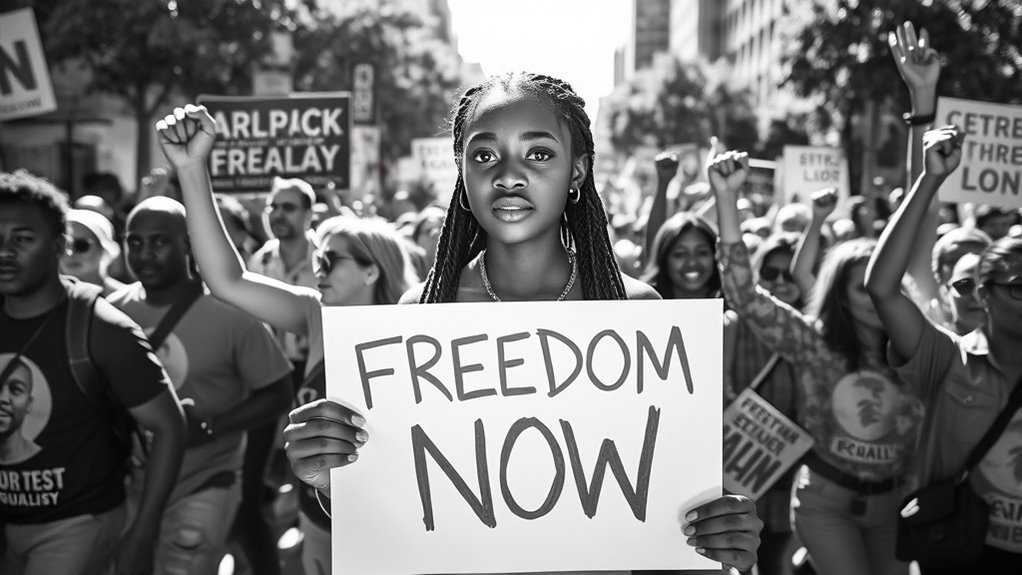

The Civil Rights Movement in the US achieved major milestones that transformed society, including the landmark Supreme Court decision in Brown v. Board of Education, which declared segregation unconstitutional, and the passage of the Civil Rights Act of 1964 and Voting Rights Act of 1965, ending legal segregation and discriminatory voting practices. You’ll see how grassroots protests like the Montgomery Bus Boycott and leaders like Martin Luther King Jr. paved the way for lasting change. Keep exploring to uncover more about these pivotal moments.
Key Takeaways
- Landmark legislation like the Civil Rights Act (1964) and Voting Rights Act (1965) declared segregation unconstitutional and protected voting rights.
- Brown v. Board of Education (1954) legally ended racial segregation in public schools.
- The Montgomery Bus Boycott (1955-1956) galvanized mass protest against bus segregation and racial injustice.
- Key figures such as Martin Luther King Jr. and Rosa Parks symbolized resilience and led pivotal activism.
- Supreme Court rulings challenged the “separate but equal” doctrine, advancing societal and legal change.
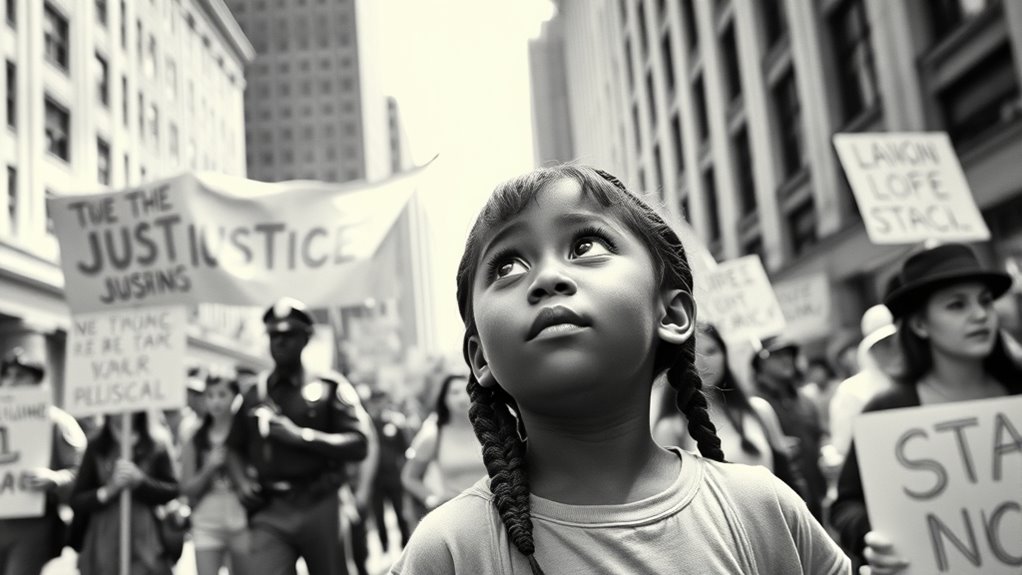
The Civil Rights Movement in the US was a pivotal series of events that challenged racial segregation and discrimination, reshaping the nation’s social and legal landscape. You see, at its core, the movement aimed to dismantle the institutional barriers that kept Black Americans and other marginalized groups from enjoying equal rights. One of the most pressing issues was racial segregation, which enforced separate facilities, schools, transportation, and public spaces based solely on race. This system perpetuated inequality and fostered deep social divisions. Through protests, legal challenges, and grassroots activism, civil rights leaders worked tirelessly to end these practices, prompting landmark legislation that declared segregation unconstitutional. The movement also focused heavily on voting rights, which had long been suppressed through tactics like literacy tests, poll taxes, and intimidation. These tactics effectively disenfranchised many Black voters, denying them political influence and voice in a democracy that claimed to serve all its citizens equally. You’d learn about pivotal moments like the 1965 Voting Rights Act, which aimed to eliminate discriminatory practices and establish Black Americans could register and vote without fear or obstruction. It marked a significant victory, but the fight for voting rights wasn’t over. Efforts continued through legal battles, protests, and advocacy to protect these gains from new forms of suppression. As you explore this history, you see how activists like Martin Luther King Jr., Rosa Parks, and countless others became symbols of resilience and hope. Rosa Parks’s refusal to give up her seat on a Montgomery bus ignited the Montgomery Bus Boycott, a powerful stand against racial segregation in public transportation. This boycott, spanning over a year, helped inspire nationwide activism and demonstrated the power of collective action. Meanwhile, legal cases like Brown v. Board of Education challenged the “separate but equal” doctrine, leading to the Supreme Court’s decision to desegregate public schools. These milestones signaled a shift in public attitude and government policy, but they also exposed the deep-rooted resistance to change. You realize that the movement’s success depended not only on legal victories but also on changing societal attitudes about race and equality. The fight for voting rights and an end to racial segregation fundamentally transformed American society, inspiring future generations to continue advocating for justice. Today, the legacy of these milestones reminds you that progress often requires relentless activism and unwavering commitment to equality. The Civil Rights Movement’s achievements serve as a powerful testament to what collective action can accomplish in the face of injustice.

Civil Rights Movement: A History from Beginning to End
As an affiliate, we earn on qualifying purchases.
As an affiliate, we earn on qualifying purchases.
Frequently Asked Questions
Who Were the Key Leaders of the Civil Rights Movement?
You see, key figures like Martin Luther King Jr., Rosa Parks, and Malcolm X played essential roles in the movement. Their leadership dynamics inspired millions and helped push for change. King’s nonviolent approach, Parks’ defiance on the bus, and Malcolm X’s advocacy for Black empowerment created powerful momentum. Their dedication showed how individual leadership can ignite collective action, shaping the course of history and advancing civil rights across the nation.
How Did Media Coverage Influence the Movement’s Progress?
You might think media coverage always helped, but the press portrayal of the Civil Rights Movement was a double-edged sword. While it brought national attention to injustices, it also sometimes painted activists unfairly or focused on violence to sensationalize stories. Your awareness of press coverage’s influence reveals how media shaped public opinion—sometimes fueling support, other times hindering progress—highlighting the power and pitfalls of media portrayal in social change.
What Role Did Women Play in the Movement?
Women played a crucial role in the movement through women’s activism and female leadership. You see, they organized protests, sit-ins, and marches, often risking their safety. Women like Rosa Parks and Ella Baker inspired others and kept momentum alive. Their efforts helped shape key strategies and brought attention to issues of racial injustice. Without women’s active participation, the movement’s progress would have been substantially slower and less impactful.
How Did the Civil Rights Movement Impact Other Social Justice Causes?
Imagine a ripple spreading across a pond, as the Civil Rights Movement sparks change beyond its borders. You see intersectionality challenges rising as diverse groups unite, fighting for justice. This movement’s passionate fight inspired global influence, igniting social justice causes worldwide. You witness a powerful shift, where the struggle for equality becomes interconnected, transforming societies and encouraging others to stand up, challenge injustice, and push for lasting change.
What Were the Long-Term Effects on U.S. Legislation?
You see that the civil rights movement led to significant legislative reforms, like the Civil Rights Act and Voting Rights Act, which aimed to end discrimination and promote enduring equality. These laws transformed society by providing legal protections for marginalized groups and setting a precedent for future social justice initiatives. Their long-term effects continue to influence U.S. legislation, fostering ongoing efforts toward fairness and equal rights for all citizens.

King: A Life
As an affiliate, we earn on qualifying purchases.
As an affiliate, we earn on qualifying purchases.
Conclusion
You’ve seen how the Civil Rights Movement fought for equality, yet progress still faces challenges today. Ironically, after all those milestones, some might wonder if true justice is just a distant dream. You’ve learned that change requires relentless effort, but it’s easy to forget that the fight isn’t over. Keep pushing forward, because history shows that even the smallest victories can spark the biggest transformations—if you’re willing to keep fighting.

8×10 CELEBRITY QUOTE ROSA PARKS "EACH PERSON MUST LIVE THEIR LIFE" PHOTO
As an affiliate, we earn on qualifying purchases.
As an affiliate, we earn on qualifying purchases.

Transfer Art Store 1964 Civil Rights Act – 60th Anniversary T-Shirt
2024 marks the 60th anniversary of the Civil Rights Act of 1964, which prohibits discrimination on the basis…
As an affiliate, we earn on qualifying purchases.
As an affiliate, we earn on qualifying purchases.