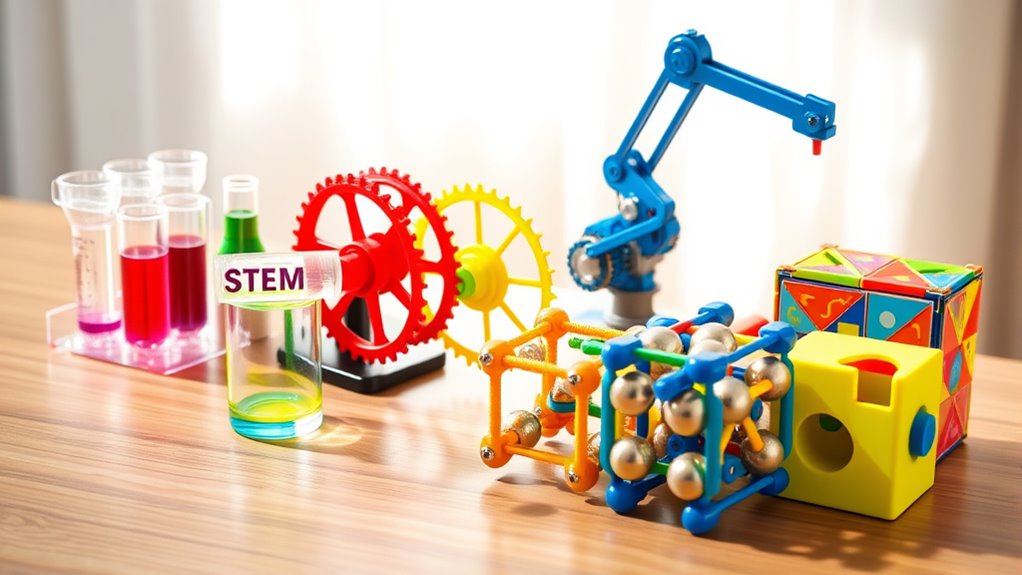
Choosing a STEM toy for a toddler means balancing an inviting first activity with room to keep learning. My strongest picks serve different play styles: the PEBIRA Wooden Shape Sorting and Stacking Toy offers a straightforward starting point for sorting and stacking, the Stay Fun Ball Drop and Car Ramp turns movement into cause-and-effect play, and PicassoTiles 100-Piece Magnetic Tiles gives older toddlers more scope to build. Each has a different fit: simple wooden pieces are approachable but limited in complexity, while magnetic tiles and take-apart dinosaurs need closer attention to age suitability and small parts.

Get the little things that make your day delivered free with Prime
- Fast, free delivery on millions of items
- Prime Video, Amazon Music and more included
- Member-only deals all year
I ranked these options by how clearly their play supports early STEM ideas, how well the activity matches toddler abilities, and what tradeoffs caregivers should expect. The age labels matter: not every toy here is suitable for a child under three, even though some products are marketed for younger toddlers. My guide focuses on choosing a toy that fits the child’s current skills, available supervision, and appetite for open-ended or guided play.
Key Takeaways
- PEBIRA is the simplest entry point: its 20 wooden pieces focus on sorting, matching, and stacking without the setup demands of a track or building system.
- Stay Fun offers the most movement: a ball drop and car ramp combine cause-and-effect play, but the multiple track pieces require assembly.
- PicassoTiles has the most open-ended building: 100 magnetic tiles can support larger constructions, though the listed age starts at three and tile dimensions are unspecified.
- Melissa & Doug suits guided pattern play: five double-sided boards add structure, while the 3+ age label and small tiles make it a poor fit for younger toddlers.
- Officygnet is the tool-focused pick: children can assemble four dinosaurs, but its drill and small parts call for adult supervision, especially around younger siblings.
| PEBIRA Montessori Wooden Shape Sorting and Stacking Toy |  | Best Overall for Early Sorting | Brand: PEBIRA | Material: Wood | Piece count: 20 | VIEW ON AMAZON | See Our Full Breakdown |
| 2-in-1 Ball Drop and Car Ramp Race Track Toy for Toddlers |  | Best for Cause-and-Effect Play | Brand: Stay Fun | Model: SF2503 | Recommended age: 12 months to 5 years | VIEW ON AMAZON | See Our Full Breakdown |
| PicassoTiles 100-Piece Magnetic Building Tiles for Kids Ages 3+ |  | Best for Open-Ended Building | Piece count: 100 | Design: Clear 3D magnetic building tiles | Recommended age: 3 years and up | VIEW ON AMAZON | See Our Full Breakdown |
| Melissa & Doug Pattern Blocks and Boards Set |  | Best for Guided Pattern Matching | Brand: Melissa & Doug | Model: Pattern Blocks and Boards Classic Toy | Age range: 3+ years | VIEW ON AMAZON | See Our Full Breakdown |
| Officygnet Take-Apart Dinosaur STEM Toy Set with Electric Drill, 4 Dinosaurs |  | Best for Tool-Based Pretend Play | Brand: Officygnet | Set size: 4 dinosaurs | Included dinosaurs: Tyrannosaurus Rex, Triceratops, Parasaurolophus, and Velociraptor | VIEW ON AMAZON | See Our Full Breakdown |
| stem toys for toddler | Brand | Material | Recommended age |
|---|---|---|---|
| PEBIRA Montessori Wooden Shape | PEBIRA | Wood | 12 months to 6 years |
| 2-in-1 Ball Drop and Car Ramp | Stay Fun | Plastic | 12 months to 5 years |
| PicassoTiles 100-Piece Magneti | — | — | 3 years and up |
| Melissa & Doug Pattern Blocks | Melissa & Doug | Wood | — |
| Officygnet Take-Apart Dinosaur | Officygnet | ABS | 36 months and up |
More Details on Our Top Picks
PEBIRA Montessori Wooden Shape Sorting and Stacking Toy
For a toddler’s first experience with STEM-style play, I put PEBIRA first because its central task is easy to grasp: sort and stack geometric pieces by color, shape, and peg holes. Those repeated actions let a child test simple ideas—does this piece fit here, and what changes when I stack it another way? Compared with Melissa & Doug’s pattern boards, this is a simpler, more tactile introduction; compared with the Stay Fun track, it trades moving action for calmer matching and placement.
The wooden format and 20-piece count make the activity feel more contained than a 100-piece magnetic building set. Its listed age range begins at 12 months, which gives it a wider stated age span than the products marked 3+, but caregivers should still supervise because the pieces may be small for some children. Smooth edges and water-based paint are useful details, though they do not remove the need to check pieces during play.
The main limitation is that the play centers on one sorting-and-stacking format. A toddler who quickly masters the pegs may want more construction choices or moving parts, which the magnetic tiles or ball-and-car track provide. I recommend it as the most approachable starting point in this group, not as the most expandable toy.
Pros:- Sorting and stacking introduce shape, color, and size recognition.
- Twenty pieces create a more contained activity than larger sets.
- Wooden construction with smooth edges and water-based paint.
- Listed age range spans 12 months to 6 years.
Cons:- Small pieces may call for close supervision with young toddlers.
- The play pattern is more limited than magnetic construction or track play.
Best for: Toddlers ready to practice sorting, stacking, and matching with an adult nearby.
Not ideal for: Families seeking a large open-ended building system or a toy with motion and sound-like sensory action.
- Brand:PEBIRA
- Material:Wood
- Piece count:20
- Colors:5
- Geometric shapes:5
- Recommended age:12 months to 6 years
- Item dimensions:11.4 x 2.4 x 2.7 inches
- Paint:Water-based
Our verdict“I recommend PEBIRA as the clearest first STEM-style activity here for toddlers who are ready to match, sort, and stack.”
2-in-1 Ball Drop and Car Ramp Race Track Toy for Toddlers
When a toddler is more interested in watching things move than matching pieces, the Stay Fun set is the strongest fit. Its ball tower and car ramp give children a repeatable experiment: release a ball or car and follow what happens. That makes cause and effect more visible than it is with PEBIRA’s stationary sorting activity. The hammer adds another way to interact, while the included balls and cars offer variety without asking a child to invent a whole structure.
The product is listed for ages 12 months to 5 years and includes rounded plastic components. Its range of tracks, launcher, base, and collection pieces creates more activity options than the compact wooden sorter, but those parts also bring a drawback: the track needs assembly. A caregiver may need to set it up and check that the pieces stay connected, particularly when a young toddler is playing enthusiastically.
This is not the best choice for a child who prefers quiet, independent sorting or for a household wanting a low-part-count toy. Compared with PicassoTiles, it offers a more guided action and an obvious result rather than open-ended building. I rank it second because that clear feedback can make basic exploration engaging, while setup and the larger collection of components make it less straightforward than PEBIRA.
Pros:- Combines ball-drop and car-ramp activities in one set.
- Includes multiple cars, balls, tracks, and a hammer.
- Supports cause-and-effect exploration and visual tracking.
- Listed for ages 12 months to 5 years.
Cons:- Multiple track components require assembly.
- More pieces and setup may require adult help and storage space.
Best for: Toddlers who enjoy rolling objects, repeating actions, and watching how tracks change movement.
Not ideal for: Caregivers looking for a compact, ready-to-play toy with minimal setup and fewer loose components.
- Brand:Stay Fun
- Model:SF2503
- Recommended age:12 months to 5 years
- Material:Plastic
- Tracks:4 straight tracks and 5 turning tracks
- Vehicles and balls:3 racing cars and 3 balls
- Other components:Hammer, base, middle board, ball-drop device, car launcher, display board, ball collection device, sticker, and manual
- Stated safety standards:US ASTM/CPSIA
Our verdict“Choose Stay Fun over a basic sorter when moving objects and repeated cause-and-effect play are the main draw.”
PicassoTiles 100-Piece Magnetic Building Tiles for Kids Ages 3+
PicassoTiles is the choice for families who want construction play to grow beyond a single matching task. The 100 magnetic tiles can be joined into three-dimensional structures, inviting children to explore how shapes connect and how a build changes when they add or rearrange pieces. Compared with Melissa & Doug’s boards, which guide children toward specific patterns, PicassoTiles leaves more of the design up to the child. That freedom can support imaginative building, but it also asks for more planning and hand control than a simple sorter.
The set is described for children ages three and up, so it is not my pick for a child under that age simply because the broad toddler label in the roundup might suggest otherwise. The product information also does not specify tile dimensions or materials. Caregivers who need those details before choosing should seek the manufacturer’s complete product information rather than assume a size or construction detail.
Compared with Stay Fun’s track, these tiles prioritize making and rebuilding over watching a vehicle travel a set path. They may also suit shared play, since the description allows for individual or group use. The tradeoff is that open-ended construction can be less immediately intuitive for a toddler who mainly wants a clear action and result. I place this below the younger-age options, but it leads the group for children ready to build.
Pros:- One hundred pieces support varied three-dimensional builds.
- Open-ended construction can prompt experimentation with shapes and connections.
- Suitable for individual or group play.
- Pieces are described as easy to assemble and store.
Cons:- Recommended age begins at three years, so it may not suit younger toddlers.
- Tile dimensions and materials are not specified in the supplied details.
- Open-ended building may be less guided than a sorter or track.
Best for: Children aged three and up who enjoy constructing, rebuilding, and playing with shapes in open-ended ways.
Not ideal for: Toddlers under three or buyers who need listed tile dimensions and material details before purchasing.
- Piece count:100
- Design:Clear 3D magnetic building tiles
- Recommended age:3 years and up
- Play style:Individual or group building
- Building format:Magnetic tiles for three-dimensional structures
- Learning themes:Shapes, colors, counting, magnetism, and architectural design
- Tile dimensions:Not specified in the supplied product details
- Materials:Not specified in the supplied product details
Our verdict“PicassoTiles is my pick for older toddlers ready for flexible construction, provided its age guidance and missing dimensions fit your needs.”
Melissa & Doug Pattern Blocks and Boards Set
This set gives children a clearer destination than PicassoTiles: instead of inventing an entire structure, they can use shape tiles to match designs on the boards or create their own patterns. That guided format makes it a good choice for an older toddler or preschooler who benefits from visual prompts. The 120 wooden tiles and five double-sided boards provide more matching variety than PEBIRA’s 20-piece sorter, while asking children to notice how shapes fit together and how patterns repeat.
That richer activity comes with an age limitation. The set is labeled for ages three and up, and its many small tiles can be easy to lose. I would not choose it for a younger toddler who still mouths toys or needs larger, simpler pieces. Compared with PicassoTiles, it offers more structured pattern practice but less open-ended three-dimensional building. Compared with Officygnet, it has no tool-based assembly or dinosaur theme; its strength is quiet, visual problem-solving.
The wooden pieces support hands-on, screen-free play, but the boards do shape the activity more than a free-building set does. That is an advantage for children who like a prompt and a drawback for those who quickly move on from matching. I rank it fourth because the 3+ guidance makes it less broadly toddler-friendly than PEBIRA and Stay Fun, even though it offers substantial guided pattern variety for its intended age.
Pros:- Includes 120 colorful wooden shape tiles.
- Five double-sided boards provide multiple visual prompts.
- Supports shape recognition, spatial awareness, and early math play.
- Offers hands-on play without screens.
Cons:- Small tiles may be lost easily and need supervision.
- Designed for children aged three and up, not younger toddlers.
- Board-based patterns offer less open-ended construction than magnetic tiles.
Best for: Children aged three and up who enjoy matching visual patterns and working with shape tiles.
Not ideal for: Younger toddlers, children who mouth small pieces, or families seeking large-scale free building.
- Brand:Melissa & Doug
- Model:Pattern Blocks and Boards Classic Toy
- Age range:3+ years
- Tile count:120 wooden shapes
- Puzzle boards:5 double-sided boards
- Material:Wood
- Play activities:Pattern matching, sorting, and creating designs
- Learning themes:Shape recognition, spatial awareness, hand-eye coordination, and early math
Our verdict“For a child aged three or older who likes visual challenges, this is the strongest guided pattern set, but its small tiles rule it out for many younger toddlers.”
Officygnet Take-Apart Dinosaur STEM Toy Set with Electric Drill, 4 Dinosaurs
Officygnet makes assembly the activity: children take apart and rebuild four poseable dinosaurs using a low-speed electric drill or manual screwdrivers. That gives it a more mechanical feel than the other picks, especially compared with the shape sorting of PEBIRA and the pattern matching of Melissa & Doug. The dinosaur theme adds a strong imaginative-play hook, while switching between an electric drill and hand tools lets children try different ways of fastening parts.
The set is marked for children 36 months and up. Its small parts and tools call for adult supervision around young children, so I would treat it as a supervised activity rather than a toy to leave out for unsupervised toddler play. Compared with PicassoTiles, the building task has a more defined result and involves tools; compared with the Stay Fun track, it is less about movement and more about taking components apart and joining them again.
Four dinosaurs offer more variety than a single assembly model, but the tool-focused play is more specialized than sorting, ramps, or broad construction. A child who is not interested in dinosaurs may get less from it, and caregivers should be comfortable managing the drill bits, screwdrivers, and other pieces. I rank it fifth for this toddler-focused roundup because its stated age and supervision demands narrow its fit, not because the hands-on assembly idea lacks appeal.
Pros:- Includes four different dinosaurs with poseable joints.
- Offers both a low-speed electric drill and manual screwdrivers.
- Taking models apart and rebuilding them provides hands-on assembly play.
- ABS construction is described as sturdy and non-toxic, with smooth edges.
Cons:- Small parts and tools need adult supervision for young children.
- Listed for ages 36 months and up.
- The dinosaur-and-tool format is more specialized than sorting or building tiles.
Best for: Dinosaur-loving children aged three and up who can use assembly tools with an adult supervising.
Not ideal for: Younger toddlers, children who mouth small objects, or caregivers seeking an independent, low-part-count play activity.
- Brand:Officygnet
- Set size:4 dinosaurs
- Included dinosaurs:Tyrannosaurus Rex, Triceratops, Parasaurolophus, and Velociraptor
- Tools:Low-speed electric drill with 2 drill bits and 4 manual screwdrivers
- Material:ABS
- Recommended age:36 months and up
- Model number:Take Apart Dinosaur Toys – 817
- Play style:Take-apart assembly and imaginative play
Our verdict“Choose Officygnet for a supervised, dinosaur-themed introduction to assembly, rather than as a general-purpose first STEM toy.”

How We Picked
I compared the five toys by the kind of early STEM thinking each invites, rather than treating every colorful toy as interchangeable. For toddlers, useful play can mean sorting shapes, noticing what happens when a ball rolls, building a stable structure, or practicing how parts fit together. I gave weight to clear, hands-on activities and to whether a toy offers a manageable starting point for a child’s age and fine motor skills.
I also looked at how much adult involvement the product may call for. A compact wooden sorter is different from a multi-part track that must be assembled, and both differ from a set with small tiles or tools. Age guidance, component count, material information, and stated play features all shape the recommendations. Where the supplied details do not identify a feature—such as magnetic tile dimensions—I treat that as an information gap rather than guessing.
The ranking reflects distinct roles, not a claim that one toy suits every toddler. PEBIRA comes first as the clearest early sorting activity; Stay Fun follows for children who learn through movement and repetition. Melissa & Doug and PicassoTiles suit children ready for more structured pattern work or open-ended construction, while Officygnet is a more specialized choice for dinosaur fans who can manage tool-based play with supervision. Age labels are product guidance, not a substitute for checking a child’s abilities and supervising play.
| stem toys for toddler | Brand | Material |
|---|---|---|
| PEBIRA Montessori Wooden Shape | PEBIRA | Wood |
| 2-in-1 Ball Drop and Car Ramp | Stay Fun | Plastic |
| PicassoTiles 100-Piece Magneti | — | — |
| Melissa & Doug Pattern Blocks | Melissa & Doug | Wood |
| Officygnet Take-Apart Dinosaur | Officygnet | ABS |
Factors to Consider When Choosing Stem Toys For Toddlers
I would choose by matching the activity to how the child already likes to play, then check age guidance and supervision needs. A toy can introduce useful ideas without making every play session feel like a lesson; the best fit is the one a child can engage with safely and repeat with growing confidence.
Match the activity to the child’s play style
Some toddlers want to put objects in, take them out, and watch what happens. For that pattern, the Stay Fun ball drop and car ramp offers a direct action and visible movement. A child who likes fitting pieces into places may get more from PEBIRA’s sorter. Children who enjoy arranging shapes can progress to Melissa & Doug’s guided boards, while PicassoTiles gives older children room to invent their own builds. Officygnet is the most specific option: it makes sense when dinosaurs and hands-on assembly are already appealing.
Watch what holds the child’s attention. Repeating one action is not a weakness in toddler play; repetition gives children chances to notice what changes when they act differently. A more open-ended set can be a better match later, once the child enjoys making choices about what to build.
Use age labels alongside supervision
Age guidance is an important starting point. PEBIRA and Stay Fun list an age range starting at 12 months, while PicassoTiles and Melissa & Doug begin at three, and Officygnet is listed for 36 months and up. Those distinctions matter when a toy includes small pieces, tools, or components that a toddler may put in their mouth. I would not treat a broad age range as proof that every piece suits every child in that range.
Consider the child’s habits and the household, too. Small shape tiles or screwdriver parts may be a concern if younger siblings share the play area. Stay close enough to supervise when a toy’s components need assembly or could be misplaced, and put pieces away after play. Follow the manufacturer’s instructions for the specific product.
Choose between guided tasks and open-ended building
Guided toys give children a clear starting point. Melissa & Doug’s boards show patterns to match, and PEBIRA’s pegs invite sorting and stacking. That structure can help a young child get going, but it may offer less freedom than a toy with many ways to build. Open-ended toys such as PicassoTiles ask children to decide what to make, which can suit children who enjoy experimenting but may be less immediately satisfying for someone who wants a visible prompt.
The Stay Fun track and Officygnet set sit between these styles. Both have a defined way to play, but children can repeat actions or change their approach. I would prioritize a clear first action for a younger toddler and more building choices for a child who is ready to plan, connect, and rebuild.
Think about setup, cleanup, and storage
Piece count does not tell the whole story. Melissa & Doug has 120 tiles and multiple boards, which offers pattern variety but also creates many pieces to collect. PicassoTiles includes 100 pieces, so it provides construction options alongside a larger cleanup job. The Stay Fun track requires assembly, while Officygnet’s drill and screwdrivers add tools to manage. PEBIRA’s 20-piece set is the most contained activity in this group.
Before choosing, think about where the toy will be used and who will put it away. A track that needs assembly may suit a family happy to set up a play space, but be inconvenient when a quick activity is the goal. Smaller, self-contained play may make it easier to bring out and store between sessions.
Treat learning claims as play possibilities
These toys offer different ways to explore shapes, movement, patterns, connections, and assembly. That does not mean a child needs to master a specific skill for the toy to be worthwhile. Sorting colored pieces, watching a ball travel, or joining magnetic tiles can all prompt curiosity through ordinary play. Choose based on the activity the child can enjoy, not on a promise that a toy will produce a particular developmental result.
Also check product details that affect your decision. The PicassoTiles information provided here does not specify tile dimensions or materials, while other sets list materials and age guidance. If a missing detail affects fit, storage, or your household’s needs, verify it with the manufacturer before buying.
Frequently Asked Questions
Which of these STEM toys is the best starting point for a toddler?
I would start with the PEBIRA wooden sorter if the child is ready to handle its pieces with supervision. Its sorting and stacking task is straightforward, and the set is more contained than the larger building or track options. For a toddler who is more drawn to moving objects, Stay Fun offers an equally clear starting action, though its track needs assembly.
Are all five toys suitable for children under three?
No. PEBIRA and Stay Fun list age ranges starting at 12 months, but Melissa & Doug and PicassoTiles are marked for ages three and up, while Officygnet is listed for children 36 months and older. Small pieces and tools also affect suitability, so check the product age guidance, the child’s habits, and the required level of adult supervision before choosing.
Which toy offers the most open-ended play?
PicassoTiles offers the broadest open-ended construction in this lineup: children can join the magnetic tiles into different three-dimensional builds rather than match a fixed board or follow a track. It is listed for ages three and up, and the supplied details do not specify tile dimensions or materials. Melissa & Doug is more guided, while PEBIRA centers on sorting and stacking.
Which option is best for learning through cause and effect?
The Stay Fun ball drop and car ramp makes cause and effect especially easy to observe: a child releases a ball or car and follows its movement along the track. That differs from the quieter matching play of PEBIRA or Melissa & Doug. Its many components need assembly, so it is a better fit for families comfortable with setup and adult help.
What should I check before buying a STEM toy for a toddler?
Start with the stated age range, then check for small pieces, tools, setup requirements, and details that affect storage or handling. Think about whether the child prefers matching, movement, construction, or pretend play, and whether an adult can supervise. For PicassoTiles, the supplied information does not list tile dimensions or materials; if those details matter to you, verify them before purchasing.
Conclusion
For a toddler who is beginning to sort and stack, I would choose PEBIRA as the most approachable match in this group. Pick Stay Fun if the child prefers watching balls and cars move and you are comfortable assembling the track. For a child aged three or older who enjoys visual prompts, Melissa & Doug offers guided pattern matching; for a budding builder ready for flexible construction, choose PicassoTiles. I would reserve Officygnet for a dinosaur fan who can use the assembly tools with an adult nearby. The best choice depends less on the word STEM on the box and more on whether the activity fits the child’s age, interests, and need for supervision.
NFL season / tailgating Picks
team gear
As an affiliate, we earn on qualifying purchases.