
Autonomous vehicles are reshaping transport by challenging existing laws, raising ethical questions, and requiring major infrastructure upgrades. You’ll find that safety and accountability are central concerns, with debates around moral dilemmas and responsibility. Upgrading roads, standardizing technology, and creating new regulations are essential steps to ensure smooth adoption. Understanding these hurdles is key, and there’s much more to explore about how society navigates this complex journey toward fully autonomous mobility.
Key Takeaways
- Developing clear regulations and standards is essential for addressing ethical dilemmas and ensuring accountability in autonomous vehicle deployment.
- Infrastructure upgrades, including sensor compatibility and dedicated lanes, are critical for seamless autonomous vehicle integration.
- AI-driven decision-making raises ethical concerns that influence policy development and public acceptance of autonomous systems.
- Legal frameworks must evolve to clarify liability and enforce safety standards in autonomous vehicle accidents.
- Societal acceptance depends on transparency, understanding of AI ethics, and coordinated efforts among industry, government, and communities.
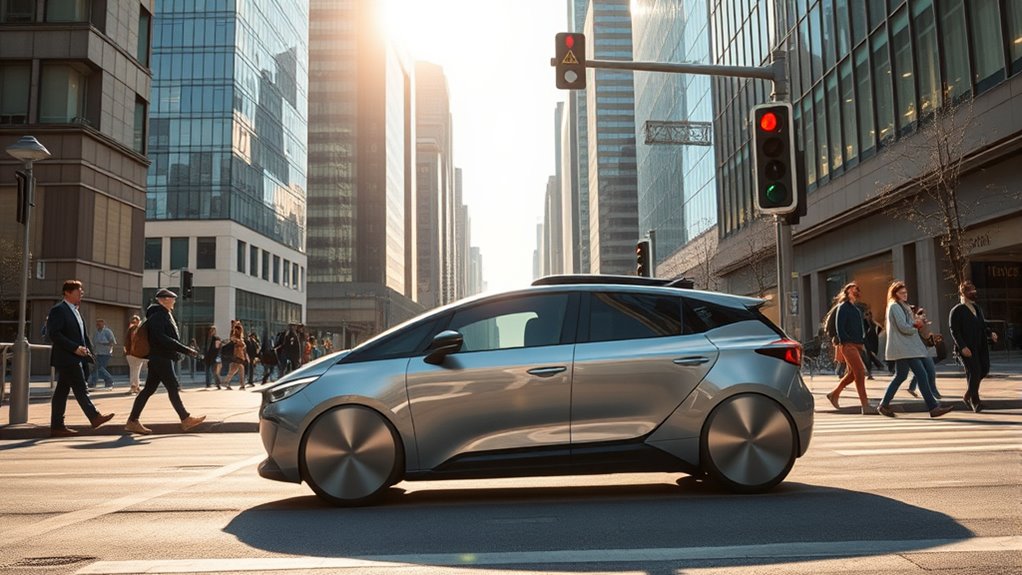
Have you ever wondered how self-driving cars are transforming transportation? These autonomous vehicles promise to revolutionize how we move, but they also bring complex issues that need careful steering. One of the biggest hurdles isn’t just technology; it’s the ethical considerations surrounding their deployment. Autonomous vehicles are programmed to make split-second decisions, such as how to prioritize safety in a crash scenario. Who’s responsible if something goes wrong? Is it the manufacturer, the software developer, or the owner? These questions challenge existing legal frameworks and demand new regulations that address moral dilemmas—like how a car should react in unavoidable accident situations. Balancing safety, responsibility, and moral judgments isn’t straightforward, and public trust hinges on transparency and clear standards. As these vehicles become more common, society must grapple with how to ethically integrate them into daily life while ensuring that accountability is maintained.
Meanwhile, infrastructure challenges represent another significant obstacle to widespread adoption. Cities and regions need to adapt their existing roads, signage, and communication systems to support autonomous vehicles effectively. For example, many current roads are designed with human drivers in mind, relying heavily on visual cues and manual signals. To facilitate safe operation, infrastructure may require upgrades such as clearer lane markings, dedicated lanes, and enhanced sensor compatibility. Additionally, reliable high-speed internet and vehicle-to-infrastructure communication networks are essential for real-time data exchange. Without these improvements, autonomous vehicles could face difficulties steering complex environments or responding swiftly to road hazards. Implementing these changes involves substantial investment and coordination among local governments, transportation agencies, and private companies. The challenge isn’t just in upgrading physical infrastructure but also in establishing standards and protocols that ensure compatibility across different vehicle brands and models. Until these infrastructure challenges are addressed, the full benefits of autonomous vehicles remain limited, and their integration into existing transportation systems could be delayed or compromised.
Furthermore, research into AI-driven decision-making and its ethical implications plays a crucial role in shaping policies for autonomous vehicle deployment. Both ethical considerations and infrastructure challenges highlight that deploying autonomous vehicles isn’t simply a matter of technology but a multifaceted process that requires careful planning and regulation. You need to understand that their success depends on societal acceptance and the ability of our systems to evolve alongside this new technology. Governments and industry leaders must work together to develop frameworks that prioritize safety, accountability, and seamless integration. Only then can autonomous vehicles truly realize their potential to make transportation safer, more efficient, and accessible for everyone. Until those hurdles are overcome, the journey toward fully autonomous transportation remains a complex balancing act—one that involves ethics, infrastructure, and a shared vision for the future.

SANDETOUN Parking Sensor Kit Backup Sensor Kit Reverse Sensor for Car 18 Color Options for Probes Adjustable Alarm Volume Professional Sensore de Reversa para Carro Safe Driving Assistant(Black)
Parking sensor for car Parking sensor kit Three Adjustable Reverse Alert Sound Modes: Easily Switch Between Sound, Soft…
As an affiliate, we earn on qualifying purchases.
As an affiliate, we earn on qualifying purchases.
Frequently Asked Questions
How Will Autonomous Vehicles Impact Urban Infrastructure Costs?
Autonomous vehicles will likely reduce urban infrastructure costs by decreasing the need for extensive road maintenance and parking facilities. Your urban planning efforts can focus more on public transit and green spaces instead of sprawling parking lots. With smarter traffic management, congestion lessens, saving money on road repairs. Overall, you’ll see a shift toward more efficient use of resources, making cities more sustainable and less costly to maintain.
What Are the Cybersecurity Risks Associated With Autonomous Vehicle Systems?
Great, your autonomous vehicle’s cybersecurity vulnerabilities threaten your data privacy like a hacker’s favorite game. They can hijack controls, steal personal info, or cause chaos on the road. So, while you trust tech, remember that cyber threats lurk behind every smart sensor and connection, ready to exploit weak security. Stay vigilant, upgrade defenses, and don’t forget—your car’s secrets are only as safe as its cybersecurity measures.
How Will Insurance Policies Adapt to Autonomous Vehicle Accidents?
Your insurance policies will adapt by shifting towards new liability frameworks, focusing less on driver fault and more on manufacturer or software provider responsibility. Insurance coverage will evolve to include autonomous system malfunctions, cybersecurity breaches, and software updates. You’ll likely see more personalized policies based on vehicle data, and insurers may require new technology standards. This shift aims to better address the complexities of autonomous vehicle accidents and guarantee thorough protection for all parties involved.
What Are the Ethical Considerations in Decision-Making Algorithms?
You face moral dilemmas in decision-making algorithms, especially when balancing passenger safety against pedestrian risk. It’s essential to prioritize bias mitigation to prevent unfair outcomes and guarantee ethical fairness. When designing these systems, you should consider diverse scenarios and cultural values, making algorithms transparent and accountable. By actively addressing moral dilemmas and reducing bias, you can help autonomous vehicles make ethically sound decisions that protect everyone involved.
How Will Autonomous Vehicles Affect Employment in Transportation Sectors?
You’ll likely see job displacement in transportation sectors as autonomous vehicles become more common, reducing the need for human drivers. This shift means you’ll need to adapt by upgrading your skills to meet new job requirements, focusing on technology and maintenance related to autonomous systems. While some roles may diminish, new opportunities could emerge in tech support, programming, and vehicle management, so staying adaptable will be key.
dedicated lanes for self-driving cars
As an affiliate, we earn on qualifying purchases.
As an affiliate, we earn on qualifying purchases.
Conclusion
As you see, maneuvering regulations is vital for autonomous vehicles’ success. Imagine a city where self-driving taxis operate seamlessly, reducing accidents and traffic. For instance, Waymo’s pilot programs show how clear policies can boost public trust and adoption. By addressing legal hurdles now, you can help accelerate this technology’s integration into everyday life, making roads safer and more efficient for everyone. Embrace the change, and you’ll be part of shaping a smarter transportation future.

Communication Technologies for Vehicles: 8th International Workshop, Nets4Cars/Nets4Trains/Nets4Aircraft 2015, Sousse, Tunisia, May 6-8, 2015. … Networks and Telecommunications)
As an affiliate, we earn on qualifying purchases.
As an affiliate, we earn on qualifying purchases.

J. J. Keller & Associates, Inc. Federal Motor Carrier Safety Regulations Handbook, English, Spiral Bound
FMCSR handbook gives drivers easy access to word-for-word Federal Motor Carrier Safety Regulations.
As an affiliate, we earn on qualifying purchases.
As an affiliate, we earn on qualifying purchases.