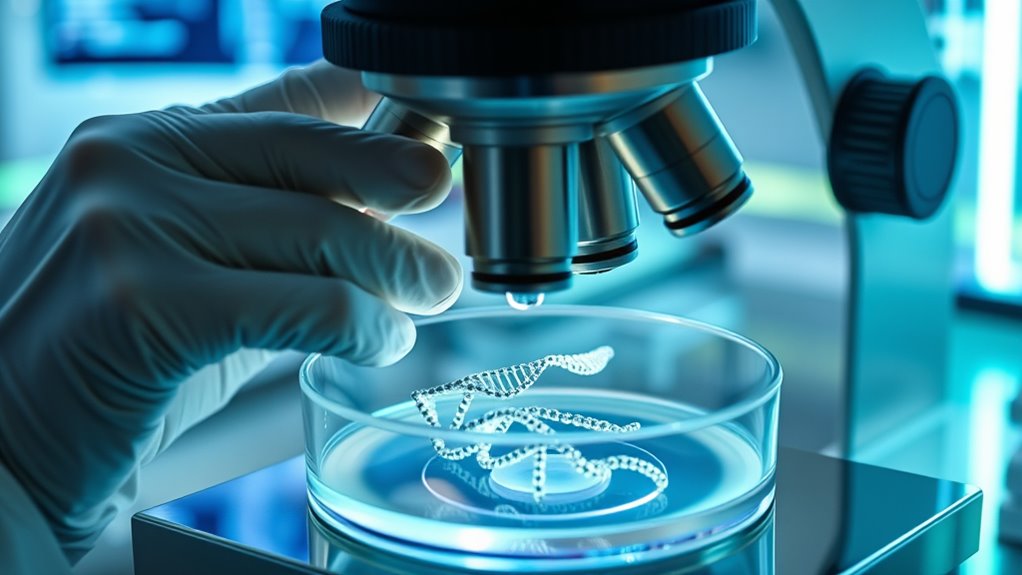

Prime editing is an advanced gene-editing tool that lets you make precise DNA changes without causing double-strand breaks, reducing errors. It works like a highly accurate word processor for your genes, directly rewriting specific sections. Using a special protein complex, it locates the exact spot and inserts the desired change with minimal risk of unintended effects. If you want to understand how this unique technology works and its potential, there’s more to discover below.
Key Takeaways
- Prime editing is a precise gene editing method that directly writes desired genetic changes into DNA without causing double-strand breaks.
- It uses a fusion enzyme called a prime editor, combining Cas9 nickase and reverse transcriptase, to target and modify specific DNA sequences.
- The process involves making a single-strand nick, then reverse transcribing the new genetic information into the DNA at the target site.
- Prime editing offers high accuracy, reducing unintended mutations and off-target effects compared to traditional CRISPR methods.
- This technology has potential applications in treating genetic diseases, improving agriculture, and advancing biological research.
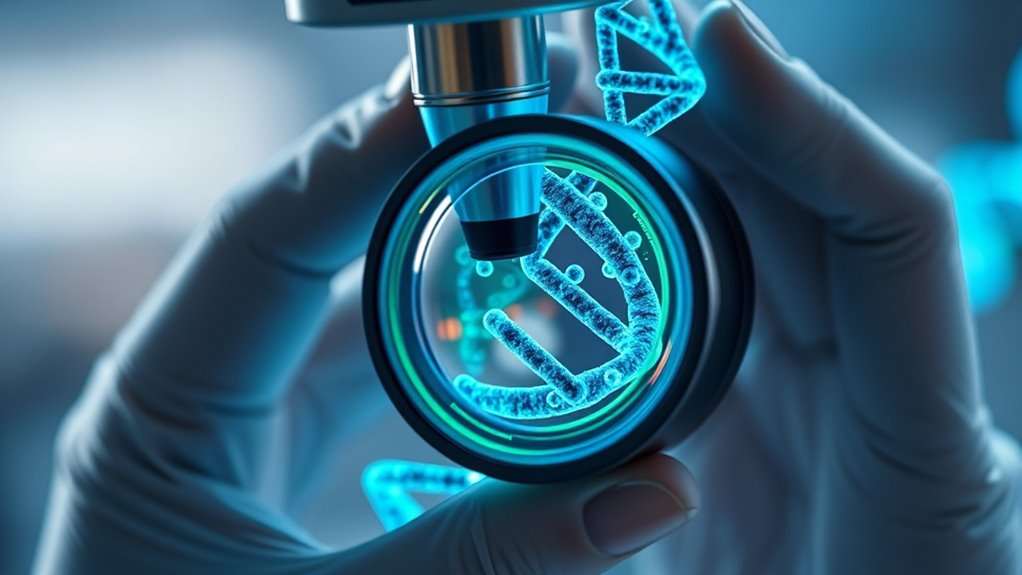
Have you ever wondered how scientists are changing the future of genetic engineering? It’s a fascinating universe where tiny changes can have monumental impacts. Prime editing is at the forefront of this revolution, offering unprecedented precision in correcting genetic mutations. Unlike earlier methods, prime editing doesn’t just cut DNA; it acts more like a sophisticated word processor, making exact changes to your genetic code. This breakthrough builds on the foundation of CRISPR applications, which initially gained fame for their ability to target specific DNA sequences. However, CRISPR’s early versions often relied on cellular DNA repair mechanisms that weren’t always precise, sometimes leading to unintended mutations. Prime editing addresses this issue by harnessing and guiding the DNA repair process directly, making gene correction safer and more accurate.
Prime editing transforms genetic correction with unmatched precision, acting like a sophisticated word processor for DNA.
When you think about DNA repair, it’s fundamentally the cell’s way of fixing broken or damaged DNA strands. Traditional CRISPR techniques create double-strand breaks, prompting the cell to fix itself, but this process can be unpredictable. Prime editing, on the other hand, introduces a modified enzyme called a prime editor—an engineered fusion of a Cas9 nickase and a reverse transcriptase. This complex is designed to make specific edits without causing double-strand breaks, reducing the chance of errors. Once the prime editor locates the target DNA sequence, it makes a single-strand nick and then uses its reverse transcriptase to directly write the desired genetic change into the DNA. This process leverages the cell’s natural DNA repair pathways but guides them more precisely, considerably enhancing the accuracy of gene editing.
By focusing on precise DNA repair, prime editing opens up possibilities that were previously thought too risky. It can correct point mutations responsible for genetic diseases, potentially curing conditions like sickle cell anemia and certain forms of blindness. Because it minimizes off-target effects, it’s considered safer for therapeutic applications. Researchers are also exploring its use in agriculture, aiming to develop crops with beneficial traits without introducing foreign DNA. The ability to make exact genetic modifications means fewer unintended consequences and a faster path from discovery to real-world application.
In a nutshell, prime editing refines the tools of genetic engineering, making them more reliable and adaptable. It’s a direct extension of CRISPR applications but with added control and precision. As scientists continue to innovate, you can expect prime editing to become a cornerstone technology for treating genetic disorders, improving crops, and advancing biological research. It’s an exciting time, as this technique promises to transform what’s possible in the domain of genetic medicine and beyond, all by harnessing the cell’s own DNA repair mechanisms with unprecedented finesse.
Frequently Asked Questions
How Does Prime Editing Compare to Traditional CRISPR Methods?
You’ll find prime editing more precise than traditional CRISPR methods, as it reduces off-target effects considerably. Unlike CRISPR, which cuts both strands of DNA, prime editing uses a modified enzyme to make exact changes without causing double-strand breaks. Delivery methods are similar, but prime editing’s accuracy minimizes unintended mutations, making it a safer option for gene correction. Overall, it offers enhanced control and fewer risks compared to conventional CRISPR techniques.
What Are the Main Limitations of Prime Editing Technology?
You might think prime editing is flawless, but it still faces off-target effects and delivery challenges. These limitations mean you risk unintended mutations and struggle to efficiently introduce edits into cells. Ironically, a tool designed for precision can sometimes cause errors or be difficult to deliver to the right cells. Despite its promise, these hurdles remind you that even advanced gene editing isn’t yet perfect or foolproof.
Can Prime Editing Be Used in Human Clinical Applications?
You can use prime editing in human clinical applications, but ethical concerns and regulatory challenges still need addressing. You should consider the potential risks, such as off-target effects, and guarantee compliance with strict guidelines. While promising, this technology requires thorough testing and approval from regulatory bodies before it can be safely applied to treat patients. Staying informed about ongoing research will help you understand its evolving clinical potential.
What Types of Genetic Mutations Can Prime Editing Correct?
You can use prime editing to correct a wide range of mutation types, including point mutations, small insertions, and deletions. While some mutations may be more challenging, this technology offers precise genetic corrections, reducing unintended effects. Keep in mind, though, not all mutations are currently targetable, but ongoing research continues to expand its capabilities for different genetic corrections, making it a promising tool for treating genetic disorders.
How Cost-Effective Is Prime Editing for Large-Scale Gene Editing?
Prime editing can be cost-effective for large-scale gene editing, especially when compared to traditional methods, due to its high precision and reduced need for extensive screening. However, scalability challenges exist, such as delivery efficiency and reagent costs, which may increase overall expenses. You might find that investments in optimizing delivery systems and bulk reagent production can help lower costs and improve scalability, making prime editing more viable for large projects.
Conclusion
Prime editing is revolutionizing the way you can fix genes with incredible precision, like a master sculptor shaping a masterpiece. With this groundbreaking technology, you’re on the verge of curing diseases once thought unstoppable. Imagine wielding the power to rewrite the very blueprint of life—it’s nothing short of miraculous. As prime editing continues to evolve, it promises a future where genetic errors are wiped out faster than you can blink. The possibilities are truly awe-inspiring!