
Robot vacuums work better in homes with well-organized layouts, minimal clutter, and clear pathways, which help them navigate efficiently and avoid obstacles. Larger homes or those with complex designs benefit from models with longer battery life and advanced smart features. Regular cleaning and tidiness keep sensors and brushes in good shape, boosting performance and lifespan. Want to find out how to optimize your space for the best results? Keep going for more helpful tips.

Get the little things that make your day delivered free with Prime
- Fast, free delivery on millions of items
- Prime Video, Amazon Music and more included
- Member-only deals all year
Key Takeaways
- Well-organized, clutter-free layouts enable better navigation and thorough cleaning by robot vacuums.
- Larger homes with longer battery life models allow for complete cleaning sessions without interruptions.
- Regular maintenance of sensors and brushes improves navigation accuracy and overall vacuum performance.
- Advanced features like smart mapping and obstacle avoidance enhance cleaning efficiency in complex environments.
- Tidier homes reduce sensor workload and battery drain, boosting vacuum effectiveness and longevity.
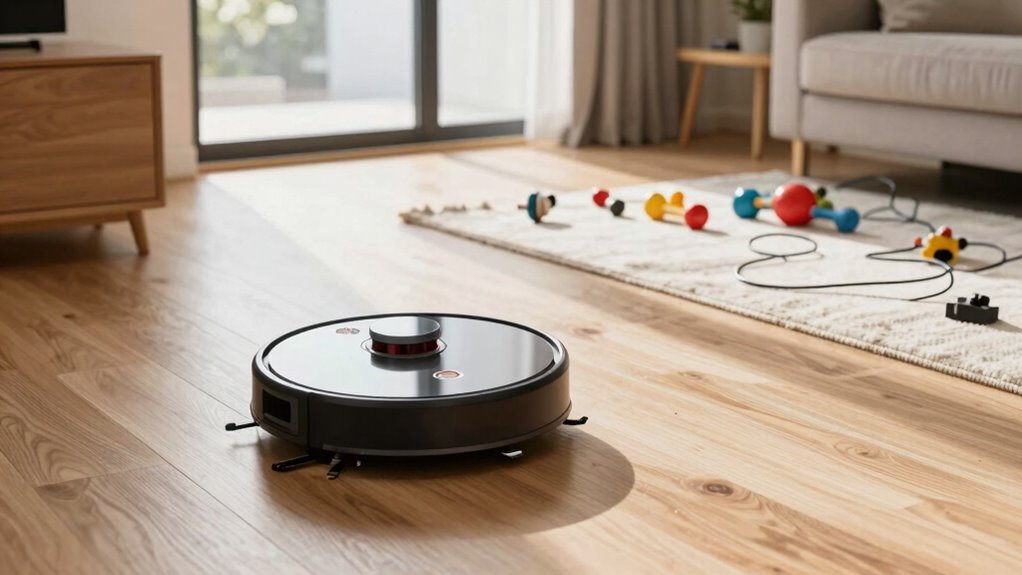
Robot vacuums have become a popular choice for keeping homes clean, but they work better in some environments than others. One major factor influencing their performance is smart navigation. If your home has a well-organized layout with clear pathways and minimal clutter, your robot vacuum can navigate more efficiently. It can map out the space, avoid obstacles, and clean more thoroughly without getting stuck or missing spots. Conversely, homes with complex layouts, many furniture pieces, or lots of clutter can hinder the robot’s ability to move smoothly. In such environments, it may require more time to clean or may even miss areas altogether, reducing its overall effectiveness.
Another key aspect is battery life, which determines how long your robot vacuum can operate before needing a recharge. Homes with larger areas or multiple levels demand a vacuum with a longer battery life to cover the entire space without frequent interruptions. If your robot has a limited battery, it might need to return to its charging dock mid-clean, leaving parts of your home uncleaned. This can be frustrating and may require you to manually intervene or run the vacuum multiple times. On the other hand, models with extended battery life are better suited for bigger homes, ensuring thorough cleaning in a single session.
The combination of smart navigation and battery life directly influences how well the robot vacuum performs in your home. If your space is open and straightforward, even a basic model with decent battery life and simple navigation features might suffice. However, if your home has a complex layout or multiple rooms, investing in a robot with advanced smart navigation and a longer-lasting battery pays off. These features allow the vacuum to create detailed maps, avoid obstacles more effectively, and finish cleaning without frequent recharges. Additionally, the home environment plays a crucial role in how efficiently the vacuum operates and maintains its battery over time. Regular maintenance, like cleaning sensors and brushes, helps preserve battery health and navigation accuracy. Properly maintaining the vacuum can prevent issues that drain the battery faster or impair the sensors. If your home is cluttered or has many tight spaces, the vacuum’s sensors will work harder, potentially draining the battery faster and reducing navigation precision. A tidy environment can significantly improve the robot’s overall performance and longevity. Creating a clutter-free space can further enhance the effectiveness of your robot vacuum and extend its lifespan. Overall, the environment you create around your robot vacuum plays a major role in determining its efficiency and effectiveness.
As an affiliate, we earn on qualifying purchases.
Frequently Asked Questions
How Do Robot Vacuums Handle Pet Hair Differently?
Robot vacuums handle pet hair differently by excelling at pet hair removal thanks to specialized brush rolls and suction power. They often feature advanced filter systems that trap pet dander and hair, preventing allergies. You’ll find they work best on smooth surfaces, efficiently collecting pet hair from floors and carpets. Regular maintenance, like cleaning filters and brushes, guarantees your robot vacuum keeps up with pet hair, maintaining a cleaner home.
Are Robot Vacuums Suitable for Homes With Multiple Levels?
In a multi-level home, a robot vacuum can be suitable if it has stair navigation. For example, Sarah’s house with two floors works well because her robot vacuum easily moves between levels and avoids stairs. However, without stair sensors, it risks falling and isn’t ideal. You should choose a model with reliable stair navigation features to keep cleaning efficient and safe across all your levels.
Can Robot Vacuums Clean Under Low Furniture Effectively?
Yes, robot vacuums can clean under furniture effectively, especially if they have good under furniture clearance. Look for models with low clearance obstacles, typically around 2-3 inches, so they can easily slide under beds, sofas, and cabinets. Regularly check for any obstacles that might block their path, and make sure the vacuum’s sensors are clean to optimize their ability to navigate tight spaces and reach those hard-to-access areas.
Do Robot Vacuums Work Well on Thick Carpet or Just Hard Floors?
Think of your robot vacuum as a skilled explorer. On hard floors, it easily navigates the smooth terrain, efficiently cleaning with its brushes and suction. But on thick carpet, where the rug pile is tall and dense, it struggles to climb and pick up debris effectively. So, it works best on hard floors and may need extra help on thick carpets, depending on your floor type.
How Do Noise Levels Vary Between Different Robot Vacuum Models?
You’ll notice noise levels vary between robot vacuum models, with some being quieter than others. The noise comparison helps you find a model with lower volume control, perfect for homes with noise sensitivities or pets. Look for vacuums labeled as “quiet” or “low noise,” and consider models with adjustable volume settings. This way, you can vacuum without disturbing your daily activities or sleep.
As an affiliate, we earn on qualifying purchases.
Conclusion
In the grand dance of cleanliness, your home’s layout and clutter can either lead or trip up your robot vacuum’s performance. Think of it as a well-choreographed ballet—clear, open spaces let your robot glide effortlessly, while chaos throws it off beat. By tidying up and arranging your space thoughtfully, you’re giving your robot vacuum the perfect stage to shine. With a little prep, your home becomes a smooth-running symphony of spotless floors.
robot vacuum sensors cleaning kit
As an affiliate, we earn on qualifying purchases.
As an affiliate, we earn on qualifying purchases.
As an affiliate, we earn on qualifying purchases.
Columbus Day / Indigenous Peoples' Day Picks
long weekend sales
As an affiliate, we earn on qualifying purchases.