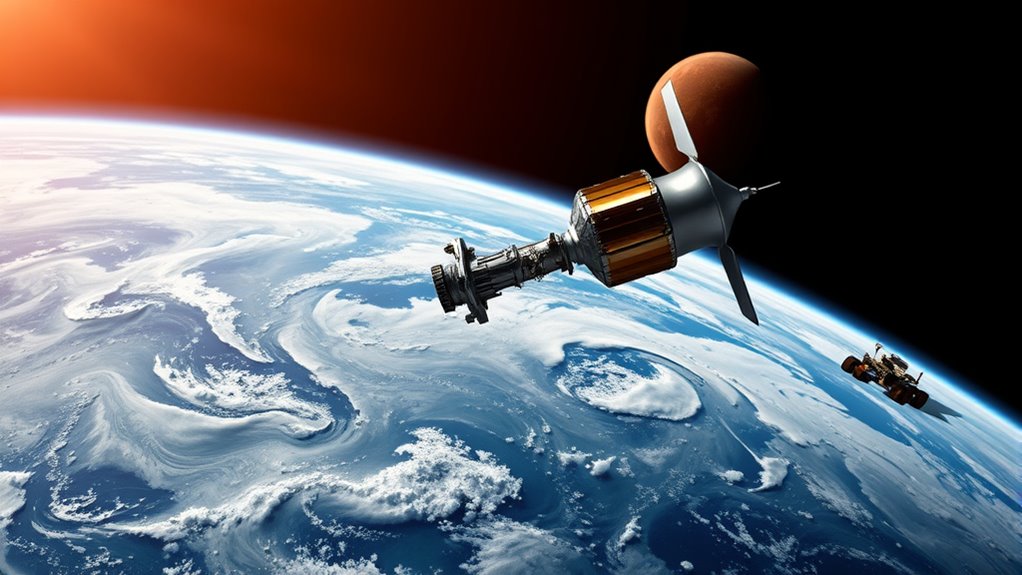

You’ve witnessed how space exploration evolved from Sputnik’s launch as the first satellite to the development of advanced satellites, space stations, and plans for Mars missions. Early efforts focused on Earth’s observation, but now we’re creating habitats designed for long-term human presence beyond Earth. With technology continually advancing, our exploration reach expands into deep space. If you keep exploring, you’ll uncover even more about humanity’s exciting journey from orbit to new worlds.
Key Takeaways
- Space exploration began with Sputnik, the first artificial satellite, marking humanity’s initial step into space.
- Development of space habitats and stations, like the ISS, advanced human living conditions beyond Earth.
- Progressed from simple satellites to sophisticated spacecraft enabling scientific research and planetary observation.
- Technological innovations support crewed missions to Mars, including life support and navigation systems.
- Ongoing breakthroughs continue to expand our understanding, driving ambitious plans for future interplanetary exploration.
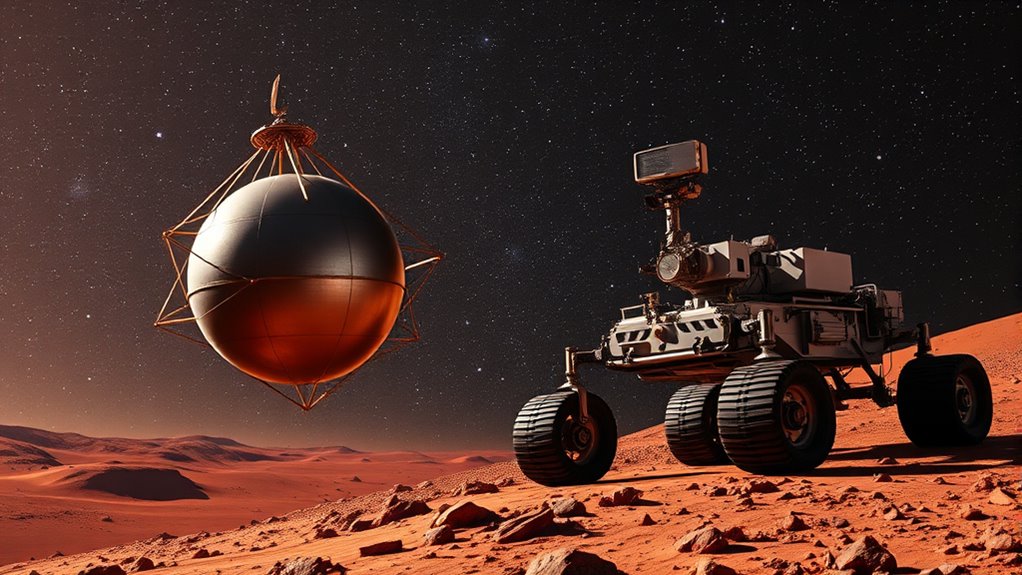
Have you ever wondered what lies beyond our planet? The journey to explore space has been nothing short of extraordinary, opening new frontiers and challenging our understanding of the universe. It all began with simple satellite technology, which revolutionized the way we observe Earth and the cosmos. These tiny devices orbiting our planet provide essential data for weather forecasting, communication, and scientific research. Satellite technology has become the backbone of space exploration, enabling us to monitor distant planets, study cosmic phenomena, and plan future missions. As technology advanced, so did our ambitions, leading to the development of sophisticated space habitats designed to support human life beyond Earth. Space habitat design now focuses on creating sustainable living environments that can withstand the harsh conditions of space, including radiation, microgravity, and limited resources. These habitats incorporate innovative engineering solutions, such as closed-loop life support systems, which recycle water and air, ensuring astronauts have what they need to survive for extended periods. The design process emphasizes safety, comfort, and energy efficiency, all indispensable for long-term missions to the Moon, Mars, and beyond. The evolution from early satellite launches to building complex space stations like the International Space Station exemplifies this progress. These stations serve as testing grounds for habitat technology and serve as a base for scientific experiments and international collaboration. The quest to reach Mars builds upon these advancements, pushing the boundaries of what’s possible. Today, spacecraft are equipped with cutting-edge technology that allows for precise navigation and communication across vast distances. This includes robust satellite systems that facilitate real-time data transfer and remote operations. As we prepare for manned missions to Mars, the focus on space habitat design becomes even more essential, aiming to create self-sufficient environments where humans can live and work for years. The challenges are immense, but so are our innovations. With each step forward, from launching the first satellite to planning crewed Mars expeditions, we’re expanding our reach into the cosmos. Space exploration’s future relies on continued breakthroughs in satellite technology and habitat design, both of which are fundamental to sustain human presence beyond Earth. As we develop these space habitats, our ability to support life in extraterrestrial environments will improve dramatically. As you follow these developments, it’s clear that humanity’s drive to explore the unknown is unstoppable. Every new satellite launched and every new habitat designed brings us closer to understanding the universe and our place within it. The journey from Sputnik to Mars might be miles apart, but they’re connected by our relentless curiosity and technological ingenuity. And as you look up at the night sky, remember that each step forward is a testament to our collective desire to explore what lies beyond our home planet.
Top picks for "exploration space sputnik"
Open Amazon search results for this keyword.
As an affiliate, we earn on qualifying purchases.
Frequently Asked Questions
What Are the Future Plans for Human Colonization of Mars?
You’ll see plans for Mars colonization advancing with NASA, SpaceX, and international efforts aiming to establish sustainable habitats. They’re exploring technologies for life support, resource utilization, and even terraforming prospects to make the Red Planet more Earth-like. Your role may involve participating in these missions, developing new solutions, or supporting space policies that turn Mars colonization from a dream into reality. The future of human presence on Mars is becoming increasingly tangible.
How Do Space Agencies Fund Their Extensive Exploration Programs?
Think of space agencies as a well-oiled machine, fueling their exploration programs through public-private partnerships and international collaboration. You’re likely to see governments contribute budgets, while private companies invest in technology and innovation. These collaborations act like a cosmic web, spreading costs and expertise across nations and industries, making ambitious missions possible without one entity bearing the entire weight. It’s teamwork that propels humanity into the stars.
What Technological Innovations Are Currently Being Developed for Deep Space Travel?
You’re exploring the latest innovations for deep space travel, focusing on advanced propulsion systems like ion thrusters and nuclear thermal engines that boost speed and efficiency. You’ll also see progress in space habitat design, making long journeys more livable with sustainable life support and radiation protection. These innovations aim to overcome current limitations, enabling humans to venture farther into space and establish sustainable presence beyond Earth’s orbit.
How Do Astronauts Prepare Physically and Mentally for Long-Duration Missions?
You prepare for long-duration missions by building your psychological resilience and physical endurance. You undergo rigorous mental training to handle isolation, stress, and uncertainty, often practicing mindfulness and stress management techniques. Physically, you follow specialized exercise routines to maintain muscle mass and bone density in microgravity. You also receive medical assessments and nutritional guidance to guarantee you’re both mentally and physically ready for the challenges of deep space travel.
What Are the Environmental Impacts of Space Exploration on Earth?
Imagine you’re in a spaceship heading to Mars, and Earth feels the weight of your journey. Space exploration impacts our planet through increased space debris and resource contamination, which can harm ecosystems and hinder future missions. These environmental effects remind us that while advancing technology, we must also manage waste and preserve Earth’s environment. You can help by supporting sustainable practices in space activities and pushing for responsible exploration policies.
Conclusion
As you reflect on space exploration’s journey from Sputnik to Mars missions, imagine yourself as part of this grand adventure. Just like the Mars Rover Curiosity, which explores distant terrains, your curiosity fuels future discoveries. Every milestone, from launching satellites to landing rovers, brings you closer to understanding the universe. Keep dreaming and exploring—who knows, maybe someday you’ll be part of humanity’s next giant leap into the cosmos.