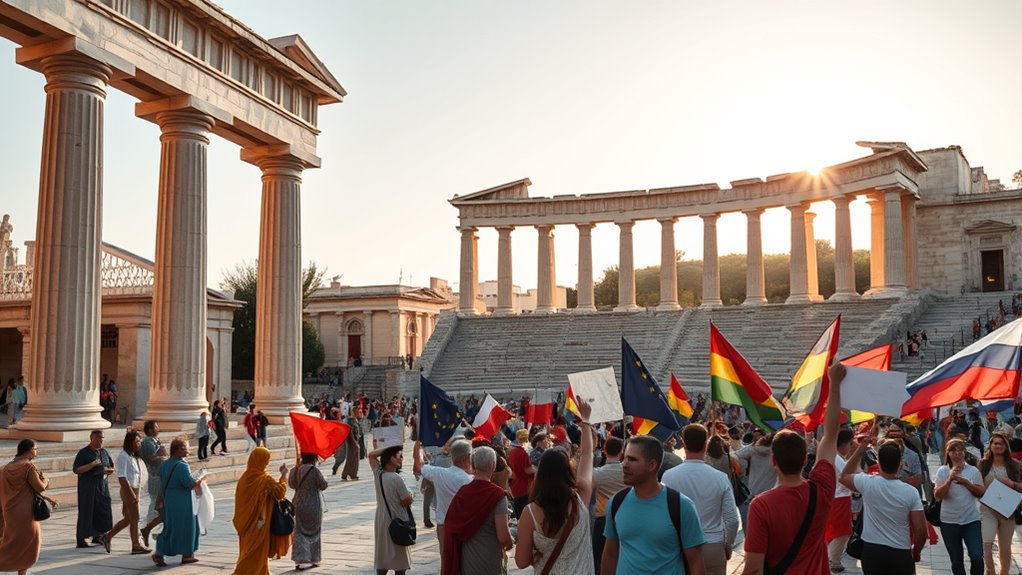

The history of democracy begins in ancient Athens around the 5th century BCE, where citizens participated directly in decision-making. It evolved through Rome’s republic, medieval systems, and was revived during the Enlightenment with ideas from thinkers like Locke and Montesquieu. Revolutions in America and France expanded democratic ideals worldwide. Over time, democracies broadened rights and representation. Today, democracy continues to grow and adapt, shaping societies worldwide. To discover more about this fascinating journey, keep exploring how these ideas transformed over centuries.
Key Takeaways
- Democracy originated in 5th-century BCE Athens as a direct system emphasizing citizen participation.
- Roman Republic introduced representative structures like the Senate, blending aristocracy with popular input.
- Enlightenment thinkers like Locke and Montesquieu promoted ideas of separation of powers and social contracts.
- Democratic principles expanded globally through revolutions and reforms in the 18th to 20th centuries.
- Modern democracies evolve with technology and social movements, focusing on inclusion, transparency, and responsiveness.
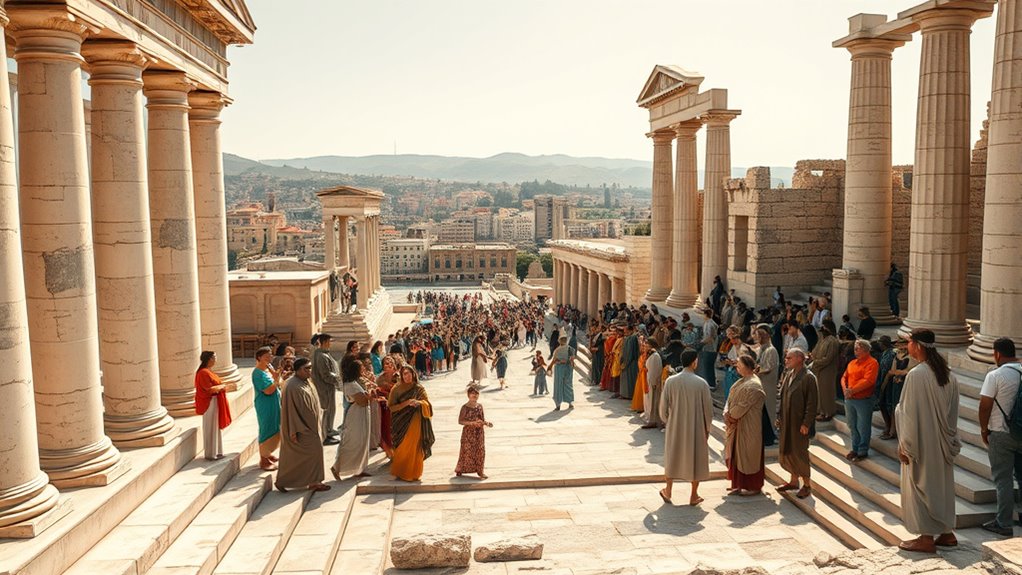
Have you ever wondered how democracy evolved from ancient ideas to the political system we recognize today? It all begins with its ancient origins, where early civilizations laid the groundwork for what would become a revolutionary way to govern. In ancient Greece, particularly in Athens, democracy first took shape around the 5th century BCE. Unlike modern representative systems, Athenian democracy was direct: citizens gathered to discuss and vote on laws themselves. This practice emphasized participation and the idea that power resides with the people, setting a foundational principle that still influences democratic thought. These early experiments in self-governance demonstrated that collective decision-making could work, inspiring future political models.
Ancient Athens pioneered direct democracy, emphasizing citizen participation and collective decision-making as the foundation of modern democratic principles.
As centuries passed, the concept of democracy continued to develop through various cultural and political shifts. The Roman Republic, for example, introduced ideas like a Senate and elected officials, blending elements of aristocracy with popular participation. Yet, it was largely limited to certain classes, showing that early democratic ideas often coexisted with exclusion and inequality. During the Middle Ages, democratic principles faded somewhat, overshadowed by monarchies and feudal systems. However, the Renaissance and Enlightenment periods rekindled interest in human rights, individual liberty, and the importance of civic participation. Thinkers like John Locke and Montesquieu argued for the separation of powers and the social contract, ideas that would influence modern political systems profoundly.
Modern developments in democracy emerged prominently during the 17th and 18th centuries, especially with the American Revolution and the French Revolution. These upheavals challenged monarchies and aristocratic rule, advocating for elected representation, constitutional governance, and universal rights. The American colonies, for instance, established a republic rooted in democratic principles, emphasizing voting rights, separation of powers, and rule of law. Similarly, revolutionary France promoted ideas of equality and popular sovereignty, shaping modern notions of democracy as a system that serves the will of the people. Over the 19th and 20th centuries, democratic systems expanded globally, gradually including broader segments of society through reforms that extended voting rights and civil liberties.
Today, democracy continues to evolve, adapting to new challenges like digital communication, globalization, and social movements. While the core principles—participation, representation, and individual rights—remain constant, modern developments focus on making democracy more inclusive, transparent, and responsive. You now live in a world where democracy isn’t just an ancient idea but a dynamic, living system that constantly adapts to meet the needs of diverse populations. Understanding its ancient origins and modern developments helps you appreciate how far this political system has come—and how much further it can go.

Democracy Awakening: Notes on the State of America
As an affiliate, we earn on qualifying purchases.
As an affiliate, we earn on qualifying purchases.
Frequently Asked Questions
How Did Ancient Athens Influence Modern Democratic Systems?
Ancient Athens directly influences modern democratic systems by establishing Democracy’s origins, where citizens actively participate in decision-making. You benefit from Athenian concepts like Athenian citizenship, which emphasizes civic involvement and equality. These ideas laid the groundwork for contemporary democracy, inspiring political structures that prioritize citizen engagement, voting rights, and public debate. By understanding Athens’s role, you see how foundational principles shape your participation in today’s democratic processes.
What Are the Major Differences Between Direct and Representative Democracy?
You should know that in a direct democracy, citizen participation is direct, with people voting on laws and policies themselves through mechanisms like referendums. In contrast, a representative democracy relies on voting for elected officials who make decisions on your behalf. The key difference is how involved citizens are in decision-making, with direct democracy offering more immediate control, while representative democracy emphasizes trusted representatives.
How Has Democracy Evolved in Non-Western Societies?
Imagine democracy as a river that adapts as it flows through different landscapes. In non-western societies, it evolves through cultural adaptations and governance innovations, blending traditional customs with modern ideas. For example, in India, village councils still play a crucial role, illustrating how local practices shape democratic processes. This ongoing evolution shows democracy’s flexibility, allowing it to thrive uniquely across diverse societies worldwide.
What Role Did Women and Minorities Play in Historical Democracies?
Women’s suffrage and minority participation played vital roles in shaping democracies. You see, women fought for voting rights, transforming democratic systems to include their voices, like during the suffrage movements. Minority groups also pushed for equal participation, demanding fair representation and civil rights. Their efforts expanded democratic ideals, ensuring more inclusive governance. Today, ongoing struggles for women’s suffrage and minority participation continue to strengthen and evolve democratic societies worldwide.
How Do Contemporary Challenges Threaten Democratic Institutions Today?
Imagine your democratic vote as a fragile flame flickering in a storm; today, voter suppression and misinformation campaigns threaten to snuff it out. These tactics distort truth, erode trust, and make it harder for genuine voices to be heard. As a result, your ability to participate freely and fairly in elections weakens, risking the very foundation of democracy. Staying informed and vigilant helps keep that flame burning bright against these modern threats.
citizen participation voting kit
As an affiliate, we earn on qualifying purchases.
As an affiliate, we earn on qualifying purchases.
Conclusion
Now, as you stand at the crossroads of history, democracy is like a mighty oak that has weathered storms and grown stronger over time. From Athens’ cradle to today’s global stage, it’s a living, breathing story of human hopes and dreams. Remember, your voice is a essential leaf on this ancient tree. Together, you can nurture its branches, ensuring democracy’s vibrant future continues to flourish, reaching for the sky with every new generation.

Emilie Du Chatelet: Daring Genius of the Enlightenment
As an affiliate, we earn on qualifying purchases.
As an affiliate, we earn on qualifying purchases.

Syrian Kurds, the Democratic Union Party (PYD), and the Strategic Framing of the Civil War: Selling the New Model of Governance
As an affiliate, we earn on qualifying purchases.
As an affiliate, we earn on qualifying purchases.