To build early science curiosity through simple experiments, involve children in hands-on activities like observing plant growth, exploring sinking and floating objects, or mixing baking soda and vinegar. Use safe, age-appropriate tools that encourage active participation and wonder. These activities help spark questions, boost confidence, and make science fun and meaningful. Keep encouraging their natural curiosity, and you’ll discover more ways to turn everyday moments into exciting learning experiences—if you keep exploring further.

Get the little things that make your day delivered free — and shop member deals
- Fast, free delivery on millions of items
- Access to Prime Big Deal Days deals on October 6–7
- Prime Video, Amazon Music and more included
Key Takeaways
- Use age-appropriate, safe tools to encourage hands-on exploration and independent experimentation.
- Conduct simple experiments like observing plant growth or floating objects to ignite curiosity.
- Incorporate immediate, visible results to help children connect actions with outcomes.
- Engage senses and promote active participation to make science learning exciting and memorable.
- Provide guidance and resources to support questions, fostering a lifelong interest in science.
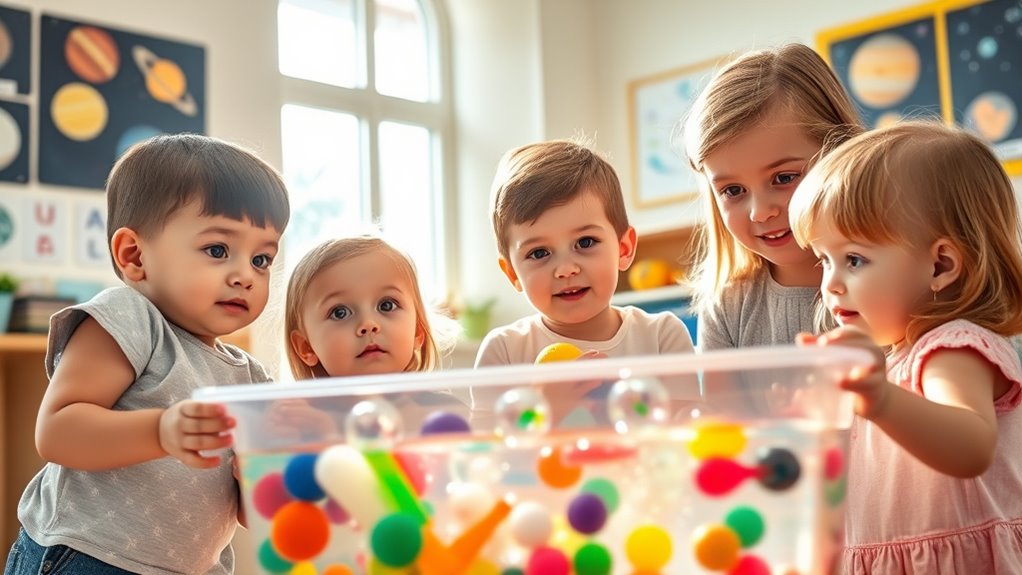
Have you ever wondered how to spark a child’s natural curiosity about the world around them? The key lies in engaging their senses through hands-on exploration. When children actively participate in experiments, they don’t just observe; they understand and remember. To do this effectively, you should provide age-appropriate tools that are safe and easy for them to handle. For example, small plastic droppers, measuring cups, and soft brushes can make a big difference. These tools empower children to explore without feeling overwhelmed, encouraging independence and confidence in their ability to experiment.
Using hands-on exploration allows children to connect directly with the materials and phenomena they’re learning about. Instead of passively watching a demonstration, they get their hands dirty, so to speak. This active involvement stimulates curiosity and makes learning more meaningful. For instance, when introducing a simple experiment like mixing baking soda and vinegar, you can give children their own small containers, spoons, and safety goggles. Watching the bubbling reaction firsthand sparks their interest and prompts questions about what’s happening. It turns science into an exciting discovery rather than just a lesson to memorize.
Hands-on science sparks curiosity and makes learning fun through direct, active exploration.
Choosing age-appropriate tools is essential because it ensures safety and promotes engagement. Young children might find large, chunky measuring cups easier to handle than small ones, and using non-toxic, washable materials keeps the experience safe and stress-free. As they grow, you can gradually introduce more precise tools like droppers or magnifying glasses to enhance their understanding. The goal is to match the tools to their developmental stage, making each experiment accessible and enjoyable.
Creating opportunities for hands-on exploration also means setting up simple experiments that don’t require complex equipment. Think of activities like observing plant growth in a clear jar or exploring how different objects sink or float in water. These experiments are easy to prepare, safe, and perfect for little hands. They give children immediate feedback and foster a sense of achievement when they see the results of their efforts. Plus, they encourage questions, which is a fundamental step in nurturing scientific curiosity.
In addition, incorporating educational support hours from trusted resources can provide guidance and new ideas for safe and engaging experiments. Ultimately, by providing opportunities for hands-on exploration with age-appropriate tools, you empower children to become active participants in their learning journey. Their natural curiosity will flourish when they can touch, see, and experiment directly. This approach lays a strong foundation for a lifelong love of science, turning everyday moments into exciting discoveries.
As an affiliate, we earn on qualifying purchases.
Frequently Asked Questions
How Can Parents Encourage Curiosity Without Direct Answers?
You can encourage curiosity by using questioning techniques that prompt your child to think and explore, rather than giving direct answers. Engage them with open-ended questions like “What do you think will happen?” or “Why do you think that?” to spark their interest. Use engagement strategies such as active listening and encouraging their ideas, which helps them develop critical thinking skills and fosters a natural desire to learn and discover independently.
What Age Is Ideal for Starting Simple Science Experiments?
You can start simple science experiments as early as age two, when your child’s curiosity begins to blossom like a colorful garden. Keep experiment complexity minimal, using safe household items and vivid visuals to spark excitement. At this age, toddlers thrive on tactile exploration and basic cause-and-effect activities, laying a foundation of wonder that grows with them. Your gentle guidance helps turn everyday moments into mesmerizing science adventures.
Are There Safety Concerns With Certain Experiments?
Yes, there are safety concerns with certain experiments, especially regarding chemical hazards. You should always supervise children closely to guarantee they handle materials properly and avoid ingestion or spills. Read labels carefully, use age-appropriate supplies, and keep dangerous chemicals out of reach. Proper supervision requirements are essential to prevent accidents, and teaching kids about safety beforehand helps them understand the importance of careful handling during experiments.
How Do I Tailor Experiments for Different Learning Styles?
You tailor experiments for different learning styles by adapting activities to suit each child’s preferences. For visual learners, incorporate colorful materials and diagrams; for kinesthetic learners, include hands-on activities and movement. Auditory learners benefit from discussions and explanations. By adjusting your experiment adaptation, you guarantee every child engages meaningfully, fostering curiosity. Observe their responses and modify approaches as needed, creating an inclusive environment that nurtures early science interest for all learning styles.
Can These Experiments Be Adapted for Group Activities?
Certainly, you can adapt these experiments for group activities to enhance group engagement and foster collaborative learning. You might assign roles, encourage discussion, and design experiments that require teamwork. By doing so, children will naturally share ideas and learn from one another, deepening their curiosity and understanding. These adaptations not only make science more interactive and fun but also build essential social skills, making the experience more enriching for everyone involved.
As an affiliate, we earn on qualifying purchases.
Conclusion
By exploring simple experiments, you plant seeds of curiosity that grow into a lifelong love of science. Think of each experiment as a tiny spark, igniting a fire that fuels your child’s wonder and imagination. When you make science fun and accessible, you’re opening a door to endless discovery, turning curiosity into a bright beacon guiding their learning journey. Together, you create a world where science becomes an adventure waiting to unfold.
As an affiliate, we earn on qualifying purchases.
kids safe measuring cups and droppers
As an affiliate, we earn on qualifying purchases.
As an affiliate, we earn on qualifying purchases.
Halloween Picks
halloween
As an affiliate, we earn on qualifying purchases.