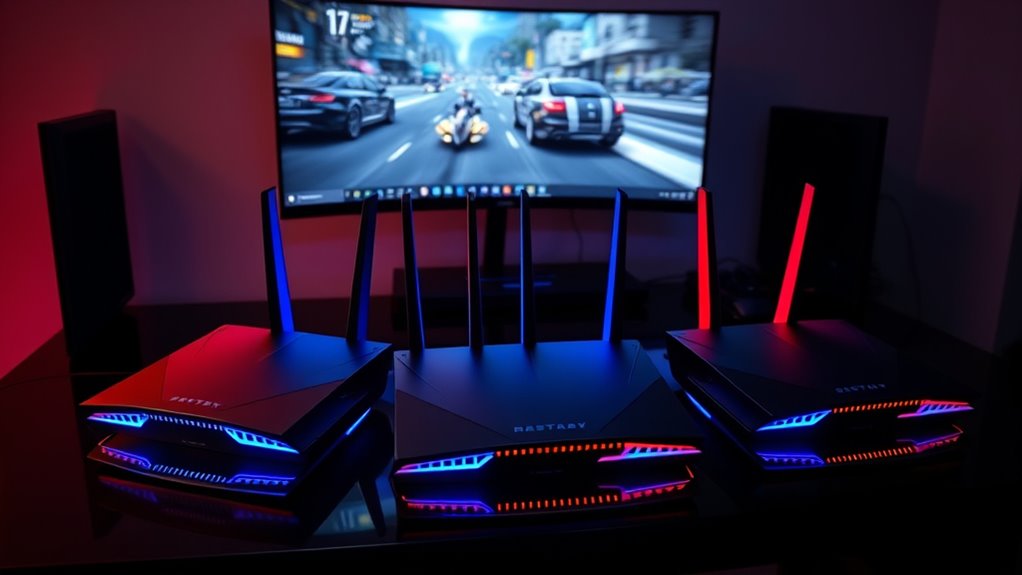

If you’re seeking the best gaming routers for low latency, you’re probably focused on minimizing lag during intense play. The ASUS ROG Rapture GT-AX11000 Pro stands out for its tri-band performance and advanced QoS features that prioritize gaming traffic. Another top contender is the NETGEAR Nighthawk WiFi 7 Router RS90, which leverages the latest WiFi 7 technology to deliver faster speeds and reduced delays. However, these high-performance options often come with tradeoffs like higher cost or complex setup. Continue reading to see how these models compare and which one fits your gaming setup best.

Get the little things that make your day delivered free with Prime
- Fast, free delivery on millions of items
- Prime Video, Amazon Music and more included
- Member-only deals all year
Key Takeaways
- WiFi 7 routers generally provide lower latency and faster speeds, but at a higher price point and with more complex setup needs.
- Tri-band and quad-band routers tend to outperform dual-band options in reducing latency during multiple device use.
- Prioritization features like Intel Killer and QoS significantly impact latency for gaming traffic, making them key differentiators.
- Build quality, firmware stability, and ease of use vary widely and can influence overall gaming experience beyond raw specs.
- Higher-priced models often offer more advanced features, but some budget-friendly options can still deliver low latency for casual or competitive gamers.
| ASUS ROG Rapture WiFi 6E Gaming Router (GT-AXE16000) | 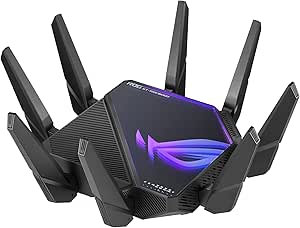 | Best Overall for High-End Gaming and Low Latency | Frequency Band: Quad-Band | WiFi Standard: 802.11ax (WiFi 6E) | Max Speed: 16000 Mbps | VIEW ON AMAZON | See Our Full Breakdown |
| NETGEAR Nighthawk WiFi 7 Router RS90, Up to 2,000 sq ft, 3.6 Gbps |  | Best for Fast, Reliable Coverage in Busy Households | WiFi Standard: WiFi 7 | Speed: 3.6 Gbps | Coverage: 2000 sq ft | VIEW ON AMAZON | See Our Full Breakdown |
| ASUS ROG Rapture GT-AX11000 Pro Tri-Band WiFi 6 Gaming Router |  | Best for Gaming with High-Speed and Customization | WiFi Standard: WiFi 6 | Speed: up to 11,000 Mbps | Bands: Tri-band | VIEW ON AMAZON | See Our Full Breakdown |
| Predator Connect T7 Wi-Fi 7 BE11000 Mesh Gaming Router with Intel Killer Prioritization |  | Best for Large-Scale Mesh Gaming Networks with Ultra-Low Latency | Wi-Fi Standard: Wi-Fi 7 | Processor: Quad-core ARM Cortex | Bands: Tri-band (2.4/5/6 GHz) | VIEW ON AMAZON | See Our Full Breakdown |
| ASUS ROG Rapture WiFi 6 Gaming Router (GT-AX11000) |  | Best for Large Homes with Priority on Gaming and Coverage | WiFi Standard: WiFi 6 | Maximum Data Rate: 10,000 Mbps | Frequency Bands: Tri-band | VIEW ON AMAZON | See Our Full Breakdown |
| GL.iNet GL-BE6500 Flint 3e Wi-Fi 7 Router with VPN for Home and Gaming |  | Best Overall for High-Speed Home and Office Use | Wi-Fi Standard: Wi-Fi 7 | Max Speed: 6.5 Gbps | Coverage Area: 2,500 sq ft | VIEW ON AMAZON | See Our Full Breakdown |
| ASUS ROG Rapture GT-BE98 Pro WiFi 7 Gaming Router – Quad-Band, 30Gbps, Mesh |  | Best for Power Gamers and Heavy Network Users | Frequency Band Class: Quad-Band | Wireless Compatibility: 802.11.be | Number of Ports: 7 | VIEW ON AMAZON | See Our Full Breakdown |
| TP-Link Tri-Band AXE5400 Wi-Fi 6E Gaming Router Archer GXE75 |  | Best for Next-Gen Wi-Fi 6E Gaming Performance | Wi-Fi Standard: Wi-Fi 6E | Tri-Band: Yes | Maximum Speed: 5.4 Gbps | VIEW ON AMAZON | See Our Full Breakdown |
| ASUS RT-AX86U Pro (AX5700) Dual Band WiFi 6 Gaming Router |  | Best for Low Latency Gaming with Advanced Security | WiFi Standard: WiFi 6 (802.11ax) | Max Speed: 5700 Mbps | Wired Speed: 2.5 Gbps | VIEW ON AMAZON | See Our Full Breakdown |
| GL.iNet GL-MT6000 Flint 2 Wi-Fi 6 Gaming Router Dual 2.5G Ports |  | Best for Budget-Conscious Gaming and Streaming | Wi-Fi Standard: Wi-Fi 6 | Max Speed: 6 Gbps | RAM: 1GB DDR4 | VIEW ON AMAZON | See Our Full Breakdown |
| ASUS RT-AX86U (AX5700) Dual Band WiFi 6 Gaming Router |  | Best Overall for Low Latency Gaming | WiFi Standard: WiFi 6 (802.11ax) | Max Speed: 5700 Mbps | Ports: 1 x 2.5G port, multiple Ethernet ports | VIEW ON AMAZON | See Our Full Breakdown |
| TP-Link Tri-Band Wi-Fi 7 Gaming Router (Archer GE650) | 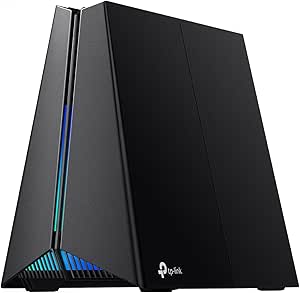 | Best for High-Speed, Multi-Device Low Latency | Wi-Fi Bands: Tri-band (6 GHz, 5 GHz, 2.4 GHz) | Maximum Speed: 5764 Mbps (6 GHz), 4320 Mbps (5 GHz), 574 Mbps (2.4 GHz) | Ports: 1× 5 Gbps WAN, 1× 5 Gbps LAN, 3× 2.5 Gbps LAN | VIEW ON AMAZON | See Our Full Breakdown |
| GL.iNet GL-BE9300 Flint 3 Tri-Band Wi-Fi 7 Router |  | Best for Ultra-Fast Coverage and Low Latency in Large Homes | Wi-Fi Standard: Wi-Fi 7 | Max Speed: 9 Gbps | Coverage Area: 2000 sq ft | VIEW ON AMAZON | See Our Full Breakdown |
| TP-Link AXE5400 Tri-Band WiFi 6E Router |  | Best for Future-Proof, High-Speed Low Latency | WiFi Speed: up to 5400 Mbps | Bands: Tri-Band (6 GHz, 5 GHz, 2.4 GHz) | 6 GHz Speed: 2402 Mbps | VIEW ON AMAZON | See Our Full Breakdown |
| gaming routers low latency | Ports |
|---|---|
| ASUS ROG Rapture WiFi 6E Gamin | 2 x 10G ports, 1 x 2.5G WAN port, 3 additional ports |
| NETGEAR Nighthawk WiFi 7 Route | One 2.5 Gbps WAN, Four 1 Gbps LAN |
| ASUS ROG Rapture GT-AX11000 Pr | One 2.5 G port, one 10 G port |
| Predator Connect T7 Wi-Fi 7 BE | — |
| ASUS ROG Rapture WiFi 6 Gaming | 15 ports |
| GL.iNet GL-BE6500 Flint 3e Wi- | — |
| ASUS ROG Rapture GT-BE98 Pro W | — |
| TP-Link Tri-Band AXE5400 Wi-Fi | 1x 2.5G WAN, 4x 1G LAN |
| ASUS RT-AX86U Pro | 2.5 Gbps port, 4 LAN |
| GL.iNet GL-MT6000 Flint 2 Wi-F | Dual 2.5G |
| ASUS RT-AX86U | 1 x 2.5G port, multiple Ethernet ports |
| TP-Link Tri-Band Wi-Fi 7 Gamin | 1× 5 Gbps WAN, 1× 5 Gbps LAN, 3× 2.5 Gbps LAN |
| GL.iNet GL-BE9300 Flint 3 Tri- | — |
| TP-Link AXE5400 Tri-Band WiFi | — |
More Details on Our Top Picks
ASUS ROG Rapture WiFi 6E Gaming Router (GT-AXE16000)
The ASUS ROG Rapture GT-AXE16000 stands out for its unprecedented quad-band WiFi 6E support, enabling speeds up to 16,000 Mbps across four frequency bands, including the new 6 GHz spectrum. Compared with the ASUS ROG Rapture GT-AX11000, it offers significantly higher speeds and expanded coverage with ASUS RangeBoost Plus, making it ideal for gamers who need ultra-low latency and multiple device handling. However, its complex setup and premium price make it less suitable for casual users or those with simpler needs. This router’s multiple high-speed ports and advanced features are designed for demanding gaming setups or high-bandwidth households that prioritize minimal lag and maximum throughput.
Pros:- Exceptional speeds up to 16,000 Mbps across four bands
- Dual 10G ports support ultra-fast wired connections
- Supports advanced WiFi 6E features for minimal latency
- Expanded coverage with ASUS RangeBoost Plus
Cons:- Setup can be challenging for non-technical users
- High price point may be prohibitive for some
Best for: Gamers and power users with large homes who demand the fastest, most reliable low-latency connections
Not ideal for: Budget-conscious buyers or those seeking easy, plug-and-play solutions, due to its complexity and cost
- Frequency Band:Quad-Band
- WiFi Standard:802.11ax (WiFi 6E)
- Max Speed:16000 Mbps
- Ports:2 x 10G ports, 1 x 2.5G WAN port, 3 additional ports
- Coverage:Extended with RangeBoost Plus
- Security Protocols:WPA3-Personal, WPA2-Enterprise
Our verdict“This is best suited for gamers and enthusiasts who need top-tier performance and are comfortable with a complex setup.”
NETGEAR Nighthawk WiFi 7 Router RS90, Up to 2,000 sq ft, 3.6 Gbps
The NETGEAR Nighthawk RS90 offers fast WiFi 7 speeds up to 3.6 Gbps over a 2000 sq ft area, making it suitable for homes with multiple devices. Unlike the ASUS ROG Rapture GT-AXE16000, it emphasizes ease of use and broad coverage with fewer setup hassles, but it doesn’t match the raw speed or advanced features for ultra-low latency. Its support for 50 devices and simple app management make it a solid choice for families needing reliable, low-latency connections without the complexity of multi-gig ports or WiFi 6E. However, it requires a separate modem and may face reduced coverage behind walls, limiting its performance in larger or more obstructed spaces.
Pros:- Fast WiFi 7 speeds up to 3.6 Gbps
- Wide coverage of approximately 2000 sq ft
- Supports up to 50 devices simultaneously
- Easy setup and management via the Nighthawk app
Cons:- Requires a separate modem or gateway
- Coverage and speeds can be impacted by walls and interference
Best for: Households with many devices seeking high-speed, low-latency WiFi with straightforward setup
Not ideal for: Pro gamers or users needing the absolute lowest latency and maximum throughput, due to moderate max speeds
- WiFi Standard:WiFi 7
- Speed:3.6 Gbps
- Coverage:2000 sq ft
- Device Capacity:50 devices
- Ports:One 2.5 Gbps WAN, Four 1 Gbps LAN
- Processor:Quad-core 2.0 GHz
Our verdict“Ideal for busy households wanting reliable, high-speed WiFi with minimal fuss, but less suited for ultra-competitive gaming scenarios.”
ASUS ROG Rapture GT-AX11000 Pro Tri-Band WiFi 6 Gaming Router
The ASUS ROG Rapture GT-AX11000 Pro excels in delivering speeds up to 11,000 Mbps with tri-band WiFi 6, making it an excellent choice for gamers prioritizing low latency. Its expanded coverage with ASUS RangeBoost Plus and flexible ports provide customization for complex gaming setups. When compared to the GT-AXE16000, it offers slightly lower max speeds but remains highly capable for demanding gaming environments. Its setup can be complex for non-technical users, and the high price reflects its premium gaming features. This router is particularly suited for those who want a balance of speed, coverage, and gaming-specific features without the need for WiFi 6E’s additional spectrum.
Pros:- High speeds up to 11,000 Mbps across tri-bands
- Expanded coverage with RangeBoost Plus
- Flexible ports for WAN/LAN configurations
- Dedicated game acceleration features
Cons:- Setup may be complicated for non-technical users
- Premium price may not suit budget buyers
Best for: Serious gamers or tech-savvy users seeking excellent gaming performance with customizable options
Not ideal for: Casual users or those seeking simplicity, due to setup complexity and cost
- WiFi Standard:WiFi 6
- Speed:up to 11,000 Mbps
- Bands:Tri-band
- Ports:One 2.5 G port, one 10 G port
- Coverage:Expanded with RangeBoost Plus
- Security:WPA3, WPA2
Our verdict“Best for gamers who want high speeds, coverage, and customization but are comfortable with a complex setup process.”
Predator Connect T7 Wi-Fi 7 BE11000 Mesh Gaming Router with Intel Killer Prioritization
The Predator Connect T7 is designed for extensive mesh gaming environments, supporting Wi-Fi 7 with multi-link mesh technology and Intel Killer prioritization for ultra-low latency. It surpasses the NETGEAR RS90 in large-area coverage—up to 3000 sq ft—and handles up to 200 devices, making it ideal for gaming setups spread across large homes or LAN parties. Its hybrid QoS and device prioritization minimize lag even in congested networks, but setup can be complex, requiring some technical knowledge. It’s a premium option, with high cost reflecting its advanced capabilities, and may face compatibility issues with non-Intel devices.
Pros:- Supports Wi-Fi 7 for ultra-fast, low-latency gaming
- Multi-link mesh for seamless large-area coverage
- Intel Killer engine for device prioritization
- Supports up to 200 devices
Cons:- Setup complexity requires technical expertise
- Premium price may be a barrier
- Limited compatibility info for non-Intel devices
Best for: Enthusiasts and large households needing a mesh network with minimal latency across many devices
Not ideal for: Casual gamers or users with small spaces, as they won’t utilize the full mesh capabilities or capacity
- Wi-Fi Standard:Wi-Fi 7
- Processor:Quad-core ARM Cortex
- Bands:Tri-band (2.4/5/6 GHz)
- Coverage:Up to 3000 sq ft.
- Device Capacity:Up to 200 devices
- Mesh Technology:Multi-link Mesh
Our verdict“Best suited for large-scale, multi-device gaming networks demanding the lowest possible latency and extensive coverage.”
ASUS ROG Rapture WiFi 6 Gaming Router (GT-AX11000)
The ASUS ROG Rapture GT-AX11000 provides tri-band WiFi 6 speeds up to 10,000 Mbps, offering strong performance for gaming and large home coverage. Compared with the GT-AXE16000, it lacks WiFi 6E but compensates with extensive coverage and AiMesh support, making it suitable for large spaces that require a reliable low-latency connection. Its 15 ports and powerful CPU support multiple devices and gaming traffic prioritization, but the setup can be daunting for beginners, and the price remains high. This router balances high-speed gaming with broad coverage, especially for users who want a tried-and-true WiFi 6 solution.
Pros:- High speeds up to 10,000 Mbps on tri-bands
- Supports AiMesh for seamless whole-home coverage
- Numerous ports for wired connections
- Prioritizes gaming traffic effectively
Cons:- Setup can be complex for non-technical users
- Premium price for high-end features
Best for: Large households or gaming setups requiring high-speed WiFi with extensive coverage
Not ideal for: Users seeking WiFi 6E or simpler installation, as setup complexity and cost are considerations
- WiFi Standard:WiFi 6
- Maximum Data Rate:10,000 Mbps
- Frequency Bands:Tri-band
- Ports:15 ports
- Coverage:Large homes
- Security Protocols:WPA2/WPA3
Our verdict“Ideal for large homes needing strong WiFi 6 speeds and coverage but not necessarily the latest WiFi 6E features.”
GL.iNet GL-BE6500 Flint 3e Wi-Fi 7 Router with VPN for Home and Gaming
This router stands out for combining Wi-Fi 7 speeds up to 6.5 Gbps with extensive coverage of 2,500 square feet, making it ideal for large homes or offices. Unlike the more gaming-focused ASUS RT-AX86U Pro, the GL.iNet Flint 3e emphasizes broad device support and VPN integration, providing a versatile solution for streaming, gaming, and work. While VPN speeds may vary based on external factors, the built-in protections support seamless, secure connectivity across numerous devices. Its setup might challenge less tech-savvy users, but its feature set offers a strong value for those needing reliable, low-latency Wi-Fi in a large space.
Pros:- High-speed Wi-Fi 7 with low latency for gaming and streaming
- Extensive coverage suitable for large spaces
- Supports over 100 devices with stable connections
- Built-in VPN, parental controls, and ad blocking
Cons:- VPN speeds can vary depending on external factors
- Setup may require technical knowledge for some users
Best for: Large households or small businesses seeking high-speed, low-latency Wi-Fi with robust device support and VPN features
Not ideal for: Casual gamers or users who prefer plug-and-play simplicity without complex setup requirements
- Wi-Fi Standard:Wi-Fi 7
- Max Speed:6.5 Gbps
- Coverage Area:2,500 sq ft
- Device Capacity:Over 100 devices
- VPN Speed:Up to 1100 Mbps
- Processor:DDR4 1GB
Our verdict“This router is best suited for users who need reliable, high-speed Wi-Fi across a large area with added security features.”
ASUS ROG Rapture GT-BE98 Pro WiFi 7 Gaming Router – Quad-Band, 30Gbps, Mesh
This model makes the most sense for dedicated gamers and power users who demand up to 30 Gbps speeds with quad-band WiFi 7. Compared with the TP-Link AXE5400, the ASUS ROG GT-BE98 Pro offers higher maximum throughput and more robust coverage with external antennas. Its multiple high-speed ports, including dual 10G and quad 2.5G, make it ideal for wired gaming rigs or streaming setups. However, its complex setup and high cost mean it’s less suitable for casual users or those with simple networking needs. This router excels when maximum speed, extensive coverage, and advanced traffic management are priorities.
Pros:- Supports WiFi 7 with speeds up to 30 Gbps
- Multiple high-speed ports including 10G and 2.5G options
- Enhanced coverage with external antennas
- Optimized for gaming with triple-level acceleration
Cons:- Setup can be challenging for non-technical users
- High-end features may be unnecessary for casual gamers
Best for: Hardcore gamers or small content creation teams needing ultra-fast, low-latency connections with extensive port options
Not ideal for: Average home users seeking an easy, straightforward setup without the need for maximum speed or port flexibility
- Frequency Band Class:Quad-Band
- Wireless Compatibility:802.11.be
- Number of Ports:7
- Data Transfer Rate:30,000 Mbps
- LAN Port Bandwidth:10 Gbps
- Security Protocol:WPA3-Personal, WPA2-Enterprise
Our verdict“This router is tailored for advanced users who require maximum throughput and extensive wired connectivity for gaming or professional streaming.”
TP-Link Tri-Band AXE5400 Wi-Fi 6E Gaming Router Archer GXE75
The TP-Link Archer GXE75 makes a compelling case for gamers looking to harness the latest Wi-Fi 6E technology. Compared to the GL.iNet GL-BE6500, its tri-band setup dedicates a band specifically to gaming, reducing latency and congestion. Its dedicated acceleration features and real-time network insights aid in maintaining low latency during intense gaming sessions. While the setup is straightforward via the Tether app, the advanced features might overwhelm casual users. The premium price is justified for those prioritizing cutting-edge Wi-Fi 6E speeds and simplified network management in a gaming environment.
Pros:- Tri-band Wi-Fi 6E with speeds up to 5.4 Gbps
- Dedicated game acceleration features
- Easy setup with the Tether app
- Supports real-time network insights for low latency
Cons:- Premium price may be high for casual users
- Complex features could be overwhelming for beginners
Best for: Enthusiast gamers and streamers seeking fast, stable, low-latency Wi-Fi 6E connections with easy monitoring
Not ideal for: Users with basic internet needs or those on a tight budget who don’t need Wi-Fi 6E capabilities
- Wi-Fi Standard:Wi-Fi 6E
- Tri-Band:Yes
- Maximum Speed:5.4 Gbps
- Ports:1x 2.5G WAN, 4x 1G LAN
- Security:TP-Link HomeShield
- Setup:Tether app
Our verdict“This router is perfect for gamers and streamers who want the latest Wi-Fi technology with low latency and easy management.”
ASUS RT-AX86U Pro (AX5700) Dual Band WiFi 6 Gaming Router
The ASUS RT-AX86U Pro offers robust Wi-Fi 6 speeds up to 5700 Mbps, making it a strong candidate for gamers who prioritize low latency. Its Mobile Game Mode reduces lag during intense gaming sessions, which is a step above the more general performance of the GL.iNet Flint 3e. While its complex setup can deter non-technical users, its security features—powered by AiProtection Pro—add an extra layer of protection for gamers concerned about online threats. Its larger size requires ample space, but its high-speed performance and low latency make it well-suited for serious gaming setups.
Pros:- High-speed Wi-Fi 6 with up to 5700 Mbps
- Low latency with Mobile Game Mode
- Advanced AiProtection Pro security
- Supports AiMesh for network expansion
Cons:- Setup process can be complex for novices
- Large size requires significant space
Best for: Dedicated gamers and households wanting low latency gaming with strong security features
Not ideal for: Users seeking a simple, plug-and-play router or those with limited space for a large device
- WiFi Standard:WiFi 6 (802.11ax)
- Max Speed:5700 Mbps
- Wired Speed:2.5 Gbps
- Ports:2.5 Gbps port, 4 LAN
- Features:Mobile Game Mode, VPN, AiProtection
- Size:Large
Our verdict“This router is well-suited for serious gamers who need fast, low-latency Wi-Fi with strong security and expandability options.”
GL.iNet GL-MT6000 Flint 2 Wi-Fi 6 Gaming Router Dual 2.5G Ports
The GL.iNet GL-MT6000 Flint 2 delivers impressive speeds of up to 6 Gbps and supports over a hundred devices, making it an attractive pick for gamers on a budget. Its dual 2.5G ports provide solid wired connectivity, and built-in VPN support allows secure gaming and streaming. Compared with the ASUS RT-AX86U Pro, it offers a more affordable price point but may lack some advanced features and the same refined security suite. Its reliance on firmware updates and potential performance variability depending on ISP make it more suitable for tech-savvy users comfortable with setup and troubleshooting.
Pros:- High-speed Wi-Fi 6 with up to 6 Gbps
- Supports over 100 devices
- Dual 2.5G ports for wired connections
- Built-in VPN with fast speeds
Cons:- Performance depends on ISP and network environment
- Requires firmware updates and some technical knowledge
Best for: Budget-conscious gamers and streamers who want high speeds with basic low latency features
Not ideal for: Casual users or those seeking a simple, out-of-the-box experience without firmware tweaks or complex setup
- Wi-Fi Standard:Wi-Fi 6
- Max Speed:6 Gbps
- RAM:1GB DDR4
- Storage:8GB eMMC
- VPN Speed:900 Mbps
- Ports:Dual 2.5G
Our verdict“This router offers strong performance for gamers who want high speeds at a lower price but are comfortable with setup complexity.”
ASUS RT-AX86U (AX5700) Dual Band WiFi 6 Gaming Router
The ASUS RT-AX86U stands out for combining high-speed WiFi 6 with low latency features tailored for gaming. Compared to the GL.iNet GL-BE9300, which offers higher theoretical speeds with Wi-Fi 7, the RT-AX86U provides a more user-friendly setup and robust security, making it ideal for serious gamers. Its Mobile Game Mode optimizes latency for mobile devices, while AiProtection ensures security without sacrificing speed. The main tradeoff involves its size and premium price, which might deter casual users. This router is best suited for gamers seeking reliable, low-latency connections without the complexity of newer Wi-Fi standards.
Pros:- High-speed WiFi 6 with up to 5700 Mbps for fast gaming and streaming
- Low latency mode optimized for mobile gaming sessions
- Advanced security including AiProtection Pro and VPN support
- Extendable via AiMesh for larger coverage
Cons:- Setup process may be complex for non-technical users
- Premium price may be prohibitive for casual buyers
- Large size requires ample space
Best for: Dedicated gamers who need consistent low latency and advanced security features.
Not ideal for: Casual users or those with limited space who prefer a simple, budget-friendly setup.
- WiFi Standard:WiFi 6 (802.11ax)
- Max Speed:5700 Mbps
- Ports:1 x 2.5G port, multiple Ethernet ports
- Antenna:External x 3, Internal PCB x 1
- Power Supply:19 V, max. 2.37 A
Our verdict“This router delivers excellent low-latency performance for dedicated gamers willing to invest in top-tier hardware.”
TP-Link Tri-Band Wi-Fi 7 Gaming Router (Archer GE650)
Compared with the ASUS RT-AX86U, the TP-Link Archer GE650 offers Wi-Fi 7’s cutting-edge tri-band speeds up to 5764 Mbps, making it ideal for multi-device gaming setups. Its dedicated WTFast game acceleration provides a tangible reduction in latency during intense gaming sessions. The multi-gigabit ports support fast wired connections, which are more stable than wireless alternatives for competitive gaming. However, its setup can be daunting for those unfamiliar with advanced networking, and the high price may be overkill for casual users. This model is best suited for gamers with demanding bandwidth needs who want the latest Wi-Fi technology and reliable low-latency performance across multiple devices.
Pros:- Tri-band Wi-Fi 7 with speeds up to 5764 Mbps for lag-free gaming
- Dedicated WTFast acceleration reduces latency during gaming
- Multiple multi-gigabit ports support wired devices for maximum stability
- Sleek, volcano-inspired design with RGB lighting
Cons:- Setup complexity may be intimidating for novices
- High cost might exceed budget for average users
- Large footprint may not fit smaller spaces
Best for: Hardcore gamers with high-speed, multi-device environments seeking Wi-Fi 7 benefits.
Not ideal for: Casual users or those with limited technical skills who prefer plug-and-play simplicity.
- Wi-Fi Bands:Tri-band (6 GHz, 5 GHz, 2.4 GHz)
- Maximum Speed:5764 Mbps (6 GHz), 4320 Mbps (5 GHz), 574 Mbps (2.4 GHz)
- Ports:1× 5 Gbps WAN, 1× 5 Gbps LAN, 3× 2.5 Gbps LAN
- Technology:Multi-Link Operation (MLO), Wi-Fi 7, WTFast
- Security:HomeShield antivirus
Our verdict“This router is a powerful choice for gamers seeking the latest Wi-Fi tech and ultra-low latency across multiple devices.”
GL.iNet GL-BE9300 Flint 3 Tri-Band Wi-Fi 7 Router
Compared with the ASUS RT-AX86U and TP-Link GE650, the GL.iNet Flint 3 offers an impressive 9 Gbps total bandwidth with Wi-Fi 7, suitable for large homes needing extensive coverage. Its support for multiple devices and advanced wireless tech like OFDMA and MLO helps maintain low latency even under high load. The built-in VPN, parental controls, and Linux-based OS add security and customization options not found in simpler routers. The main drawback involves its complex setup process, which may challenge non-technical users, and its higher price point. This router makes the most sense for power users with large home environments who need ultra-fast, low-latency Wi-Fi across many devices.
Pros:- Ultra-fast Wi-Fi 7 speeds up to 9 Gbps for demanding applications
- Large coverage area of 2,000 sq ft with reliable signal strength
- Supports multiple devices with OFDMA and MLO technology
- Built-in VPN and parental controls for security
Cons:- Setup can be complex without detailed tutorials
- Price is higher than typical consumer routers
- Overkill for basic internet needs
Best for: Tech-savvy households requiring high-speed, low-latency Wi-Fi over a large area.
Not ideal for: Less experienced users or those with small spaces who won’t leverage its advanced features.
- Wi-Fi Standard:Wi-Fi 7
- Max Speed:9 Gbps
- Coverage Area:2000 sq ft
- Number of Ports:5
- Port Speed:2500 Mbps
- Antenna Count:4
Our verdict“This router is ideal for tech-savvy users with large homes seeking top-tier low-latency Wi-Fi performance.”
TP-Link AXE5400 Tri-Band WiFi 6E Router
Compared with the Wi-Fi 7 routers like the GL.iNet Flint 3 and TP-Link GE650, the AXE5400 offers Wi-Fi 6E’s broad compatibility and solid speeds up to 5400 Mbps across three bands. Its support for OFDMA, VPN, and TP-Link’s HomeShield security makes it a strong contender for future-proofing a home network. While setup can be challenging for non-technical users, its robust heat dissipation and high-end features justify the premium price for those who want reliable, low-latency Wi-Fi now and in the future. This model suits users who need a dependable, secure connection with backward compatibility and are okay with a more complex setup process.
Pros:- High-speed Wi-Fi 6E with speeds up to 5400 Mbps
- Supports advanced security including VPN and HomeShield
- EasyMesh support for expanded coverage
- Robust cooling design for long-term reliability
Cons:- Requires a compatible modem for most ISPs
- Setup complexity may deter less technical users
- Higher price compared to standard Wi-Fi 6 routers
Best for: Enthusiasts seeking high-performance Wi-Fi 6E with low latency and strong security features.
Not ideal for: Basic users or those with simple setups who won’t utilize Wi-Fi 6E’s advantages.
- WiFi Speed:up to 5400 Mbps
- Bands:Tri-Band (6 GHz, 5 GHz, 2.4 GHz)
- 6 GHz Speed:2402 Mbps
- CPU:1.0 GHz dual-core
- Memory:512 MB
- Features:VPN Server/Client, HomeShield, EasyMesh
Our verdict“This router offers a future-ready, low-latency Wi-Fi 6E solution perfect for tech-savvy users wanting maximum speed and security.”

How We Picked
The products in this roundup were selected based on their ability to deliver consistently low latency, especially during intensive gaming sessions. We evaluated these routers on factors such as maximum throughput, latency reduction features, and traffic prioritization capabilities. Ease of setup, firmware stability, and build quality were also considered, as these influence real-world performance. The ranking reflects a balance between cutting-edge technology, user experience, and value for gamers seeking fast, reliable connections. Our goal was to identify routers that offer the best performance for latency-sensitive gaming while considering broader usability and future-proofing.Factors to Consider When Choosing Gaming Routers Low Latency
Choosing a gaming router optimized for low latency involves more than just raw speed. Several factors influence how well a router performs during gaming, especially in environments with multiple connected devices or heavy network traffic. Understanding these factors helps ensure you pick a device that truly minimizes lag and enhances your gaming experience. Here are key considerations to guide your decision:WiFi Standard and Speed
Latest WiFi standards like WiFi 6 and WiFi 7 offer higher speeds and more efficient traffic handling, which can reduce latency significantly. While faster connections benefit general browsing and downloads, for gaming, the focus should be on how well the router manages real-time data transfer. Upgrading to a WiFi 7 router can deliver noticeable improvements, but compatibility with your devices and the cost should be weighed carefully.
Traffic Prioritization and QoS Features
Quality of Service (QoS) and device prioritization are essential for low latency gaming. These features allow the router to prioritize gaming traffic over less time-sensitive data like streaming or downloads. Routers with advanced QoS settings can dynamically allocate bandwidth, minimizing lag spikes during competitive play. It’s worth investing in models that offer granular control over traffic management if gaming performance is a priority.
Processor Power and RAM
A more powerful processor and ample RAM help routers handle multiple connected devices and heavy traffic without lag. In gaming scenarios, this translates into more stable connections and lower latency, especially during extended sessions. Cheaper routers often compromise on processing power, which can lead to increased delays or dropped packets when under load.
Number of Bands and Antennas
Tri-band and quad-band routers distribute traffic more effectively, reducing congestion and latency. Multiple bands allow for dedicated gaming networks, freeing up bandwidth for your gaming devices. Additionally, a higher number of antennas can improve signal strength and stability, especially in larger or complex home environments, contributing to lower latency and fewer disconnections.
Price and Future-Proofing
High-end gaming routers tend to be more expensive but often incorporate the latest technology and features that keep them relevant for years. Investing in a premium router can provide lower latency, better security, and enhanced performance for future devices. Still, for casual gamers or those on a budget, mid-range models with good QoS and WiFi 6 support can deliver satisfactory low-latency performance without overspending.
Frequently Asked Questions
Does WiFi 6 or WiFi 7 significantly reduce gaming latency?
Yes, WiFi 6 and especially WiFi 7 introduce improvements like increased bandwidth, better traffic management, and reduced interference, which contribute to lower latency during gaming. WiFi 7, in particular, offers higher speeds and more efficient spectrum usage, making it a compelling choice for latency-sensitive activities. However, to fully benefit, your gaming devices must support these standards, and the overall network setup should be optimized for gaming performance.
Is a tri-band router worth the extra cost for low latency gaming?
In many cases, yes. Tri-band routers allocate dedicated bands for gaming, preventing congestion from other devices like smart home gadgets or streaming services. This separation reduces latency spikes and improves stability during intense gaming sessions. However, if your home network isn’t heavily congested or your devices are limited to dual-band WiFi, the added expense might offer diminishing returns.
How important are processor and RAM specs for low latency gaming?
Processor and RAM specifications directly impact a router’s ability to handle multiple data streams and traffic prioritization efficiently. A more robust processor can process traffic faster, reducing delays, especially in busy networks. For gamers who stream or have many devices connected simultaneously, investing in a router with a powerful CPU and ample memory can translate into noticeably lower latency and a smoother gaming experience.
Do mesh routers improve low latency gaming?
Mesh routers can enhance coverage and signal stability across larger homes, which can help maintain low latency even at greater distances from the router. However, they sometimes introduce additional latency due to multiple hops in the network. The key is choosing a mesh system with dedicated backhaul and high-speed capabilities designed for gaming, to minimize added delays and ensure a responsive connection.
When should I prioritize features over price for gaming routers?
If gaming is a primary activity, especially in competitive scenarios, investing in features like advanced QoS, traffic prioritization, and WiFi 6 or 7 support makes sense. These features can significantly reduce lag and improve consistency. However, for casual gaming or less congested networks, a mid-range router with solid performance may suffice, allowing you to save money without sacrificing too much latency reduction.
Conclusion
For gamers seeking the best overall low latency performance, the ASUS ROG Rapture GT-AX11000 Pro offers advanced traffic management and tri-band support. Budget-conscious players will find the TP-Link Archer GXE75 provides excellent value with solid WiFi 6 features. For those wanting future-proofing and cutting-edge tech, the Predator Connect T7 Wi-Fi 7 Mesh Router stands out, though it comes at a higher price. Beginners or casual gamers should consider simpler, user-friendly options like the ASUS RT-AX86U. Ultimately, your choice depends on your specific needs—whether prioritizing performance, budget, or ease of setup.Fall Picks
fall essentials
As an affiliate, we earn on qualifying purchases.