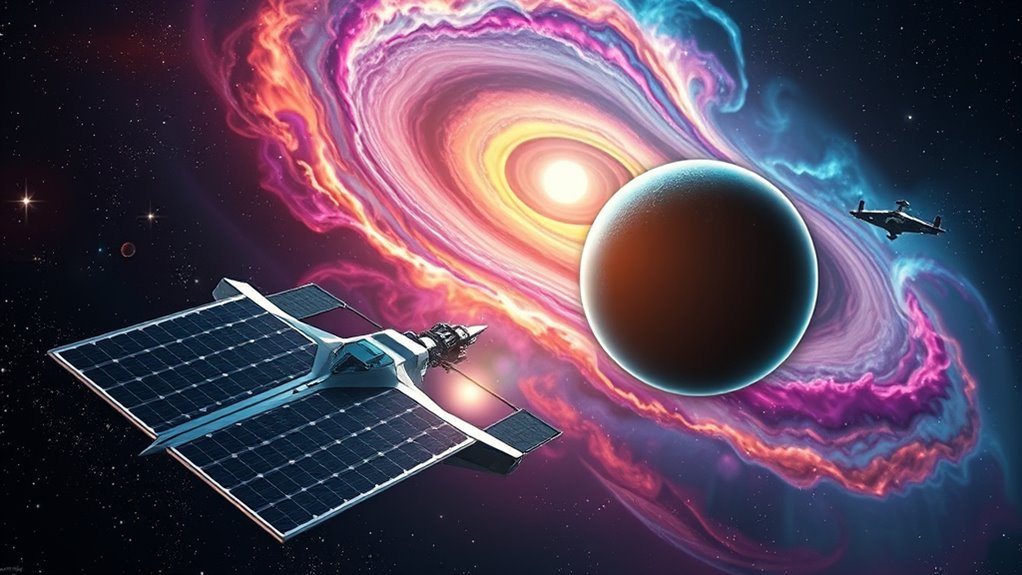

If you look beyond Mars, space exploration shifts toward missions to explore distant star systems and develop technology for interstellar travel. Researchers are working on advanced propulsion methods, sustainable resource storage, and autonomous systems for long journeys. Space mining on asteroids and moons supports future colonies and reduces dependence on Earth’s limited resources. As these efforts progress, humanity moves closer to establishing a presence among the stars. Continue exploring to learn how these ambitious ventures are shaping our future in space.
Key Takeaways
- Future missions aim to explore distant star systems and exoplanets beyond our solar system.
- Propulsion breakthroughs like faster-than-light travel are essential for interstellar missions.
- Space agencies plan robotic and crewed missions to moons and asteroids for resource extraction.
- Space mining supports long-term exploration by providing critical materials for missions beyond Mars.
- International collaboration and technological innovation drive the development of missions beyond Mars and the solar system.
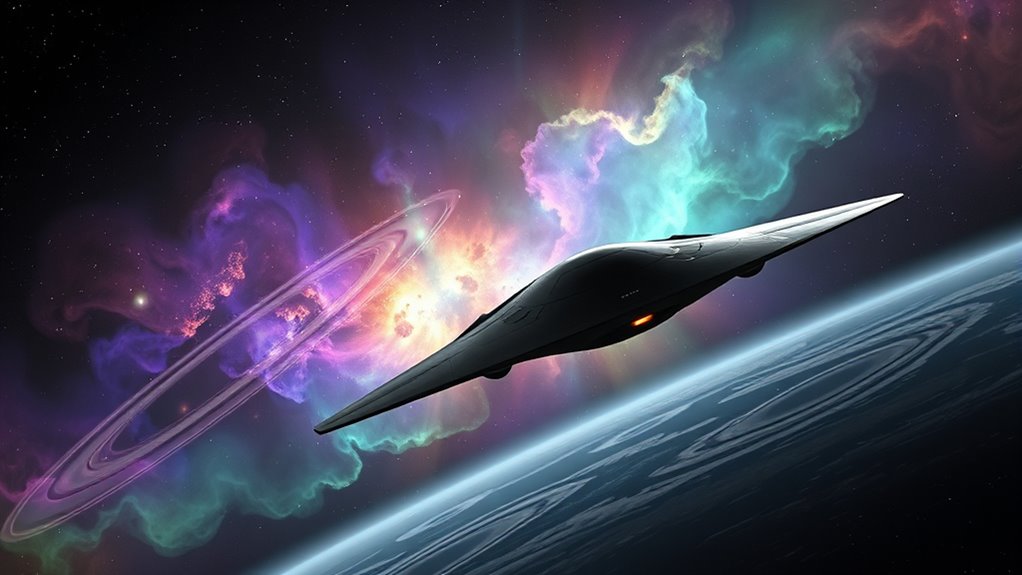
Have you ever wondered what lies beyond our planet? The vast universe beckons, filled with mysteries waiting to be uncovered. As technologies advance, the concept of interstellar travel becomes less like science fiction and more like a future reality. Instead of limiting your sights to Mars, you start to imagine journeys stretching beyond our solar system. Interstellar travel could allow you to explore distant star systems, encounter new planets, and potentially find habitats suitable for human life. This ambitious endeavor pushes the boundaries of current propulsion systems, requiring breakthroughs in faster-than-light travel or generation ships that can sustain life over centuries. The idea of reaching other star systems fuels scientific curiosity and inspires international collaborations. Proper storage and handling of resources, like fuel and supplies, will be critical for the success of these long-duration missions.
Alongside these distant journeys, space mining emerges as a practical step in expanding human presence beyond Earth. You might think of asteroids and moons as treasure troves of resources—precious metals, rare minerals, and water ice—that could support future colonies or fuel deep space missions. Space mining offers an alternative to depleting Earth’s finite resources; it could supply materials directly from space, reducing environmental strain on our home planet. Advanced robotic miners and autonomous spacecraft are already being developed to identify and extract valuable commodities from celestial bodies. This not only bolsters the economy of space exploration but also provides essential materials for sustaining long-term missions. Imagine setting up mining operations on asteroids, turning space into a resource-rich frontier, all while you watch from Earth or travel through the cosmos on your own interstellar vessel.
As you look toward these horizons, you realize that interstellar travel and space mining are interconnected pursuits. They represent humanity’s desire to push beyond existing limits, seeking new worlds and resources to ensure our survival and growth. These missions demand innovative engineering, international cooperation, and a relentless spirit of discovery. While challenges remain, each step forward brings you closer to a future where humanity might not just visit other planets but establish a presence among the stars. The universe’s vastness doesn’t seem as intimidating anymore; instead, it becomes an open invitation for exploration, adventure, and the expansion of human civilization. If you stay curious and committed, you’ll witness the dawn of a new era where space exploration transforms from distant dreams into tangible achievements, opening pathways to worlds beyond your imagination.
Frequently Asked Questions
What Are the Primary Technical Challenges of Deep Space Missions?
You face major technical challenges in deep space missions, like ensuring reliable power generation and effective radiation shielding. Power sources must last years, often relying on solar panels or nuclear options, which can be limited by distance from the Sun. Radiation shielding is critical to protect you from cosmic rays and solar radiation, requiring advanced materials and engineering solutions to keep you safe during long-duration journeys beyond Mars.
How Do Spacecraft Communicate Over Vast Interplanetary Distances?
Imagine trying to whisper across a canyon, knowing your message takes minutes to arrive. That’s what you face with spacecraft communication—radio signals travel at light speed, but data latency can be hours or even days. You send commands via radio signals, and spacecraft reply with data. This delay makes real-time control impossible, so you rely on pre-programmed instructions and autonomous systems to keep missions on track over vast interplanetary distances.
What Are the Funding Sources for Beyond-Mars Missions?
You’ll find that funding for beyond-Mars missions mainly comes from government grants and private investments. Governments, like NASA and international agencies, allocate budgets to support space exploration initiatives. Meanwhile, private companies and investors see the potential for commercial gains and technological advancements, contributing funding and resources. This combined effort helps push the boundaries of space exploration, making ambitious missions beyond Mars possible and sustainable.
How Do Astronauts Prepare for Long-Duration Space Journeys?
To prepare for long-duration space journeys, you focus on space habitat design and building psychological resilience. You undergo rigorous training, including simulations of confined environments, to adapt to limited space and resources. You learn techniques to manage stress and maintain mental health, ensuring you’re resilient during isolation. This combination helps you stay healthy physically and mentally, making you ready for the challenges of extended missions beyond Mars.
What Ethical Considerations Arise From Exploring Distant Celestial Bodies?
When exploring distant celestial bodies, you must consider ethical issues like planetary protection and the potential discovery of extraterrestrial life. You’re responsible for preventing biological contamination that could harm native ecosystems or compromise scientific integrity. Balancing the pursuit of knowledge with respect for alien environments means carefully planning missions to avoid unintended harm, ensuring that your actions preserve the purity of these worlds and uphold moral obligations to protect potential extraterrestrial life.
Conclusion
As you look beyond Mars, the universe holds secrets waiting to be uncovered. Each mission pushes the boundaries of what’s possible, opening doors to new worlds and discoveries. But as you stand on the brink of these incredible journeys, one question remains: what mysteries will we uncover next? The future of space exploration is uncertain, yet filled with promise. Are you ready to see what lies beyond the stars? The next chapter is about to begin.