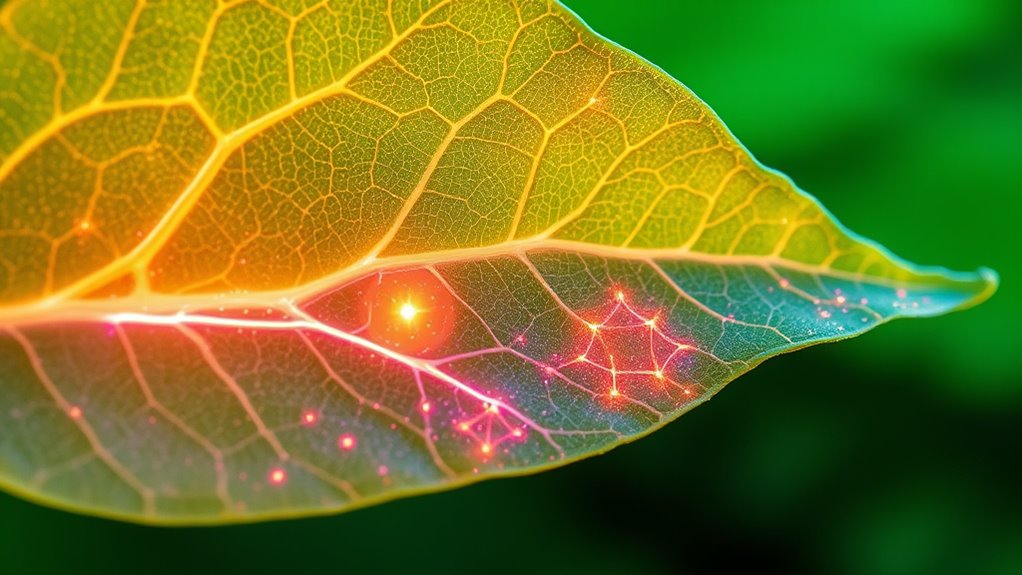

Quantum effects like superposition, tunneling, and coherence are essential in living systems. They enable efficient energy transfer in processes like photosynthesis and speed up biochemical reactions by allowing electrons to pass through barriers easily. Biological structures may even harness these quantum phenomena to operate more effectively, reducing energy loss. Recognizing how life uses quantum mechanics reveals a fascinating layer of complexity—keep exploring to uncover how these effects shape the very fabric of life.

Get the little things that make your day delivered free with Prime
- Fast, free delivery on millions of items
- Prime Video, Amazon Music and more included
- Member-only deals all year
Key Takeaways
- Quantum superposition enables efficient energy transfer in processes like photosynthesis by exploring multiple pathways simultaneously.
- Electron tunneling allows rapid, low-energy electron transfer across barriers in cellular respiration and enzymatic reactions.
- Biological structures may sustain quantum coherence, enhancing energy efficiency and reducing waste in cellular functions.
- Quantum effects such as superposition and tunneling are integral to biological processes, improving reaction speeds and energy utilization.
- Understanding quantum biology can inspire innovations in medicine, energy, and nanotechnology by leveraging natural quantum mechanisms.
Have you ever wondered how life’s most fundamental processes might be influenced by the strange rules of quantum physics? It might seem surprising, but many biological systems appear to harness quantum phenomena to function efficiently. One fascinating aspect is quantum superposition, where particles like electrons can exist in multiple states simultaneously until measured. In biological contexts, this allows for remarkable precision and efficiency. For example, in the process of photosynthesis, the energy captured by chlorophyll molecules isn’t simply transferred in a straightforward manner. Instead, quantum superposition enables excitons—quasi-particles carrying energy—to explore multiple pathways at once, finding the most efficient route to reaction centers. This quantum behavior helps plants and algae maximize energy transfer, even under variable conditions.
Another essential quantum effect is electron tunneling, which defies classical expectations. Normally, an electron needs enough energy to surmount a barrier, but in quantum mechanics, it can “tunnel” through obstacles that would otherwise be impenetrable. In biological systems, electron tunneling plays a critical role in processes like respiration and enzymatic reactions. When mitochondria generate energy, electrons move through a series of protein complexes, often tunneling across tiny gaps with astonishing speed and efficiency. This tunneling not only speeds up reactions but also reduces energy loss, making cellular respiration incredibly efficient. Without electron tunneling, many metabolic processes would be far less effective, limiting how organisms convert nutrients into usable energy.
Additionally, recent studies suggest that biological structures may have evolved to optimize quantum coherence, allowing quantum states to persist longer than expected in warm, wet environments. These quantum effects aren’t just theoretical curiosities; they’re integral to biological function. Quantum superposition ensures that energy transfer within cells is optimized, reducing waste and increasing speed. Electron tunneling allows critical reactions to occur rapidly and with minimal energy expenditure. Together, these phenomena suggest that life has evolved to exploit quantum mechanics in ways we’re only beginning to fully understand. As research advances, it’s becoming clear that living systems aren’t just classical machines but intricate quantum networks. Recognizing this opens exciting possibilities for innovations in medicine, renewable energy, and nanotechnology, inspired by nature’s quantum mastery. So, next time you think about biology, remember that at its core, life might be riding on the strange, counterintuitive rules of quantum physics, seamlessly integrating these effects to sustain life itself.
Frequently Asked Questions
How Does Quantum Biology Impact Medical Research?
Quantum biology impacts medical research by revealing how quantum coherence influences biological processes, leading to better understanding of disease mechanisms. You can explore how quantum effects enhance photosynthetic efficiency, inspiring new bioengineering strategies. This knowledge allows you to develop innovative treatments, improve drug delivery, and design advanced diagnostics. Recognizing quantum phenomena in living systems opens new avenues for personalized medicine, offering more precise and effective healthcare solutions rooted in the quantum nature of biology.
Can Quantum Effects Be Manipulated for Biological Advancements?
Imagine wielding a tiny quantum wand to tweak your cells—sounds like sci-fi, right? You can manipulate quantum effects through quantum control, opening doors for biological engineering. By fine-tuning these effects, you could enhance drug delivery or create smarter tissues. While it’s still early days, this approach holds promise for revolutionary biological advancements, turning futuristic fantasies into tangible cures and innovations.
What Are the Ethical Considerations of Quantum Biology Studies?
You should consider that ethical questions in quantum biology include concerns about genetic privacy, especially if findings lead to genetic modifications or data misuse. Additionally, you must think about ecological implications, such as unintended effects on ecosystems or species. As you explore this field, guarantee you prioritize responsible research, transparency, and respect for privacy and environmental integrity to prevent harm and promote trust in scientific advancements.
Are Quantum Effects Present in All Living Organisms?
You might think quantum effects are rare, but they’re actually everywhere in living organisms! Quantum coherence boosts photosynthetic efficiency, making plants incredibly effective at capturing sunlight. It’s not that all organisms rely equally on quantum phenomena, but many do utilize these effects subtly. From bacteria to humans, quantum mechanics influences life processes more than you’d imagine, revealing a hidden layer of complexity that’s essential to understanding biology’s true nature.
How Does Quantum Biology Influence Our Understanding of Consciousness?
Quantum biology influences your understanding of consciousness by introducing concepts like quantum cognition and consciousness modeling. You realize that quantum effects might explain how your brain processes information, leading to insights about perception, decision-making, and awareness. This perspective suggests that consciousness isn’t purely classical but could involve quantum phenomena, opening new research pathways and challenging traditional views about the mind’s nature.
Conclusion
You now see how quantum effects dance silently within living systems, much like the whispers of a hidden symphony. Just as Schrödinger’s cat hints at unseen worlds, these tiny quantum phenomena shape life’s very fabric, bridging the known and the mysterious. Embracing this connection, you realize that understanding quantum biology unlocks secrets woven into life’s tapestry—reminding us that, like the universe itself, life’s deepest mysteries often lie in the smallest, most overlooked details.
Halloween Picks
halloween
As an affiliate, we earn on qualifying purchases.