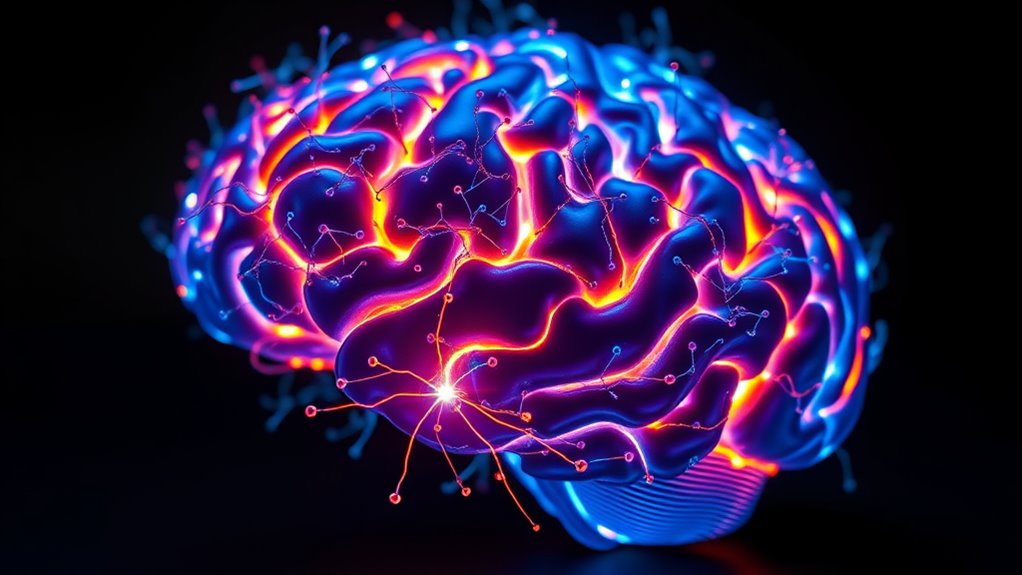

Neuroscience has advanced our understanding of mapping the human brain through powerful imaging techniques like MRI and PET scans. These tools let you see real-time neural activity and structural changes as you learn new skills or recover from injury. Your brain’s incredible plasticity means it constantly adapts, forming new connections. By exploring these developments further, you’ll discover how scientists use this knowledge to open the brain’s mysteries and potential for growth.
Key Takeaways
- Advanced brain imaging techniques like MRI and PET scans enable real-time visualization of neural activity and circuits.
- Mapping reveals how specific brain regions activate during thoughts, emotions, and skill learning processes.
- Structural changes in neural pathways are tracked as they adapt with practice and experience.
- Live brain mapping helps understand neural plasticity, aiding recovery and mental health interventions.
- Ongoing technological progress enhances understanding of the brain’s complex architecture and its capacity for change.
Have you ever wondered how your brain processes thoughts, emotions, and actions? The answer lies in the incredible adaptability of your neural networks, a phenomenon known as neural plasticity. This ability allows your brain to reorganize itself by forming new connections throughout your life, especially in response to learning or injury. Thanks to advances in brain imaging techniques, scientists can now observe these changes in real time, giving you a clearer picture of how your brain adapts and functions. These imaging methods, such as MRI and PET scans, reveal the intricate activity within different regions of your brain, showing which areas light up when you think, feel, or move. This insight helps you understand that your brain isn’t static; it’s a dynamic organ constantly reshaping itself based on your experiences.
Your brain’s plasticity reveals how it adapts and changes through real-time imaging of neural activity.
When you engage in new activities or learn new skills, your brain’s structure evolves through neural plasticity. For example, practicing a musical instrument can strengthen specific neural pathways, making you more proficient over time. Brain imaging techniques allow researchers to track these changes, highlighting how practice leads to physical alterations in brain regions responsible for fine motor control and auditory processing. These observations demonstrate the brain’s remarkable capacity for growth and adaptation, emphasizing that your mental and physical efforts directly influence your neural architecture. Additionally, the concept of brain plasticity underscores how resilient and adaptable your brain remains throughout your life.
Furthermore, brain imaging techniques have revolutionized neuroscience by providing a window into the living brain. Instead of relying solely on post-mortem studies, scientists can now visualize how different tasks activate distinct neural circuits in real time. This capability helps identify which parts of your brain are involved when you’re solving a problem, experiencing emotions, or recalling memories. Understanding these processes empowers you to harness your brain’s plasticity, whether for recovery after injury, enhancing learning, or managing mental health conditions.
In essence, neuroscience has made tremendous strides in mapping the human brain, revealing not only its complex structure but also its incredible ability to change. Your brain’s plasticity means that every thought, action, and emotion leaves a mark, shaping your neural pathways over time. The ongoing development of brain imaging techniques continues to deepen this understanding, offering new hope for therapies and interventions that can modify brain function for the better. Recognizing your brain’s capacity for change encourages you to embrace lifelong learning and resilience, knowing that your neural landscape is always adaptable, always capable of growth.
Frequently Asked Questions
How Do Brain Maps Influence Mental Health Treatments?
Brain maps help you understand how different regions influence cognitive enhancement and emotional regulation. By pinpointing specific areas linked to mental health issues, treatments become more targeted and effective. You can benefit from personalized therapies, such as brain stimulation or behavioral strategies, that focus on those critical zones. This precise approach improves outcomes, reduces side effects, and supports better mental health management tailored to your brain’s unique structure.
Can Brain Mapping Predict Future Neurological Diseases?
Imagine peering into a detailed city map of your brain’s intricate streets and neighborhoods. With advances in predictive diagnostics, brain mapping can sometimes foresee disease progression and hint at future neurological diseases. You might not get a crystal ball, but these maps help identify early warning signs, giving you and your healthcare team a chance to intervene sooner, potentially altering the course of the disease before symptoms fully emerge.
What Ethical Issues Arise From Brain Mapping Technologies?
You might face ethical issues like privacy concerns, as brain mapping reveals deeply personal information about your thoughts and mental health. Consent challenges also arise, since understanding and agreeing to how your brain data is used can be complex. You need to make certain you’re fully informed and comfortable with the process, but the technology’s intricacies can make obtaining genuine consent difficult. These concerns highlight the importance of strict safeguards and transparent practices.
How Does Neuroplasticity Affect Brain Mapping Accuracy?
Think of your brain as a flexible city’s map, constantly updating with new routes and landmarks. Neuroplasticity enhances brain flexibility, making it harder for precise mapping because the brain adapts and rewires itself over time. This requires adaptive modeling in brain mapping techniques, which must account for ongoing changes. As you learn or recover, your brain’s dynamic nature challenges static maps, emphasizing the importance of continuous, flexible approaches to accurately capture its evolving landscape.
Are There Limits to Understanding Consciousness Through Brain Mapping?
You might find there are limits to understanding consciousness through brain mapping because it raises philosophical implications about subjective experience. While mapping reveals neural correlates, it often can’t fully capture individual awareness or inner sensations. This means you can’t entirely decode consciousness, as the essence of personal experience remains elusive. Brain maps are valuable, but they fall short of revealing the complete, nuanced nature of what it feels like to be conscious.
Conclusion
You now see how neuroscience navigates the nuanced neural networks of the human mind. By mapping the myriad memories, movements, and motivations, you witness the wonder of our wiring. This journey through the jagged junctions of neurons highlights the harmony and havoc within. Keep curious, and continue to explore this enthralling cosmos of cognition, where discovery deepens your understanding and dazzles your desire to decipher the dynamic dance of brains.