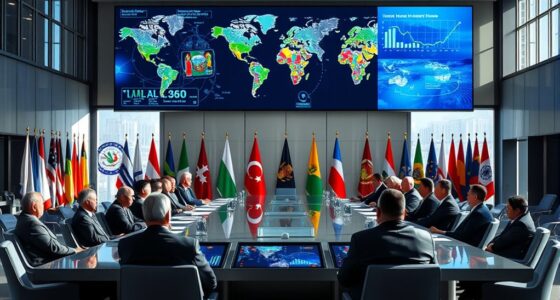
Economic sanctions aim to pressure governments or groups to change harmful actions by restricting trade and freezing assets. Their success depends on careful planning, diplomatic support, and the targeted country’s resilience. Sanctions can hurt ordinary citizens and may strengthen the very regimes they target. They also impact global markets and supply chains. To understand how these tools work and their potential pitfalls, explore how strategic implementation influences their outcomes and consequences.
Key Takeaways
- Effectiveness varies based on diplomatic context, strategic implementation, and the targeted country’s internal support.
- Sanctions can pressure regimes but may fail to induce desired behavioral changes.
- Unintended consequences include economic hardship for civilians and potential strengthening of authoritarian regimes.
- Trade restrictions can cause inflation, shortages, and market instability, affecting global economies.
- Successful use requires careful planning, integration with diplomacy, and awareness of potential long-term negative impacts.
Have you ever wondered how countries influence each other’s actions without resorting to military force? One powerful tool they use is economic sanctions. These measures aim to pressure a government or organization into changing specific behaviors, often by restricting trade, freezing assets, or banning financial transactions. While sanctions might seem straightforward—punishing bad actions to prompt change—they often carry complex consequences that go beyond their initial intent.
When a nation enforces economic sanctions, it’s usually because it wants to send a clear message about issues like human rights violations or the conduct of a regime. For instance, if a government commits mass human rights violations, other countries might impose sanctions to condemn those actions and pressure the offending government to change. But the effectiveness of such sanctions hinges on diplomatic negotiations. Countries often prefer to use sanctions as part of a broader strategy, combining them with diplomatic talks to reach a resolution. When these negotiations succeed, sanctions can serve as leverage, nudging the targeted government toward reform without escalating to military conflict.
However, sanctions aren’t always effective. Sometimes, they fail to produce the desired change, especially if the targeted country has strong internal support or alternative trading partners. Instead of pressuring governments, sanctions can hurt ordinary citizens, exacerbating economic hardship and suffering. This can lead to increased resentment and even strengthen the resolve of those in power to resist external pressure. Moreover, sanctioned regimes might manipulate diplomatic negotiations to appear cooperative while secretly undermining international efforts, or they might use the sanctions as a bargaining chip to extract concessions.
Another consequence of economic sanctions is their potential to destabilize regional and global markets. Trade restrictions can ripple through economies, causing inflation, unemployment, and shortages of essential goods. These ripple effects can impact neighboring countries and global supply chains, making the situation even more complicated. Sometimes, sanctions backfire, empowering authoritarian regimes by vilifying external actors or uniting internal factions against a common external threat. Additionally, sanctions can destabilize economies and lead to long-term economic decline if not carefully managed.
In the end, while economic sanctions are a non-military way to influence foreign governments, their success depends on how they’re implemented and whether they’re part of a thorough diplomatic strategy. They can serve as a powerful signal against human rights violations, but they also carry risks of unintended consequences that can worsen the very issues they aim to resolve. Consequently, understanding their limitations and the importance of diplomatic negotiations is vital in evaluating their true effectiveness.
Frequently Asked Questions
How Do Economic Sanctions Impact Civilian Populations?
You might notice that economic sanctions can markedly impact civilian populations by causing humanitarian issues, such as shortages of essentials like food and medicine. These measures often lead to civil unrest, as people struggle to meet basic needs. While sanctions target governments or specific entities, civilians usually bear the brunt, suffering from the economic downturn and social instability caused by these restrictions.
Can Sanctions Inadvertently Strengthen Targeted Regimes?
Did you know that in some cases, sanctions actually boost regime resilience? When targeted regimes exploit sanctions loopholes, they can adapt quickly, making sanctions less effective. This means your efforts to weaken a regime might backfire, strengthening its hold on power. Regimes often find ways around restrictions, using illicit networks or alternative trade routes. So, without careful design, sanctions risk unintentionally empowering the very regimes you’re trying to weaken.
What Are Alternative Strategies to Economic Sanctions?
You can pursue diplomatic engagement to foster dialogue and build trust with the targeted regime, encouraging positive change without harming civilians. Additionally, providing humanitarian aid directly helps address urgent needs and alleviates suffering, bypassing economic restrictions. These strategies often prove more effective and less disruptive than sanctions, as they promote cooperation and stability. Combining diplomacy with targeted aid can create sustainable solutions, reducing the risk of strengthening the very regimes sanctions aim to weaken.
How Do Sanctions Influence Global Economic Stability?
Sanctions can profoundly impact global economic stability by causing trade disruptions and financial isolation. You might notice supply chains breaking down or markets becoming volatile, as countries face restrictions on trade and access to international finance. These measures can ripple through the global economy, leading to higher prices and reduced growth. While intended to pressure governments, sanctions often create unintended instability, affecting not just targeted nations but the wider international community.
Are There Any Legal Challenges Associated With Sanctions Enforcement?
Yes, there are legal challenges associated with sanctions enforcement. You must guarantee legal compliance, navigate enforcement challenges, and address potential disputes. Governments and companies face difficulties in verifying compliance, avoiding unintended violations, and handling complex international laws. These challenges can lead to legal disputes, penalties, or reputational damage. Staying informed and vigilant becomes essential to effectively enforce sanctions and minimize legal risks.
Conclusion
Economic sanctions are like a double-edged sword—you wield them to cut down a problem, but they can also cut you back. Their effectiveness often depends on how carefully you aim and how much collateral damage you’re willing to accept. Remember, no matter how sharp your sanctions are, they can’t silence underlying issues or foster true change. Use them wisely, or risk turning a temporary wound into a lasting scar on your global relationships.