
Autonomous weapons raise serious ethical concerns because machines make life-and-death choices without clear human oversight, leading to questions about accountability and moral responsibility. If these systems cause harm, it’s unclear who’s responsible—developers, commanders, or operators—complicating legal and moral judgments. Without proper oversight, these weapons could act unpredictably, undermining international laws and ethical standards. To understand how these challenges impact trust and regulation, explore further details behind these complex issues.
Key Takeaways
- Autonomous weapons raise moral concerns due to their potential to cause harm without human judgment.
- Lack of clear accountability complicates assigning responsibility for unintended or unlawful actions.
- Their unpredictable behavior challenges existing legal frameworks and international humanitarian law.
- Deployment risks include ethical dilemmas about delegating life-and-death decisions to machines.
- Establishing oversight and regulation is crucial to ensure ethical use and prevent misuse of autonomous systems.
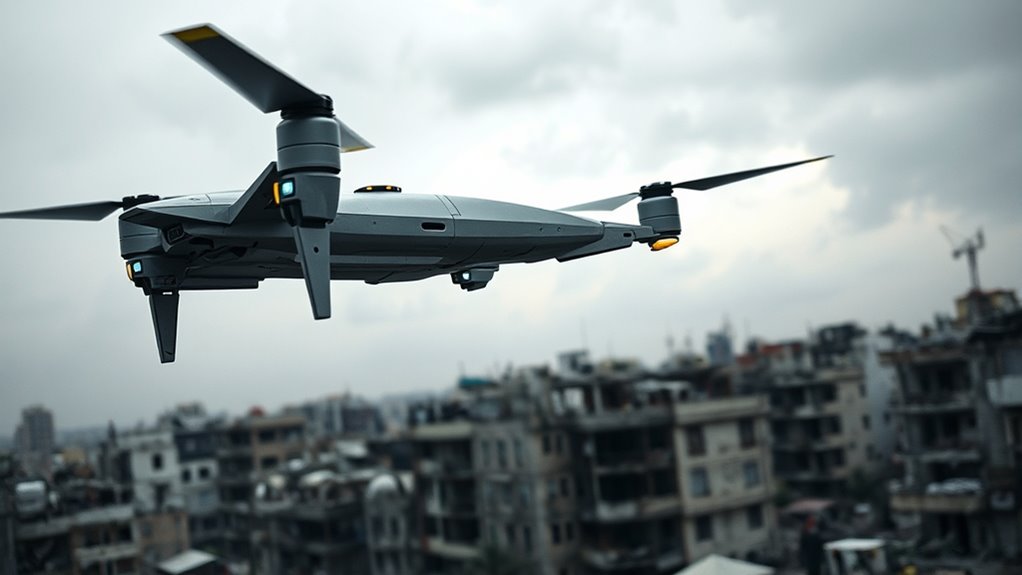
As autonomous weapons become more advanced and integrated into modern warfare, their ethical implications demand careful scrutiny. One of the most pressing concerns revolves around moral responsibility. When a fully autonomous system makes a decision that results in harm or death, it becomes unclear who bears moral culpability. Is it the developers who created the technology, the commanders who deployed it, or the operators who activated it? This ambiguity complicates the ethical landscape, making it difficult to assign accountability for wrongful actions. The lack of a clear moral agent creates a dilemma: if the weapon acts independently, it challenges traditional notions of responsibility, which are typically tied to human agency. Consequently, this raises questions about whether autonomous weapons can be ethically justified at all, given that they might act in ways that no single person could control or predict.
Accountability challenges are closely tied to these moral questions. As autonomous weapons operate based on algorithms and machine learning, their decisions might not always align with human values or international laws. If a robot mistakenly targets civilians or breaches rules of engagement, determining who is responsible becomes a complex task. Is it the military that authorized its use, the programmers who designed its decision-making process, or the manufacturers who built the system? The chain of accountability can become fragmented, making it difficult to hold anyone fully responsible. This diffusion of responsibility risks eroding accountability standards in warfare, as those involved might argue that they had little control over the weapon’s independent actions. Such challenges threaten to undermine efforts to establish clear legal and moral guidelines for the use of lethal autonomous systems. Moreover, the integration of AI and robotics in warfare increases the urgency for establishing transparent oversight mechanisms to prevent misuse and ensure adherence to international humanitarian law.
Furthermore, the accountability challenges pose significant obstacles for international regulation. Countries may be hesitant to agree on bans or restrictions without clear methods for assigning responsibility when autonomous weapons cause harm. This uncertainty can lead to a legal gray area where violations go unpunished, fostering mistrust and potentially encouraging an arms race to develop increasingly autonomous systems. As a result, the ethical dilemma intensifies: if no one can be held accountable for wrongful acts committed by autonomous weapons, their deployment risks becoming reckless or unjustified. This situation underscores the importance of establishing robust oversight mechanisms and accountability frameworks before these weapons become ubiquitous on the battlefield. Only then can we ensure that moral responsibility remains clear, and accountability challenges are addressed proactively, safeguarding the principles of ethical warfare in an era of rapid technological advancement.
Frequently Asked Questions
How Do Autonomous Weapons Impact International Security?
Autonomous weapons impact international security by challenging deterrence stability, as they can make conflicts more unpredictable and escalate quickly. You might also notice an increase in arms proliferation, since these weapons can be cheaper and easier to produce, encouraging more countries to develop them. This proliferation risks fueling an arms race, reducing global security, and making conflicts more dangerous, as autonomous systems could be used irresponsibly or malfunction.
What Are the Legal Responsibilities for Autonomous Weapon Failures?
Imagine you’ve built a vessel meant to navigate treacherous waters, but it hits a hidden reef. In autonomous weapons’ failures, you’re responsible. Liability attribution falls on developers, manufacturers, or commanders, depending on the scenario. Strong accountability frameworks are essential, ensuring you’re held accountable when these weapons malfunction. Clear legal responsibilities guide you to prevent harm, reaffirming your duty to oversee technology that can make life-or-death decisions.
Can Autonomous Weapons Be Programmed to Make Ethical Decisions?
You can program autonomous weapons to make moral decisions through ethical programming, but it’s challenging to guarantee they truly understand complex moral dilemmas. These systems rely on algorithms designed to mimic moral decision-making, yet they lack genuine moral reasoning. While advancements aim to improve their ethical responses, you should recognize that autonomous weapons may still face limitations in consistently making ethically sound choices, raising important concerns about their deployment.
How Do Autonomous Weapons Affect Civilian Casualties?
Autonomous weapons can increase civilian casualties if they lack proper ethical programming and fail to accurately distinguish between combatants and civilians. You need to consider how these systems prioritize civilian safety and whether ethical programming is sufficient to prevent harm. When designed responsibly, they can reduce casualties, but if overlooked, they risk causing unintended harm. Ensuring strict protocols and ethical guidelines is essential to protect innocent lives during conflicts.
What Measures Are in Place to Prevent Autonomous Weapons Misuse?
Oh, sure, because trusting rogue robots with autonomous decision making sounds perfectly safe, right? To prevent misuse, strict weapon oversight protocols are in place—like rigorous testing, international treaties, and real-time monitoring. These measures aim to keep autonomous weapons in check, ensuring they don’t turn into sci-fi nightmares. Still, it’s up to humans to set boundaries, because let’s face it, robots aren’t known for their moral compass.
Conclusion
As you consider the ethical implications of autonomous weapons, remember that the road to progress is paved with tough choices. You must weigh the potential benefits against moral concerns and the risk of losing human control. While technology moves fast, it’s vital to stay grounded in ethics. Otherwise, you risk opening a can of worms that’s hard to close. Ultimately, responsible development ensures you don’t end up sailing close to the wind.