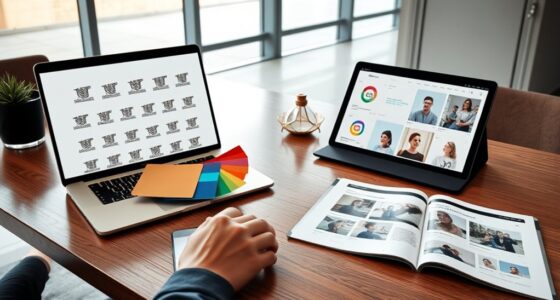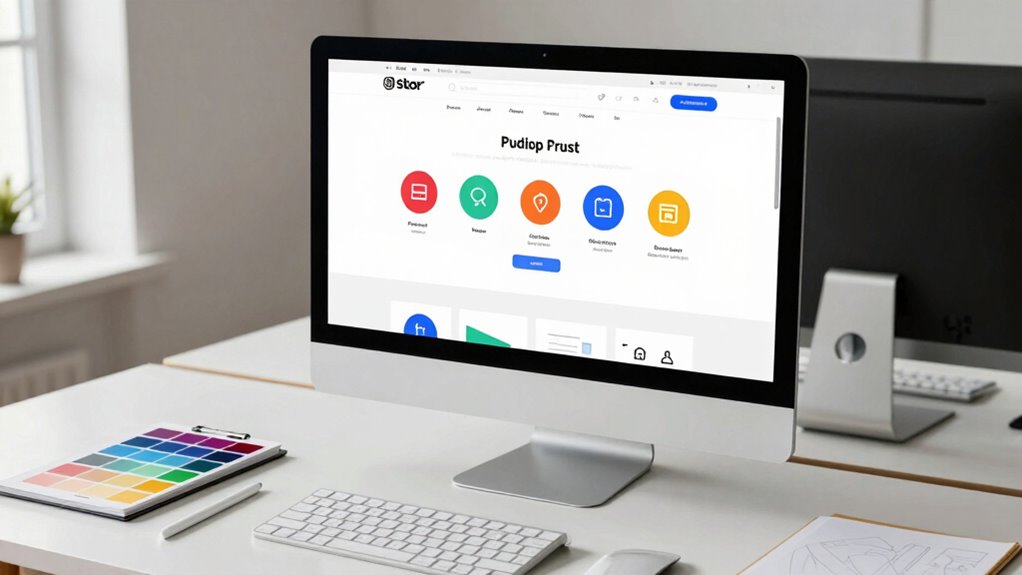
Good design guides your attention by highlighting important content through size, placement, and contrast, making you trust information more easily. It uses color psychology to evoke emotions—blue builds trust, while red signals urgency—shaping your perception. Visual cues like icons and images reinforce credibility, creating a trustworthy message. A clean, organized layout feels professional and honest, encouraging your acceptance of the information. Keep exploring to discover how design continues to influence your confidence in what you see.
Key Takeaways
- Effective visual hierarchy guides attention and emphasizes important information, enhancing clarity and trustworthiness.
- Strategic use of colors influences emotional responses, reinforcing reliability or urgency depending on the context.
- Icons and imagery support message credibility and create an emotional connection with the audience.
- Consistent and organized layout fosters professionalism, reducing skepticism and increasing confidence in the information.
- Clear and logical presentation design subconsciously influences perceived legitimacy and trustworthiness.

In today’s digital landscape, design plays a vital role in shaping how we perceive and trust information. When you browse a website or scroll through a news feed, your eyes are naturally drawn to certain elements first. This is where visual hierarchy comes into play. Good design guides your attention, emphasizing the most important information through size, placement, contrast, and spacing. If headlines are bold and positioned at the top, it signals to you that these are key points. Subtle differences in font weight or color help you distinguish between primary and secondary details, preventing confusion and making the content easier to digest. When visual hierarchy is clear, you’re more likely to trust the source because the layout appears organized and professional. It creates a sense of authority and credibility, reassuring you that the information is reliable.
Color psychology also heavily influences how you judge the trustworthiness of information. Colors evoke emotional responses; for example, blue often communicates stability and trust, while red can signal urgency or caution. When you see a website that uses calming blues and neutral tones, you subconsciously associate it with reliability. Conversely, overly bright or clashing colors might make you suspicious about the content’s authenticity. Designers leverage color psychology to craft a visual language that fosters confidence. They strategically use colors to highlight important calls to action, emphasize key points, or create a mood that aligns with the message’s intent. This emotional connection can influence your perception of accuracy and honesty, making you more receptive to the information presented. Additionally, visual cues such as icons and imagery can reinforce the message and further enhance trustworthiness. The careful combination of these elements helps establish an overall sense of credibility that influences how you interpret the information.
Furthermore, design isn’t just about aesthetics—it’s about creating an intuitive experience that builds trust. When elements like consistent color schemes, clear visual hierarchy, and thoughtful layout are present, you feel more confident navigating the content. You’re less likely to question its legitimacy because the design signals professionalism and care. In addition, content organization helps ensure that information is presented logically and systematically, which further enhances trustworthiness. Poorly designed pages with cluttered layouts, inconsistent colors, or confusing hierarchy often trigger skepticism. Your brain subconsciously picks up on these cues, affecting your trust level. Effective design acts as a visual handshake, establishing credibility and encouraging you to accept the information as valid. It’s not just what’s written but how it’s presented that shapes your trust in the digital age.

MARKETING AI: THE STRATEGIC GUIDE: Data, Tools, and Practical Strategies to Increase Customers and Turnover with AI
As an affiliate, we earn on qualifying purchases.
As an affiliate, we earn on qualifying purchases.
Frequently Asked Questions
How Does Color Influence Trust in Digital Interfaces?
Color influences trust in digital interfaces through color psychology and visual cues. When you see blue, for example, it often signals reliability and professionalism, making you more likely to trust the site. Red can evoke urgency or excitement, while green suggests safety and growth. Designers use these cues intentionally to guide your perception, reinforcing trust through carefully chosen colors that align with the message or brand, shaping your overall experience.
Can Minimalism in Design Enhance Perceived Credibility?
Minimalism in design can boost perceived credibility by emphasizing visual simplicity and aesthetic clarity. For example, a financial website with clean lines, ample white space, and straightforward navigation appears more trustworthy and professional. When you focus on reducing clutter, users find it easier to process information and feel confident in your content. This approach signals transparency and reliability, making your audience more likely to trust your message.
What Role Does Typography Play in Trustworthiness?
Typography plays a vital role in trustworthiness by influencing how your audience perceives your message. You can harness font psychology to select fonts that evoke professionalism and reliability. Focus on readability factors like clear letterforms, appropriate spacing, and size, ensuring your content is easy to read. When your typography is well-chosen and accessible, it reinforces credibility, making your information feel more trustworthy and encouraging your audience to engage confidently.
How Does User Experience Impact Trust Development?
User experience is like a bridge that connects you to trust; when it’s seamless and intuitive, you feel more confident in the information presented. By fostering user engagement through clear navigation and appealing design, it encourages ongoing interaction. This creates an emotional connection, making you more likely to trust the source. When users feel valued and understood through good design, trust naturally develops and strengthens over time.
Are There Cultural Differences in Design and Trust Perception?
Yes, there are cultural differences in how design influences trust perception. You’ll notice that cross-cultural visuals and symbolism vary widely, affecting trust levels. In some cultures, certain colors or symbols evoke positive feelings, boosting trust, while in others, they might seem irrelevant or even suspicious. Understanding these nuances helps you craft designs that resonate globally, fostering trust by aligning visual cues with cultural expectations and symbolic meanings.

Color Psychology: A Guide to Choosing the Right Colors in Design Concepts
As an affiliate, we earn on qualifying purchases.
As an affiliate, we earn on qualifying purchases.
Conclusion
Just as the shining beacon guides ships safely through treacherous waters, good design illuminates truth and fosters trust. When you craft information pages with clarity and purpose, you become a lighthouse in a stormy sea of misinformation. Remember, your design isn’t just aesthetic—it’s a silent guardian, shaping perceptions and anchoring trust. Like a trusted friend, your work can lead others safely home, proving that how you present information truly shapes how it’s believed.

Visual Usability: Principles and Practices for Designing Digital Applications
As an affiliate, we earn on qualifying purchases.
As an affiliate, we earn on qualifying purchases.
![CorelDRAW Graphics Suite 2026 | Education Edition | Graphic Design Software for Professionals | Vector Illustration, Layout, and Image Editing [PC/Mac Download]](https://m.media-amazon.com/images/I/41SFHdVMXcL._SL500_.jpg)
CorelDRAW Graphics Suite 2026 | Education Edition | Graphic Design Software for Professionals | Vector Illustration, Layout, and Image Editing [PC/Mac Download]
What’s new: Text-to-image and content-to-image AI generation, AI image remix with Nano Banana, AI background removal and masking…
As an affiliate, we earn on qualifying purchases.
As an affiliate, we earn on qualifying purchases.