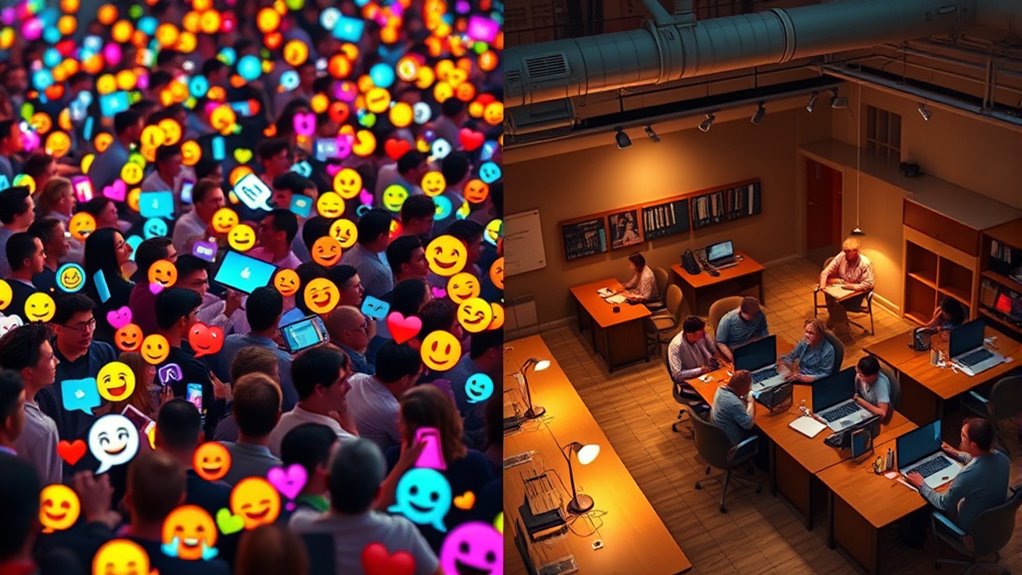

If you want quick exposure and broad reach, social media platforms like Facebook, Instagram, and Twitter are your best bet, offering instant virality and access to large audiences. However, if you seek deeper engagement and full control over your community and content, dedicated platforms provide a more secure environment, though they require more effort to grow. To discover which option suits your goals and how to make the most of each, continue exploring the key differences.
Key Takeaways
- Social media offers rapid, widespread exposure with large audiences, while dedicated platforms foster more engaged and community-focused interactions.
- Content on social media is subject to platform rights and policies, whereas dedicated platforms typically allow full ownership and control.
- Social media collects extensive user data for targeted advertising, posing privacy risks, whereas dedicated platforms often provide better privacy safeguards.
- Social media’s algorithms influence content visibility, limiting control, while dedicated platforms enable consistent, customizable content sharing.
- Social media provides immediate growth opportunities but can lead to dependence on algorithms; dedicated platforms require more effort but support targeted, long-term community building.

In today’s digital landscape, deciding between social media and dedicated platforms can substantially impact how you connect, share, and grow your online presence. When choosing where to build your community, it’s essential to consider the advantages and limitations of each option. Social media platforms like Facebook, Instagram, and Twitter offer vast audiences and ease of access, but they also come with concerns about content ownership and privacy. On these platforms, the terms of service often mean that your posts, images, and videos are subject to the platform’s rules and rights. You might think you own your content, but in reality, social media companies typically retain rights to use, modify, or distribute your content as they see fit. This lack of control can be unsettling, especially if you’re concerned about how your content might be shared or repurposed without your permission. Privacy concerns also loom large, as social media platforms collect extensive data about your habits, preferences, and interactions. This data is used to target advertisements and improve user experience, but it can also lead to issues like data breaches or misuse of personal information.
Dedicated platforms, on the other hand, often give you more control over your content and community. When you create a website, forum, or membership site, you generally retain full ownership of your content and data. You decide what’s shared, how it’s used, and who can access it. This level of control can be invaluable if you prioritize privacy or want to establish a brand with a clear identity. Without the need to conform to social media’s algorithms or policies, you can focus on creating a consistent, high-quality experience for your community. Additionally, dedicated platforms typically offer better privacy safeguards because they’re built around your specific needs rather than mass-market features. You can implement stricter data protections, control user access, and customize privacy settings to ensure your community’s safety.
However, dedicated platforms often require more effort to set up and maintain. They might lack the instant reach and virality of social media, making growth slower initially. You need to actively drive traffic, engage members, and manage technical aspects yourself or through a team. Still, if your goal is to foster a tight-knit, engaged community with full control over your content and privacy, dedicated platforms can be more effective in the long run. Ultimately, your choice depends on your priorities: whether you value broad exposure and convenience or control and security. Understanding these distinctions helps you make a strategic decision that aligns with your goals and values in the digital space.
social media content ownership tools
As an affiliate, we earn on qualifying purchases.
As an affiliate, we earn on qualifying purchases.
Frequently Asked Questions
How Do Community Engagement Levels Compare Across Platforms?
You’ll find that engagement levels vary widely across platforms. On social media, engagement consistency can be volatile, with interactions often driven by trending topics or algorithms. Dedicated platforms typically foster higher interaction quality and sustained engagement, as members share common interests. You’ll notice that communities on niche platforms tend to build stronger bonds, leading to more meaningful participation, whereas social media may promote more superficial interactions.
What Are the Costs Associated With Using Dedicated Platforms?
You’ll typically face platform subscription fees and customization expenses when using dedicated platforms. Subscription fees vary based on features and user capacity, while customization costs depend on how much you want to tailor the platform to your community’s needs. These costs can add up, but they often provide better control, security, and engagement features, making them a worthwhile investment for fostering a thriving community.
How Secure Is User Data on Social Media Versus Dedicated Platforms?
You might find that data privacy on social media isn’t as strong as on dedicated platforms, which often prioritize user anonymity and secure data handling. Social media companies can access and share your information more freely, increasing privacy risks. Dedicated platforms usually implement stricter security measures, protecting your data better. So, if privacy and user anonymity matter to you, dedicated platforms tend to offer a safer environment for your personal information.
Can Communities Grow Faster on Social Media or Dedicated Platforms?
You’ll find communities grow faster on social media because of broader reach and higher influence metrics, which boost visibility. Social platforms often offer limited platform customization, making it easier to attract followers quickly. However, dedicated platforms allow you to tailor features to your community’s needs, fostering deeper engagement over time. If rapid growth is your goal, social media typically provides a quicker pathway, but dedicated platforms support sustainable, engaged communities.
What Are the Long-Term Benefits of Choosing One Over the Other?
Choosing a dedicated platform offers you a garden where your community can flourish with customized growth, fostering stronger bonds. You’ll enjoy branding consistency that acts like a sturdy backbone, supporting your long-term vision. This stability helps build trust and loyalty, making your community resilient against the shifting tides of social media algorithms. Over time, these benefits create a solid foundation, ensuring your community thrives sustainably and authentically.
dedicated community platform software
As an affiliate, we earn on qualifying purchases.
As an affiliate, we earn on qualifying purchases.
Conclusion
As you consider where to build your community, remember that 70% of users feel more engaged on dedicated platforms, where conversations stay focused and meaningful. Unlike social media, these spaces foster deeper connections and shared interests. So, if you want your community to thrive and grow stronger, choosing a dedicated platform could be the game-changer. It’s where genuine bonds form, and your community truly comes to life.
privacy-focused website builder
As an affiliate, we earn on qualifying purchases.
As an affiliate, we earn on qualifying purchases.
community management platform
As an affiliate, we earn on qualifying purchases.
As an affiliate, we earn on qualifying purchases.