The history of money shows how you’ve moved from simple barter systems, where goods were swapped directly, to using mediums like shells and coins for easier trade. Over time, paper money and digital forms emerged, making transactions faster and more convenient. Today, cryptocurrencies operate on secure, decentralized networks, representing the latest evolution in financial exchange. If you want to discover how these changes impacted economies, there’s more to explore beyond this overview.
Key Takeaways
- Money evolved from barter systems to standardized mediums like shells, salt, and livestock to overcome exchange limitations.
- Metal coins and paper currency introduced durability, portability, and facilitated larger transactions globally.
- Digital money, including bank deposits and electronic payments, revolutionized speed and convenience in transactions.
- Cryptocurrencies utilize blockchain technology, offering decentralized, transparent, and secure digital assets beyond traditional currencies.
- Future financial systems focus on digital innovations that enable instant, global, and fractional transactions, transforming economies worldwide.
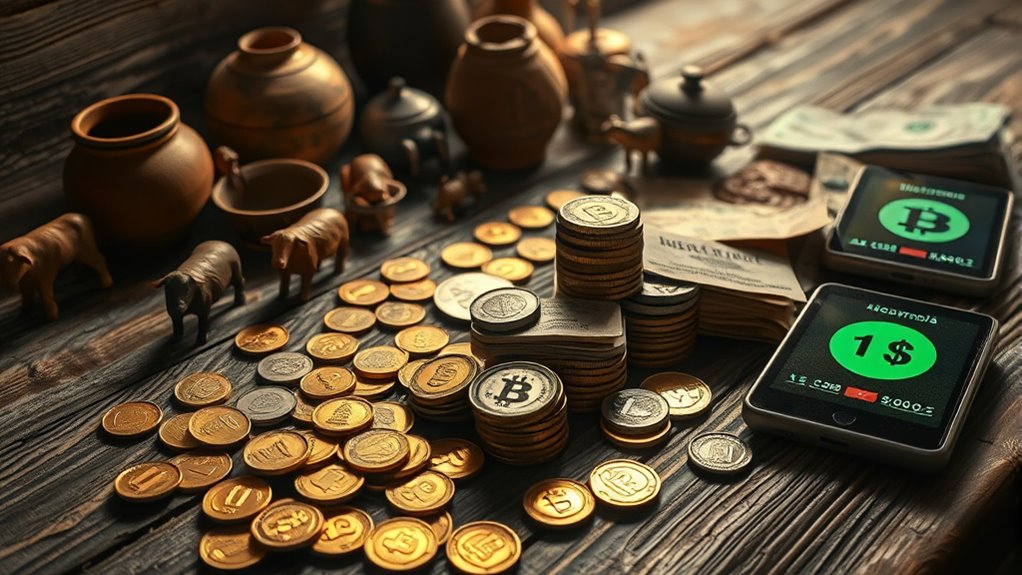
Money has played a crucial role in shaping human civilization, evolving from simple barter systems to complex financial instruments. In the earliest days, you relied on the barter system, where goods and services were exchanged directly. While effective for small communities, this method had limitations—double coincidence of wants and lack of divisibility often made transactions cumbersome. To overcome these challenges, societies began to adopt more standardized mediums of exchange, like shells, salt, or livestock, which served as early forms of money. Over time, these evolved into metal coins, which provided durability, portability, and a universally accepted value. These coins laid the foundation for more sophisticated monetary systems, facilitating trade over larger distances and among diverse groups.
As economies grew more complex, paper money appeared, initially backed by physical commodities like gold or silver in the form of the gold standard. This shift allowed for easier transportation and larger transactions. However, with the advent of banking and finance, the focus shifted from tangible coins and notes to digital representations of money. Today, you can carry out transactions without any physical cash at all, thanks to digital currencies. These digital currencies—such as bank deposits, electronic transfers, and online payment systems—have revolutionized how you manage and move money. They offer speed, convenience, and security, enabling instant payments across borders and reducing reliance on physical cash.
In recent years, digital currencies have taken a step further with the emergence of cryptocurrencies. Unlike traditional money, cryptocurrencies operate on decentralized networks using blockchain technology, offering transparency and security. You can now buy, sell, and hold digital currencies like Bitcoin or Ethereum, which aren’t controlled by any government or central bank. This evolution represents a significant leap from the barter system, which was based purely on physical exchange, to a digital environment where transactions happen seamlessly across the globe.
While the barter system was limited by physical constraints and the need for immediate mutual agreement, digital currencies eliminate many of those barriers. They allow for fractional transactions, quick transfers, and global reach, making money more versatile than ever before. The history of money illustrates a continuous quest for efficiency and trust, moving from tangible objects to intangible digital assets. As you look ahead, it’s clear that money will continue to evolve, shaped by technology and the needs of a connected world, building upon the foundations laid by centuries of financial innovation. Furthermore, innovations like high-speed digital transactions are transforming the way money functions in modern economies.

Plunkett’s FinTech, Cryptocurrency & Electronic Payments Industry Almanac 2023: FinTech, Cryptocurrency & Electronic Payments Industry Market Research, Statistics, Trends and Leading Companies
As an affiliate, we earn on qualifying purchases.
As an affiliate, we earn on qualifying purchases.
Frequently Asked Questions
How Did Ancient Societies Develop Early Forms of Currency?
You can see how ancient societies developed early forms of currency through ancient trade, where they realized the need for standardized exchange mediums. They began using items like shells, livestock, and eventually early metallurgy with metals like gold and silver, which were durable and portable. These metals became valuable and widely accepted, laying the foundation for coins and organized currency systems that facilitated more complex trade and economic growth.
What Factors Led to the Shift From Coins to Paper Money?
You might think metal coins were enough, but the shift to paper bills revolutionized everything! The main factors? Metal coins were heavy and costly to produce, while paper bills were lightweight, easy to carry, and could be produced quickly. Governments also loved paper money because they could control its supply more easily. This combination of practicality and control made paper bills the future, transforming how we handle money forever!
How Do Modern Digital Currencies Differ From Traditional Banknotes?
Modern digital currencies differ from traditional banknotes because you can store them in digital wallets, making transactions faster and more convenient. Instead of physical cash, they rely on blockchain security to protect your assets and guarantee transparent, tamper-proof records. This technology enables peer-to-peer transfers without banks, reducing fees and increasing privacy. You can access your digital currency anytime, anywhere, offering greater flexibility and control compared to traditional paper money.
What Are the Potential Future Trends in Cryptocurrency Adoption?
You’ll likely see increased cryptocurrency adoption driven by improvements in blockchain security, making transactions safer and more trustworthy. Decentralized finance (DeFi) will continue to grow, offering more accessible financial services without traditional banks. As technology advances, mainstream acceptance will rise, and regulations may evolve to support innovation. Overall, the future of cryptocurrency looks promising, with broader use cases and enhanced security boosting confidence among users and investors alike.
How Do Governments Regulate and Control Digital Currencies?
Governments regulate digital currencies mainly through central bank policies and new regulations addressing their unique features. They impose anti-money laundering rules, transaction monitoring, and licensing requirements to control use and prevent illegal activities. Regulatory challenges include keeping pace with rapidly evolving technology and balancing innovation with security. You’ll see efforts to integrate cryptocurrencies into existing financial systems while safeguarding consumer interests, but inconsistent policies can create hurdles for widespread adoption.

Ledger Nano X Crypto Wallet Signer – Securely Manage All Your Crypto Assets with This Bluetooth Enabled Classic – Onyx Black
Effortlessly build your crypto portfolio via the all in one Ledger Wallet app: buy, sell, send, receive, swap,…
As an affiliate, we earn on qualifying purchases.
As an affiliate, we earn on qualifying purchases.
Conclusion
As you’ve seen, money has evolved like a river carving its path through time, constantly shaping and reshaping society. From barter to cryptocurrencies, each step reflects your ongoing quest for trust, convenience, and innovation. Just as a river finds new channels, money flows forward, carrying your hopes for a future where transactions are seamless and secure. Embrace this journey, knowing you’re part of a story that’s still being written—one coin, bill, and digital token at a time.

Coin Collection Starter Kit 180 Countries Coins/100% Original Genuine/World Coin with Leather Collecting Album Taged by Country Name and Flags/Coin Holder Collection Storage Classic Gifts
As an affiliate, we earn on qualifying purchases.
As an affiliate, we earn on qualifying purchases.

Introduction to Online Payments Risk Management
As an affiliate, we earn on qualifying purchases.
As an affiliate, we earn on qualifying purchases.